Intelligent Call Escalations: When and How to Hand Off
Intelligent call escalation gets callers to the right person with their story intact. See the triggers, handoff choices, metrics and complaint rules to plan for.
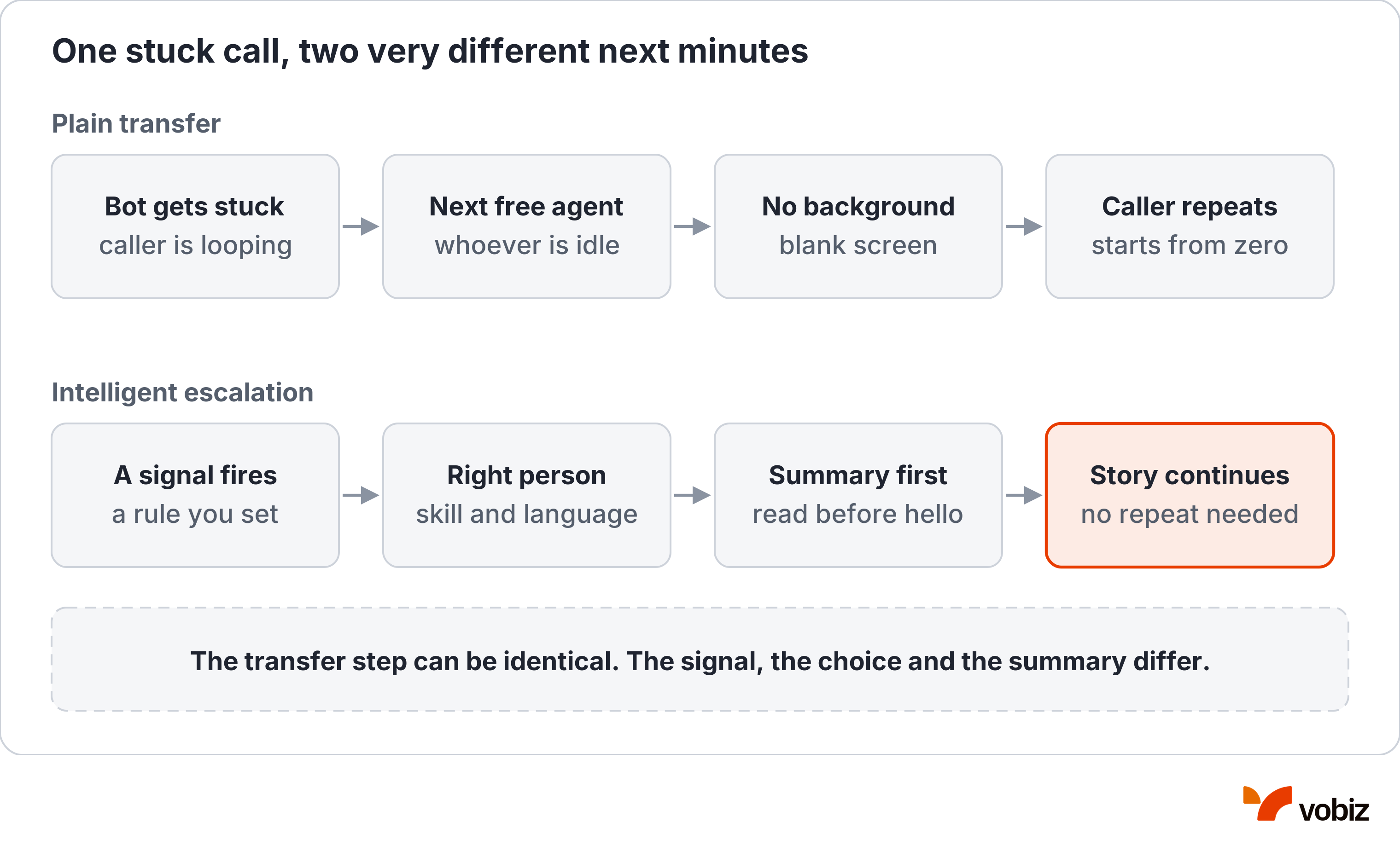
Intelligent call escalation moves a caller from a bot or frontline agent to someone better placed to help, at the moment it becomes necessary, with the reason and the conversation so far attached. A clear signal sets it off, so the caller reaches the right person without having to start again.
This guide is for the people who answer for customer experience: support heads, operations leads and founders. It helps you decide when a call should move, who should take it, what they need to know, and what to measure. It also covers the complaint, language and data rules that shape an escalation.
Note: Key takeaways
- An escalation is a decision, and a transfer is only how the call moves. The decision is what you design.
- A caller who asks for a person should get one. Published guidance puts the limit for repeated misunderstandings at two or three attempts.
- Send the story ahead of the caller. A short summary shown before the human speaks is what prevents repetition.
- Plan for nobody being free. A callback with a confirmed time beats open-ended hold.
- In regulated sectors, a call can start a complaint clock. Keep the time, the reference and the record of each complaint call.
What is intelligent call escalation?
Escalation moves a caller up, to someone with more skill, authority or judgement. A transfer only moves a call somewhere else. Sending a caller from billing to sales is a transfer, and sending a stuck caller from a bot to a trained specialist is an escalation.
The word "intelligent" adds three things to that move:
- A defined signal decides when the call moves, so timing doesn't depend on chance.
- A deliberate choice decides who takes the call, based on skill, language and availability.
- A travelling story tells that person what has already happened.
For the mechanics of moving a call, including blind and warm methods, read our guide to context-aware call transfers.
Why does a poor escalation cost so much?
A poor escalation hits the customers who were already having the hardest time. SQM Group's research with North American call centres, published in 2021, found that 19% of callers were transferred. Their satisfaction was 12% lower and their first-call resolution 14% lower than for callers who stayed with one agent. Warm transfers scored significantly higher than cold ones.
We did not find comparable public benchmarks for every market. Treat these figures as a guide to direction rather than a target.
Repetition also costs agent time, and you can estimate it in a minute. Multiply your escalated calls by the extra seconds each caller spends repeating, then divide by 3,600.
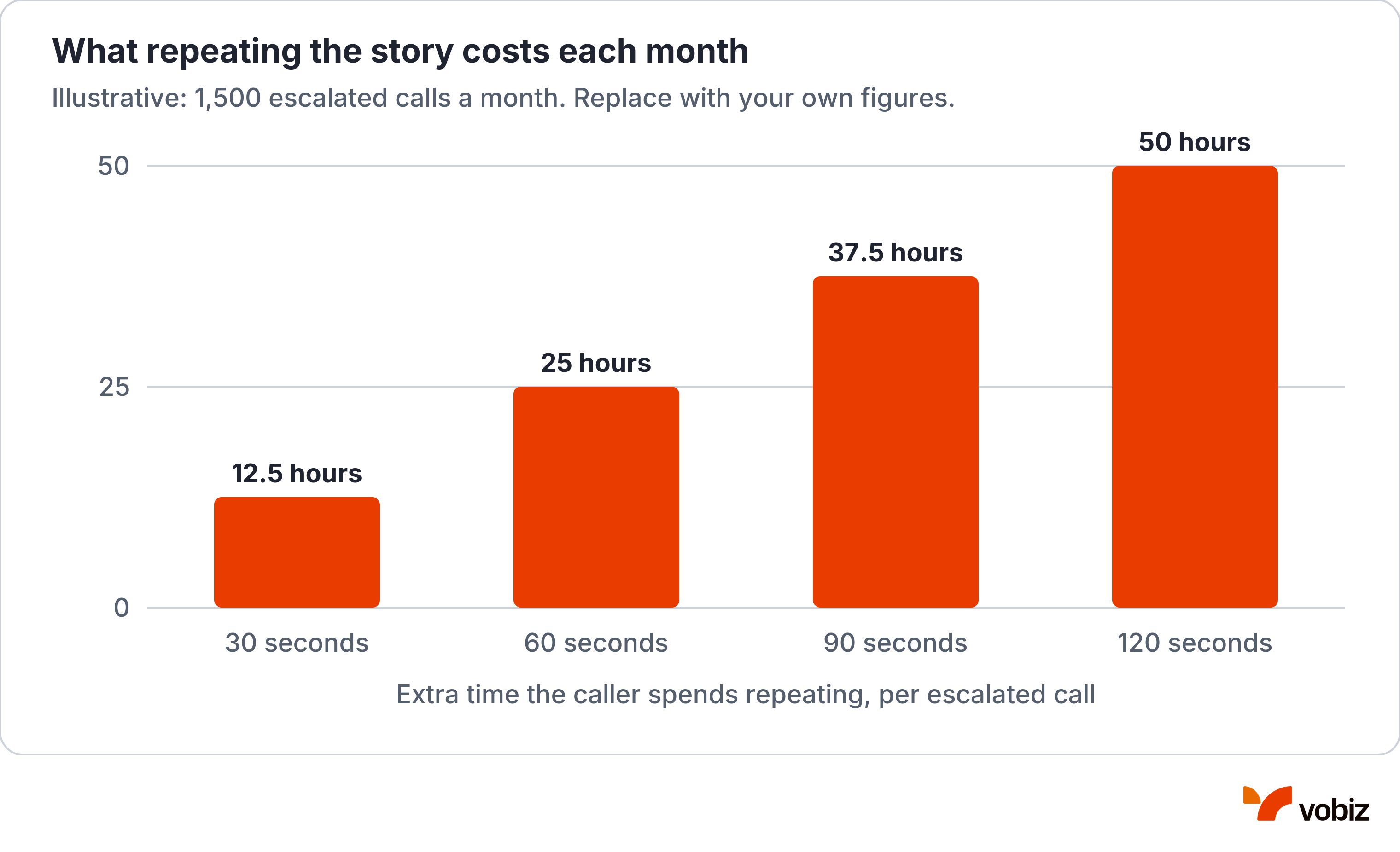
The answer isn't simply fewer escalations. Timing matters more than keeping the count low. A low rate can mean callers are trapped with a bot that can't help them.
When should a call escalate?
Sort your signals into three groups before anyone writes a rule. Some signals end the automated conversation at once. Some deserve one more try. Others are known when the call lands, so the routing can act on them straight away.
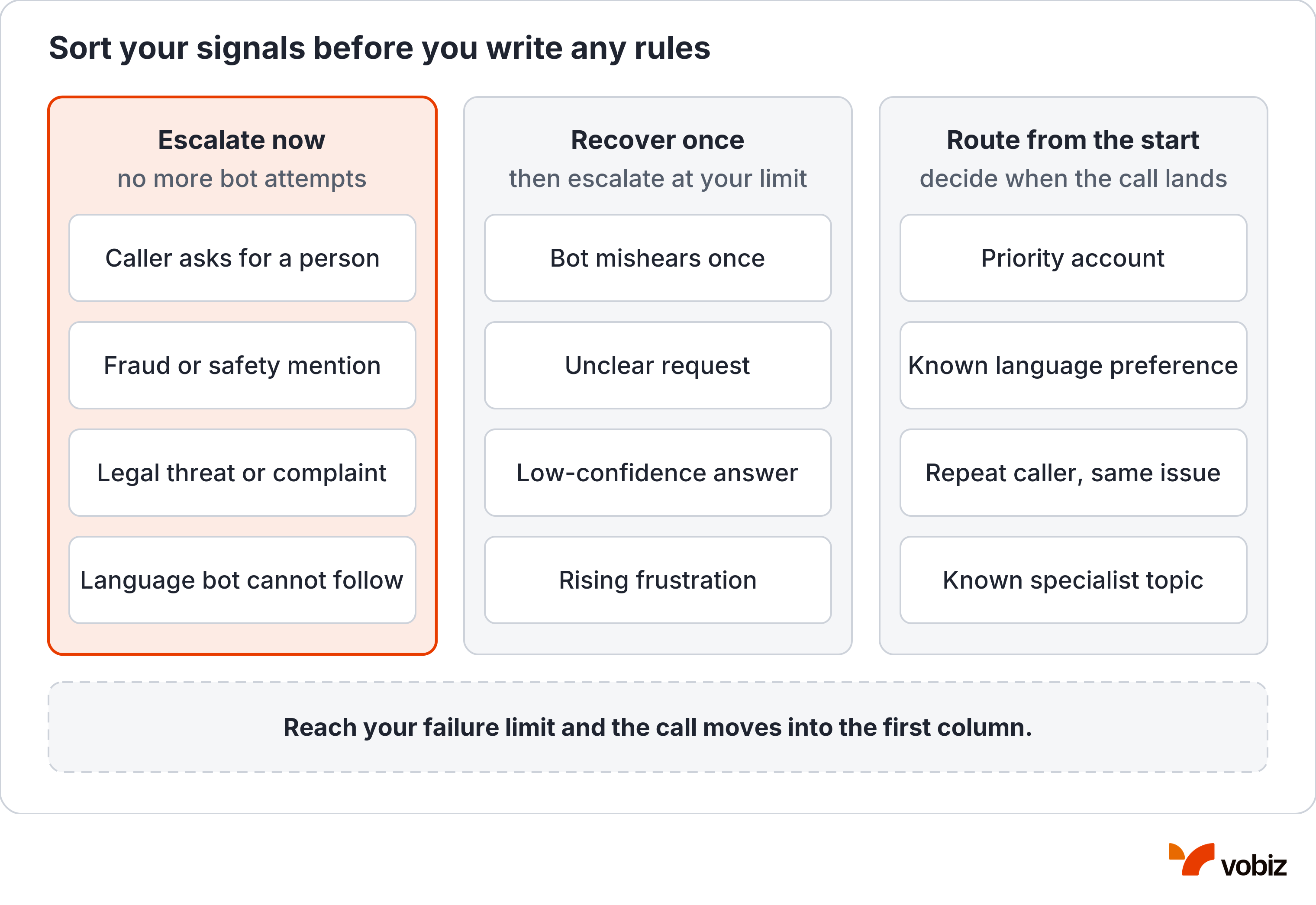
Here is how to think about each kind of signal:
- A request for a person. Treat this as final, with no exceptions. If you need a case created first, Salesforce's handoff patterns show how to require that step before the handoff. Create it without asking the caller more questions.
- Repeated misunderstanding. Published limits differ. Google's Dialogflow guidance sets a maximum of three, and Deepgram's example moves after two failed repairs. Our suggestion is two for anything involving money or health, and three for simple requests.
- Sensitive subjects. Deepgram recommends sending fraud reports and emergency symptoms to a person at the first mention, regardless of how confident the model is.
- Language. Many callers switch languages in one call, such as Spanish and English in the US, or Hindi and English in India. If your bot can't follow the switch, escalate.
- Mood and confidence. These signals are softer, so try one recovery first. If you set a confidence threshold, test it against your own recordings.
Keep your firm rules outside the AI model. Deepgram makes the case that if only the model decides, your policy can shift whenever the model changes. A plain rule such as "a fraud mention goes to the fraud team" should hold every time.
Who should take the escalated call?
Most teams arrange people in levels. L1 handles common requests, L2 takes harder cases, and L3 is a small group of experts. Levels alone can send a Spanish-speaking caller to an L2 agent who speaks only English, so combine them with other routing methods.
| Method | What it does | Use it when |
|---|---|---|
| Levels | Moves the caller up in expertise or authority | The problem is too hard for the first person |
| Skills | Matches the topic to a trained person | Topics such as claims or fraud need specific training |
| Language | Matches the caller's language | You serve callers in more than one language |
| Priority | Moves certain callers ahead in the wait | An account or an issue is time-critical |
| Time-based step-up | Widens the search as the wait grows | Specialists are few and callers can't wait long |
Time-based step-up deserves a closer look. You might try the fraud specialists for 30 seconds, then the duty supervisor, then offer a callback. Write that ladder down before launch, and include the last step for when nobody is available. Our call routing guide covers these methods in more depth.
Which kind of handoff should you use?
Two questions settle most cases: is someone available in time, and how delicate is this call?
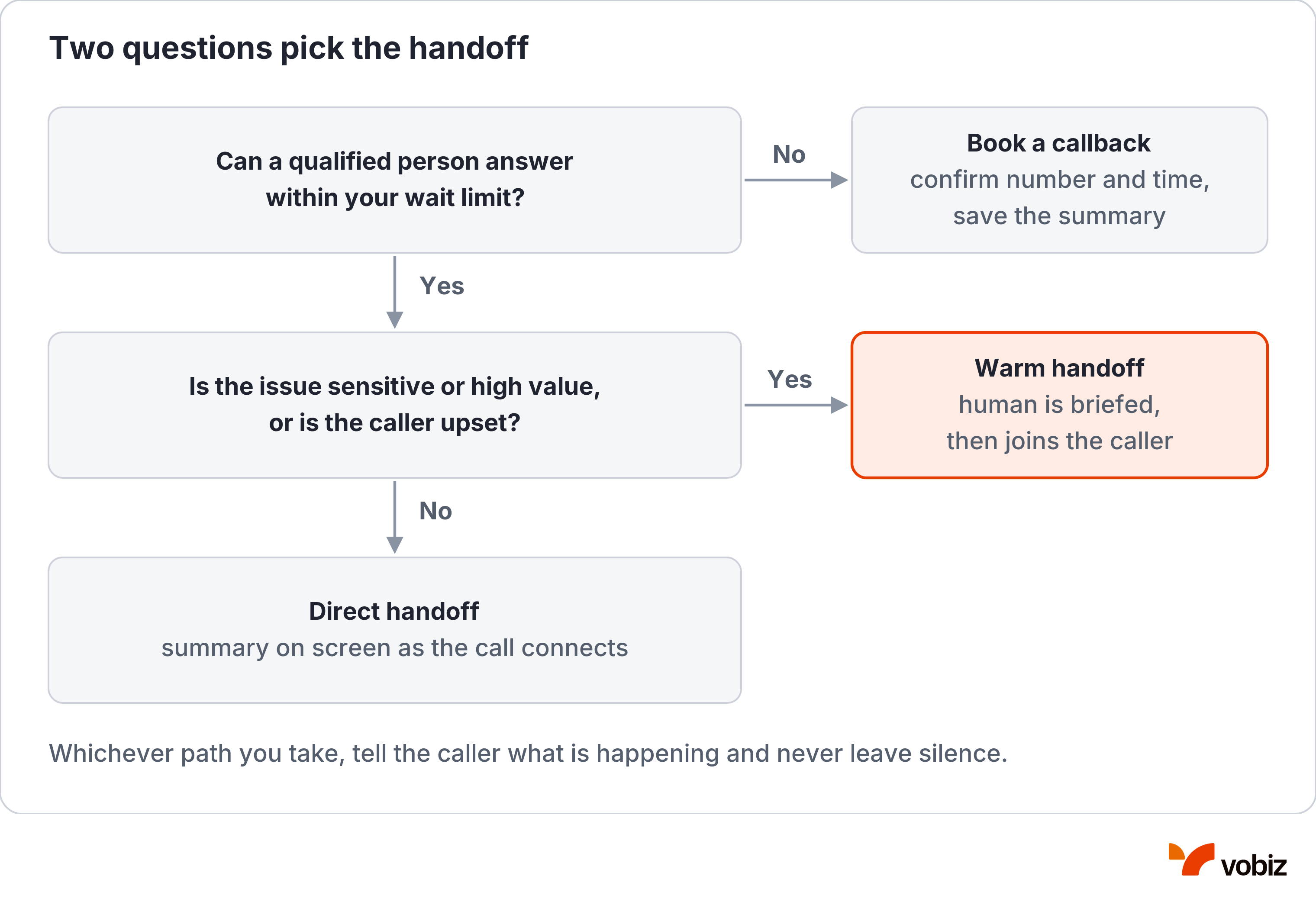
| Handoff | What the caller experiences | Trade-off |
|---|---|---|
| Direct | A short message, then a person who already has the summary | Simple, but the person has only seconds to read |
| Warm | Brief hold while someone briefs the person, who then joins | Better for hard calls, but ties up two people or lines for a moment |
| Callback | A confirmed time and a person who calls back informed | Ends the wait, but you must keep the promise |
Overlap has a real cost. Deepgram notes that a bridged handoff pays for an extra call leg during the overlap, while a direct transfer stops that cost sooner. Save warm handoffs for calls where the briefing changes the outcome.
What the caller hears matters too. Use a short, honest line, such as a promise to connect them with someone who can help. Deepgram advises spoken updates during the wait, and a callback offer with the number read back if nobody answers.
Set your wait limit deliberately. California's new law offers one reference point: Law Commentary reports that AB 1609 asks businesses with more than $500 million in annual revenue to make a good-faith effort to connect customers with a person within 15 minutes, or offer an appointment within one business day. It was chaptered in September 2026. We found no general rule of this kind in most other markets, so treat it as a sign of where expectations are heading. Most teams will want a far shorter limit for a caller who is already frustrated.
What should travel with the caller?
Send only what the next person needs in order to act. Deepgram lists six fields: verified identity, intent, key details, actions taken, an escalation reason, and a short summary. We add three that matter on multilingual and regulated calls: language, promises made, and any complaint reference. The example below is fictional.
| Field | Example: a duplicate EMI debit |
|---|---|
| Identity check | Passed, using the bank's usual questions |
| What they want | Refund of a duplicate EMI debit |
| Key details | Loan ending XX42, two debits on 1 November |
| What was tried | Bot confirmed both debits, but the refund is above its limit |
| Why it moved | Outside the bot's authority |
| Language | Hindi, with numbers in English |
| Promises made | Told a specialist will confirm the refund date |
| Complaint reference | Logged at 11:42, reference given to the caller |
| Summary | Charged twice for November and calm so far. Needs a refund date today. |
With that in front of them, the specialist can open with "I can see you were charged twice in November, and I'm looking at the refund now". This information should reach the agent's desktop before the two connect.
Store the summary in your own system against the call's ID, then have the agent's screen fetch it. That keeps sensitive details out of the phone network's signalling and lets you control who sees them.
What else should shape your escalation design?
The basics are the same everywhere, but four issues should shape your design. This section is general information, so take legal advice for your own case.
A call can start a complaint clock
Not every upset caller is making a formal complaint, but your system should be able to tell. In regulated sectors such as banking, insurance and telecoms, a complaint made on a call can start a deadline for your reply. Each sector answers to its own regulator, so ask your compliance team to map your timelines.
Train your agents and bots to recognise a complaint, log it, and give a reference. Your system should produce the date and time, a complaint reference, and a recording or transcript where you keep one. If you're in India, RBI's Integrated Ombudsman Scheme, 2026 lets a bank customer go to the Ombudsman if no reply comes within 30 days (RBI's FAQ).
Language coverage is part of escalation
Know which languages your escalation team can really cover, at which hours, and what happens outside them. Large public contact centres set a useful bar. RBI's FAQ, for example, says its contact centre connects callers to staff in English, Hindi and ten regional languages.
Where your people sit matters
Some countries restrict where the legs of a call can go. If you're in India, domestic calls require the legs, and conference participants, to stay in India (calling regulations). Plan your escalation team and supervisors with this in mind, especially if specialists or vendors work abroad.
Summaries contain personal data
A handoff summary often holds a name, an account detail and a complaint. Data protection laws such as the EU's GDPR set duties for notices, security and retention of that data. If you're in India, the DPDP Rules, 2025 phase in, with core duties due around May 2027. Build for these duties now by limiting who sees each summary and how long you keep it.
Tell callers when a call may be monitored or recorded, too. A supervisor listening in should be covered by the same notice as your recording.
Outbound AI calls have their own rules
If your AI agent places the call, the escalation inherits that call's compliance position. Our SIP trunking guide lists the rules for commercial and automated calling, and if you're in India, the UCC page explains complaint handling.
How do you measure whether escalation is working?
Track these together, because any one of them can mislead on its own. No single number is a universal benchmark, so compare yourself with your own previous month.
| Measure | What it tells you | Read it with care |
|---|---|---|
| Escalation rate | Escalated calls as a share of all calls | A low figure can hide trapped callers |
| Time to a human | How long the move takes after the signal | Report the slowest calls as well as the average |
| Drop-off during handoff | Callers who hang up before reaching someone | Check it by hour and by language |
| Repeat questions | How often the person re-asks for known details | Sample real calls, because no dashboard shows this well |
| Resolved after escalation | Whether the move actually fixed the problem | Count repeat calls on the same issue as unresolved |
| Unneeded escalations | Calls the receiving person says the bot could have handled | Feed these back into bot training |
| Complaints from escalated calls | Where failures become formal | Split by topic to find the cause |
Outcomes should also feed back into your automation. Each unneeded escalation shows what the bot should learn, and each late one shows where a rule should fire sooner.
A checklist before you go live
Use these questions in a review with your support, compliance and engineering leads:
- Can a caller reach a person by asking once, in plain words, in every language you offer?
- What is your limit on failed attempts, and does it sit outside the AI model?
- Which topics go to a human on first mention?
- Who takes each kind of escalation, at what hours, and in which languages?
- What happens when nobody is free, and who keeps the callback promise?
- What does the receiving person see before saying hello?
- Can you produce the time, reference and record of a complaint call?
- Have you replayed real recordings through the flow before launch, as Deepgram suggests?
Vobiz docs for this topic
The setup details for this are in the Vobiz docs:
- Vobiz docs introduction
- Call escalation
- Agent handoff
- VobizXML
- Transfer Call API
- Dial results
- Sequential dialing
- Conference
- Conference member unmute
- Play a recording to one member
- End the agent's leg
- Audio streaming
- Vapi
- LiveKit
Anything that places calls or sends messages is billed and reaches real people, so run it only with your own credentials after confirming the details.
Frequently asked questions
What is call escalation in a call centre?
Call escalation moves a caller to someone with more skill, authority or judgement than the bot or agent they reached first. It might go from an AI agent to a person, or from a frontline agent to a specialist or supervisor. A good escalation also carries the reason and the conversation so far.
What is the difference between a call transfer and a call escalation?
A transfer moves a call to a new destination, which may be at the same level, such as billing to sales. An escalation moves the caller up to someone better placed to resolve the issue. Most escalations use a transfer as their final step, so the difference lies in the decision behind it.
When should an AI voice agent hand over to a human?
Hand over straight away when a caller asks for a person or mentions fraud, safety or a legal issue. Also hand over when the agent can't follow the caller's language. For misunderstandings, allow one recovery attempt, then set a firm limit of two or three failures, depending on the stakes.
How do you stop customers repeating themselves after a transfer?
Have the bot or first agent write a short summary before the transfer starts. Include verified identity, the request, what was tried and why the call is moving. Show it to the receiving person before they speak, so they can open by confirming the issue rather than asking for it.
What do L1, L2 and L3 mean in support?
They are levels of support. L1 handles common requests and follows set procedures. L2 takes harder cases that need deeper product knowledge or more authority. L3 is the smallest group of experts, who handle rare or complex problems. Some teams also place an AI agent in front of L1.
How long does a bank have to answer a complaint?
It depends on the country and the regulator. If you're in India, RBI's FAQ on its 2026 ombudsman scheme gives 30 days, or longer where RBI, NPCI or card network guidelines set a longer time. The customer can then go to the Ombudsman within 90 days of that deadline or of the bank's last communication, whichever is later.
Further reading on Vobiz
- Context-aware call transfers · What is a call leg? · What is call routing?
- What is an IVR? · Call center optimization with AI
- Contact centre solution · India calling regulations
Sources
Regulators and law
- Reserve Bank of India, RBI issues Reserve Bank - Integrated Ombudsman Scheme, 2026, press release, 16 January 2026.
- Reserve Bank of India, FAQs on the Reserve Bank - Integrated Ombudsman Scheme, 2026, updated 1 July 2026.
- MediaNama, DPDP Rules 2025: fiduciary duties phase in over 18 months, November 2025.
- Cyril Amarchand Mangaldas, Client alert on the DPDP Rules, November 2025.
- S.S. Rana & Co., DPDP (Removal of Difficulties) Order, 2026, 12 October 2026.
- Storyboard18, MeitY seeks industry views on a 12-month DPDP timeline, 28 January 2026.
- Law Commentary, California's AB 1609 and reaching a real person, 29 September 2026.
- BillTrack50, California AB 1609 status, chaptered 28 September 2026.
Research and vendor guidance
- SQM Group, Call transfer and hold performance impact on customer satisfaction and FCR, December 2021.
- Google Cloud, Dialogflow CX voice agent design best practices.
- Deepgram, AI voice agent to human handoffs, October 2026.
- Salesforce, How Agentforce Voice escalation works.
Build escalations on Vobiz — Provision a number and wire a context-rich, well-triggered escalation.
If your frontline is a voice AI agent handing calls to people, Vobiz provides the SIP trunks and voice API on the phone side.
About the author
- I'm a Founding Member at Vobiz, telephony for AI voice agents. I write about where voice agents meet the phone network: SIP, phone numbers, latency, echo, barge-in and everything that breaks on real calls but not in browser demos. More at piyushsahoo.me
Comments
Join the discussionNo comments yet. Be the first to comment.