What Is Answering Machine Detection? Errors, Tuning and Rules
How AMD classifies who picked up an outbound call, which errors cost most, how to test it on your traffic, and how dialler rules count its mistakes.
A reference on answering machine detection: how the verdict is made, the two error types and their costs, a testing approach, and how different countries treat abandoned calls.
Answering machine detection (AMD) is a call-analysis feature that listens to the first seconds of an answered outbound call and judges whether a person or a machine picked up. Your application then branches: connect someone, leave a message, or hang up. The verdict is a probability, so wrong answers are part of the design.
This guide explains how detectors decide, why a headline accuracy figure tells you little, and how to measure the error that matters on your own traffic. It also compares the abandoned-call rules in the US, the UK, and India, because each one counts the same mistake differently.
Note: Key takeaways
- AMD starts where call signalling stops. The network tells you a call was answered. Only the audio can suggest who or what answered it.
- Accuracy is the wrong first question. Two detectors can both score 92% while one drops ten times as many people. Ask for the false-machine rate instead.
- Background detection doesn't remove the wait. It starts your call flow at once, but an agent held for the verdict still stays quiet until the verdict arrives.
- Phones now answer for people. iPhone, Pixel, and Truecaller screening can all put a spoken assistant in front of the person you called.
- Denominators differ by country. The US and UK measure abandoned calls against live answers, while India's TRAI measures them against attempted calls.
What does answering machine detection decide?
AMD answers one narrow question after a call connects: is this a person? Ringing, busy, and no-answer are different outcomes, and they arrive as call progress and hangup signals. A voicemail system looks like an ordinary answer to the network, so the detector has to work from sound.
Result labels vary by product. Typical results cover a person, a machine, a fax, or an unknown answer, and some say how a greeting ended. Three common uses follow from that verdict:
- Protect agent time. Connect only answered humans to a live agent.
- Protect AI spend. Keep a voice AI agent from talking to a recording.
- Deliver a message. Wait for the greeting to end, then leave a voicemail.
How often a machine answers depends on your traffic, so measure it on your own calls.
How does a detector tell a person from a machine?
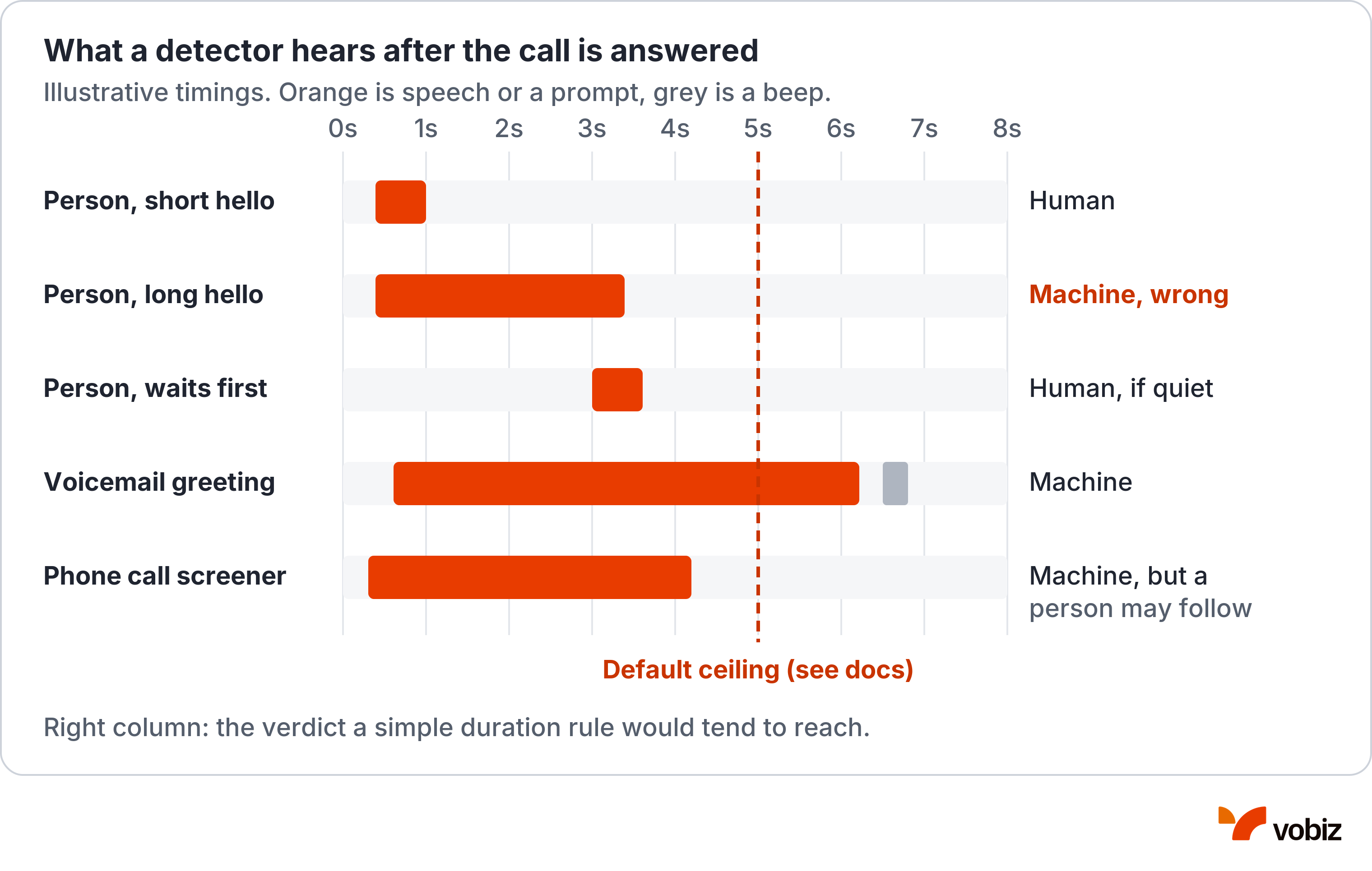
Most detectors weigh a few signals in the opening seconds. People tend to say something short and wait for a reply. Recordings tend to keep talking because nothing is listening.
| Signal | What it measures | Where it fails |
|---|---|---|
| Speech length | How long the first utterance runs | A person who answers with a full sentence |
| Silence after speech | Whether the speaker stops to wait for you | A short recording that pauses like a person |
| Silence before speech | How long nothing happens after answer | A person who doesn't say hello straight away |
| Word count | How many separate words arrive. Asterisk's AMD application calls a greeting a machine past a set maximum | A chatty person, or background talk |
| Tones | Beeps, fax tones, and network tones | Beeps that vary between systems and countries |
| Words or sound patterns | Voicemail phrases, or a trained acoustic model | Languages the model or transcription doesn't cover |
The last row matters for multilingual traffic, such as calls in India. A transcript-based check can only match phrases in languages its speech recognition handles. A timing rule ignores language, but it still assumes people everywhere greet at a similar length. Neither assumption should ship without a test on your own audience.
Why does a 92% accurate detector still fail?
Accuracy blends two different mistakes into one number, and those mistakes have very different costs.
- False machine. A person is classified as a machine. You hang up on them or play them a recording.
- False human. A machine is classified as a person. An agent or AI talks to a recording until someone notices.
The chart shows two invented detectors on the same traffic. Both are right on 920 of 1,000 answered calls.
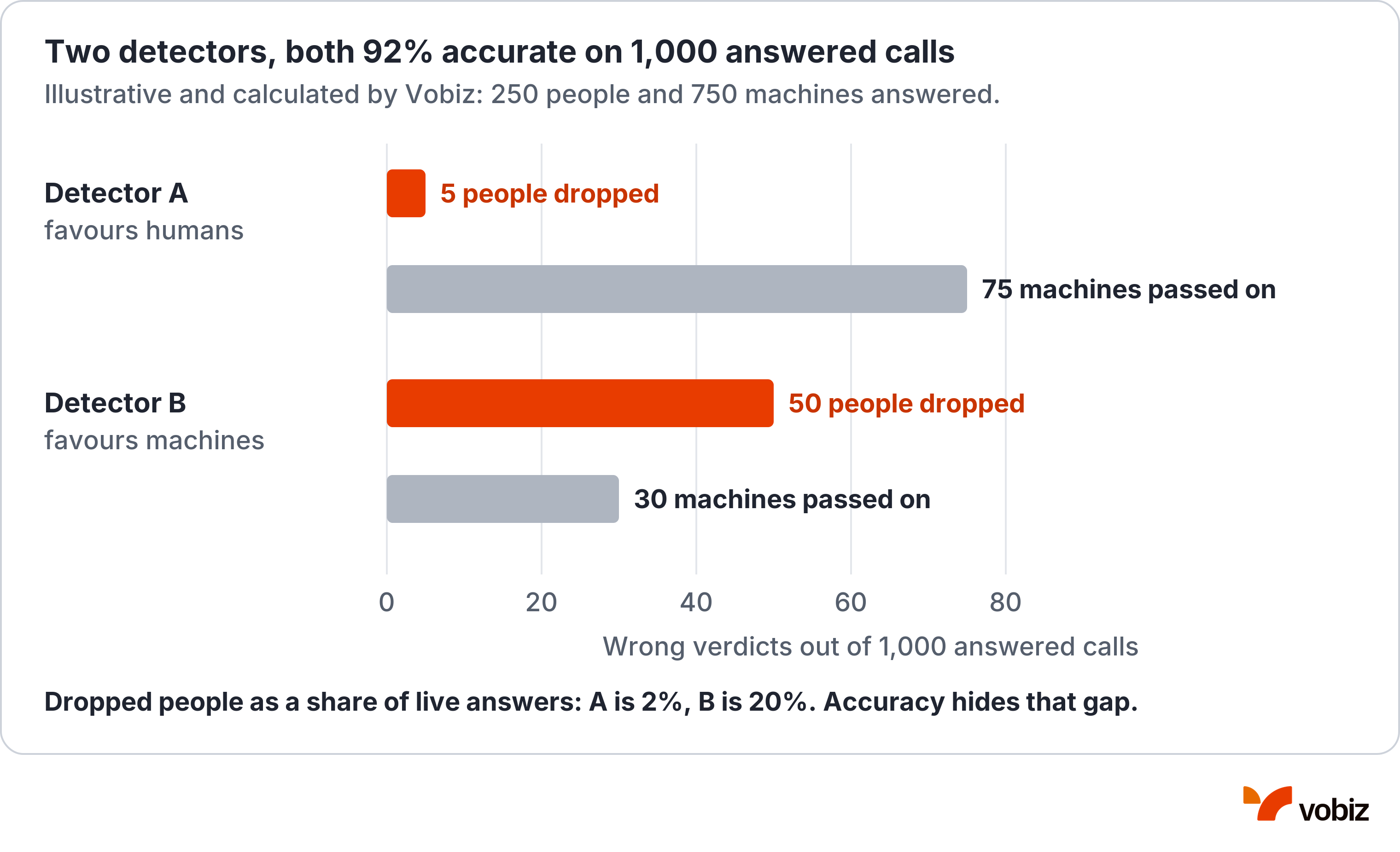
Detector A wastes more agent time. Detector B discards 50 of the 250 people you worked to reach. When machines dominate a list, a detector can also look strong simply by leaning toward "machine". On this traffic, one that always says "machine" scores 75% and never reaches a person.
Published figures don't settle the question, because the conditions differ. Vendors quote numbers from different traffic, and most are self-reported, so don't rank products on them.
Does background detection remove the wait?
Only part of it. Detection needs audio from the answered call, which often takes a few seconds. Very short timeouts tend to hurt accuracy. The design choice is what the person hears during that time.
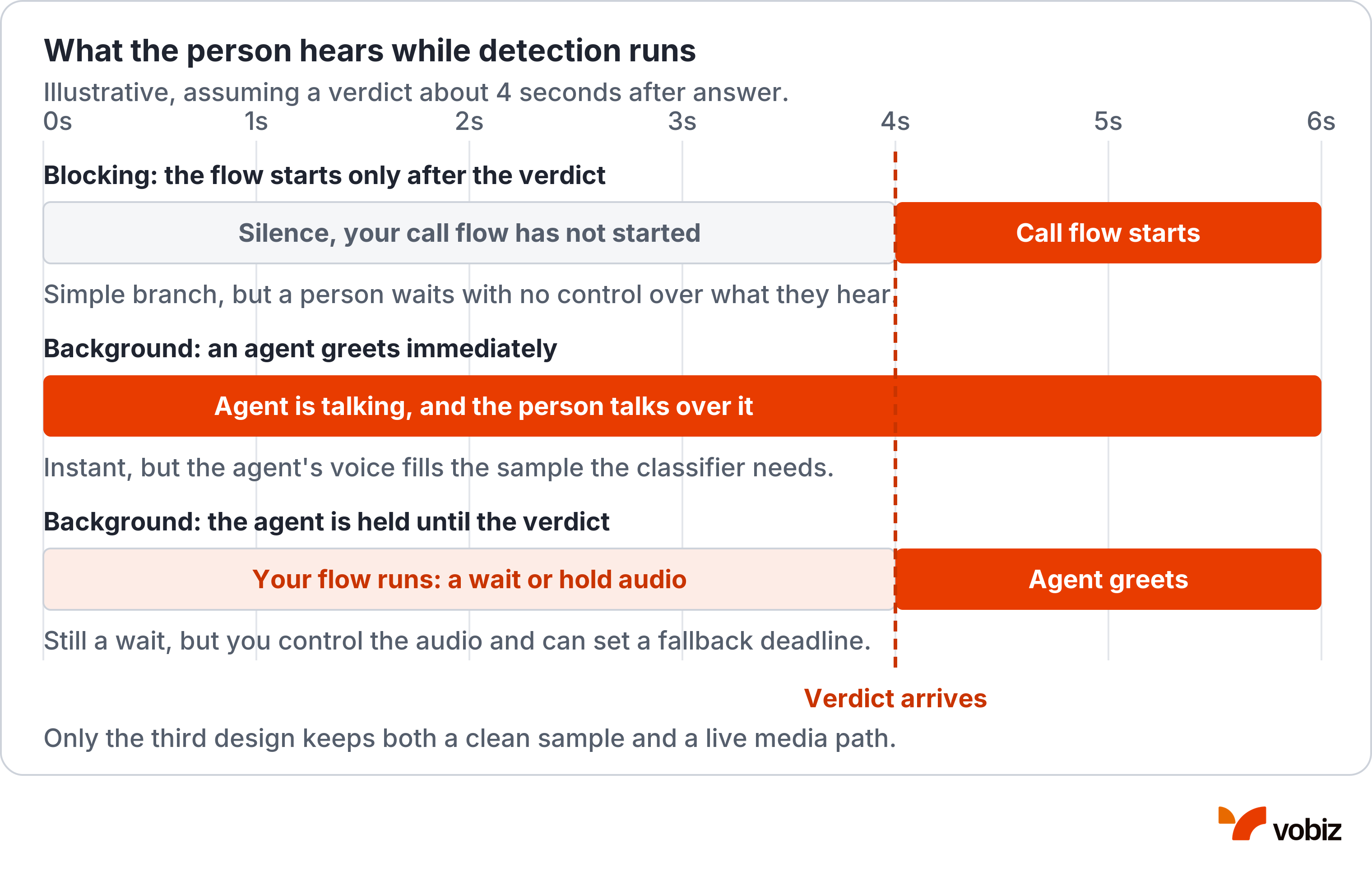
- Blocking detection suits flows with no live conversation, because the branch is simple and nobody is waiting to talk.
- Background detection with an immediate greeting sounds fast, but it damages the sample. The person answers over the agent, and the classifier loses the "hello, then pause" shape it depends on.
- Background detection with a held agent is usually the right design for voice AI. You still pay for the verdict in seconds, so size the timers deliberately and add a fallback.
A fallback covers the case where no verdict arrives in time. If the choice is between a person left on hold and an agent talking to voicemail, the person on hold is usually the worse outcome. Let the agent start.
What changed when phones began answering for people?
Some "machines" are now assistants with a person behind them. That breaks the old assumption that a machine answer means nobody is there.
| Screening service | What happens on the call | Availability when we checked |
|---|---|---|
| iPhone Call Screening | iOS answers and asks the caller for a name and reason, then the owner decides | Apple lists English (India) for the feature |
| Pixel Call Screen | The phone asks who is calling and why before the owner picks up | Google lists manual screening in India on Pixel 10 and Pixel 11 models |
| Truecaller Assistant | An AI assistant answers and transcribes the caller | Launched in India in July 2023 in English, Hindi, and Hinglish. We couldn't confirm the current language list |
| Truecaller voicemail | Unanswered calls forward to an app-based voicemail | Launched for Android in India in December 2025, with transcription in 12 Indian languages |
A screening prompt is long, continuous speech, so a duration rule tends to call it a machine. The person may join seconds later, which is why an automatic hang-up on that verdict can lose a real contact.
We found no reliable public figure for how many calls reach voicemail or a screener in most markets. Don't import a US voicemail rate into another country's campaign plan. Measure it on a labelled sample, as described below.
How do you measure AMD on your own calls?
You can't find false machines by reading AMD results alone. Ofcom made this point in 2010: the equipment can't identify its own false positive as a call picked up by a live person. So you need to hear what happened after the verdict.
- Keep the call open. Run a small test where a machine verdict doesn't end the call, so the audio after the verdict still exists.
- Record lawfully. Follow your consent and retention duties. Compliant call recording pipelines covers the design.
- Label by listening. Mark each call as person, voicemail, screener, or network announcement, without looking at the verdict.
- Split the results. Report by country, operator, language, device group, and time of day where you can. Tuning on a handful of devices can mislead you once you deploy widely.
- Tune one timer at a time. Then repeat the test, because a change that saves people can let more machines through.
Plan for enough live answers. If you label 300 and find 6 false machines, the rate is 2%, but the 95% Wilson interval runs from about 0.9% to 4.3%. That sample can't show you're under a 3% limit.
These are real calls to real people, and they cost money. Use your own Auth ID and Auth Token, confirm your list and consent, and start small.
Which AMD setup fits your campaign?
Start from what should change when a machine answers. Sometimes nothing should, and then AMD only adds a wait and a way to fail.
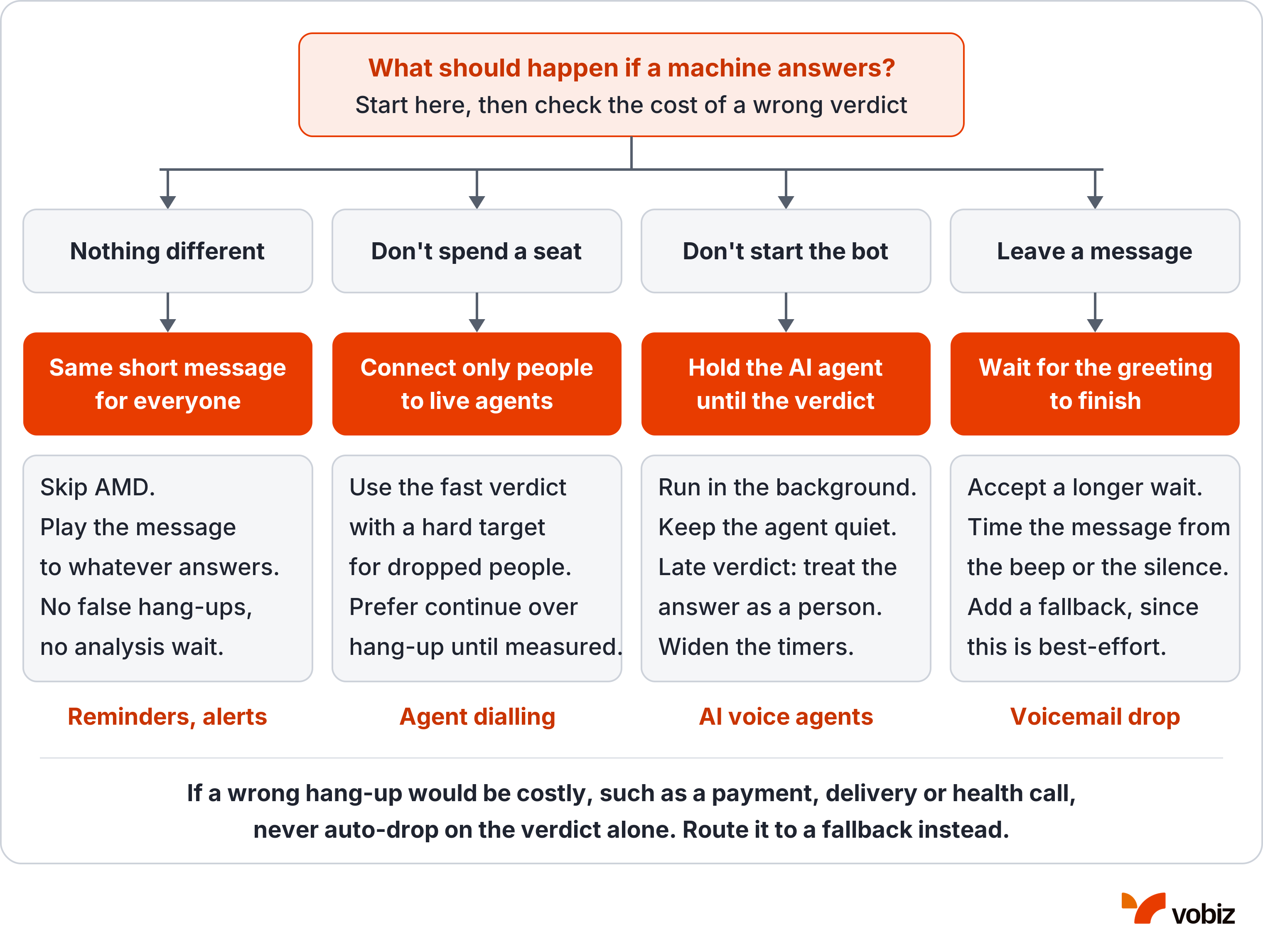
Two checks apply to every branch. Decide who owns a late or missing verdict, and decide what your dialler does next. Ofcom's current policy treats a repeat silent or abandoned call within 72 hours as an aggravating factor, unless a live agent was guaranteed. A false machine verdict looks like voicemail in your logs, so guaranteeing an agent on the retry is a sensible habit anywhere.
How do regulators treat AMD mistakes?
Regulators mostly don't regulate the detector. They regulate what happens to the person who answered, and a false machine can count against you. Rules change often, so confirm the current text and take legal advice for your campaign.
| India (TRAI) | US (FCC and FTC) | UK (Ofcom) | |
|---|---|---|---|
| Abandoned call | Not connected to a live agent after the recipient answers | Not connected to a live sales representative within two seconds of the completed greeting | The person answers and hears a message instead of an agent |
| Limit | Reporting criterion: above 3% | 3% for telemarketing | No specific rate in the policy, though Ofcom may weigh the rate when prioritising cases |
| Measured against | Total attempted calls | Calls answered live by a person | Calls connected to a live person |
| Period | 24 hours | 30 days per campaign | Calendar day |
| AMD false positives | Not mentioned in the text we read | Not named, though a dropped person appears to fit the definition | Named as a cause of silent calls, and Ofcom may ask for evidence of AMD accuracy |
The denominator changes your result
Take 1,000 attempts that reach 300 live people, with a detector that drops 5% of them. That is 15 people, and nothing else goes wrong.
- Against live answers, as in the US rule and Ofcom's formula, the rate is 5%. That is above the US limit of 3%.
- Against attempted calls, as in TRAI's 2018 criterion, the rate is 1.5%, which is below 3%.
Don't treat the second number as a safe margin. It only shows that a figure from one country can't be read across to another.
If you're in India, TRAI's 2018 regulations set that attempts-based 3% criterion, and its Third Amendment adds advance declaration of A2P calls, including those that connect live agents. Its definition says "live agent", so a recorded message or an AI agent may not satisfy it. Vobiz's India calling regulations, UCC guide, and 140 and 160 series guide cover the wider requirements.
The UK shows how this debate moved. In its 2008 statement, Ofcom worked through a scenario where a 3% false positive rate on machine verdicts, added to a 2% base of abandoned calls, produced a rate of 4.85%. Its current policy, in force since March 2017, names no specific rate and says the old 3% figure was never a safe harbour. A call with no message counts as a silent call, which sits outside the rate formula, and the policy names AMD as one cause. Ofcom's January 2026 reminder says it can still act on these calls, with penalties of up to £2 million.
US: a two-second clock, under review
47 CFR 64.1200(a)(7) and the FTC's 16 CFR 310.4(b)(1)(iv) both start the clock at the person's completed greeting. A detector that waits for silence spends that time first.
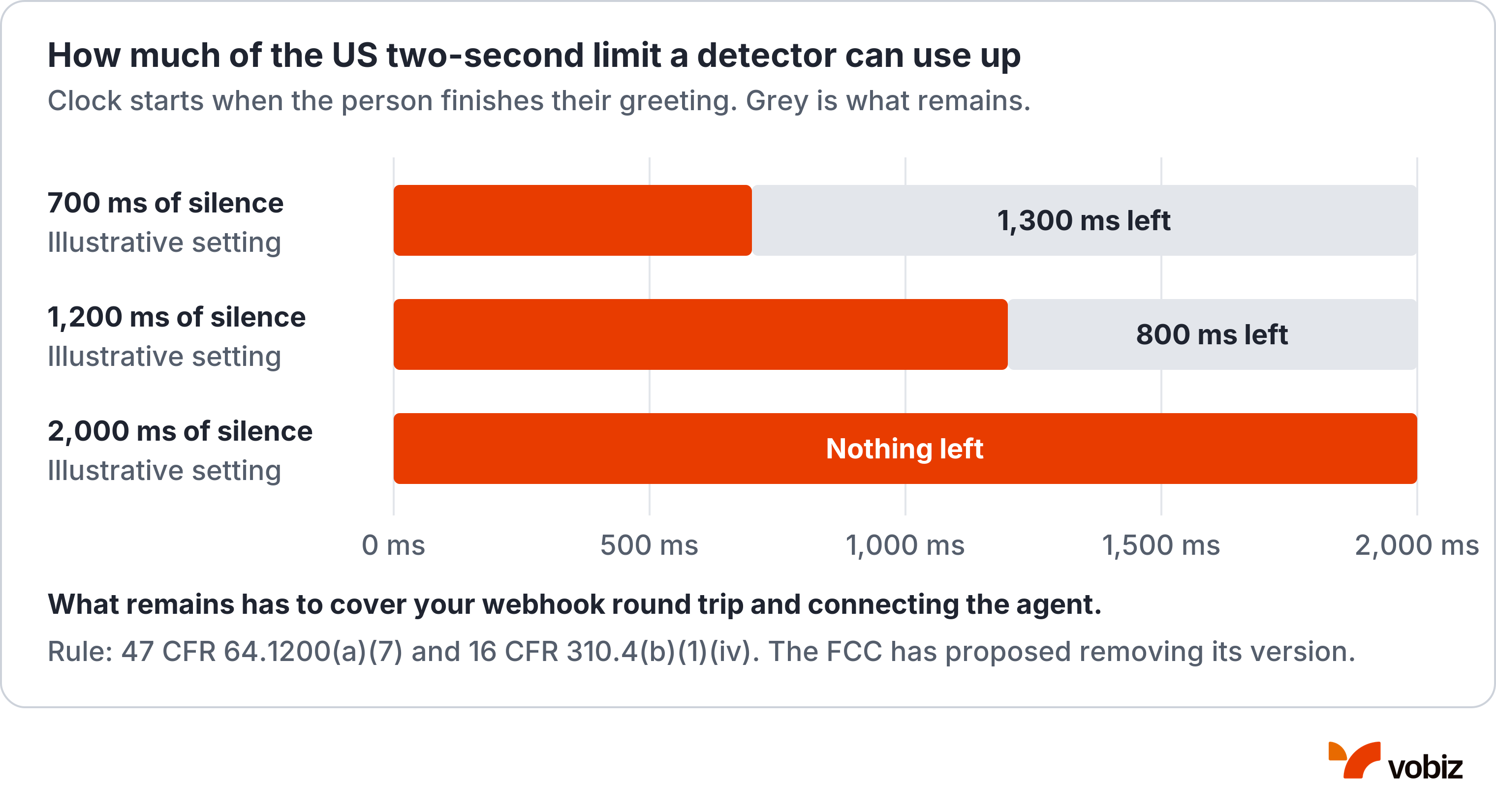
The chart shows illustrative detector settings, not measured verdict times. The remainder still has to cover your webhook (callback) round trip and the agent connection.
The FCC has proposed deleting its abandonment limits in a notice published in December 2025. Kelley Drye's summary covers the proposal. We found no final order as of 3 November 2026, and the FTC's separate rule isn't part of that FCC proposal.
How Vobiz handles AMD
Vobiz machine detection is a set of parameters on the Make Call API, not a separate endpoint. It applies to outbound calls placed through that API.
| Vobiz parameter | What it controls | Default | Range |
|---|---|---|---|
| machine_detection | true continues the call, and hangup ends it on a machine verdict | Optional | true, hangup |
| machine_detection_time | Time spent analysing audio | 5,000 ms | 2,000 to 10,000 ms |
| machine_detection_initial_silence | Maximum silence after answer | 4,500 ms | 2,000 to 10,000 ms |
| machine_detection_initial_greeting | Maximum greeting length | 1,500 ms | 1,000 to 5,000 ms |
| machine_detection_maximum_speech_length | Maximum speech duration | 5,000 ms | 1,000 to 6,000 ms |
| machine_detection_maximum_words | Maximum sentences in the greeting | 3 | 2 to 10 |
- Background results. Set machine_detection_url and optionally machine_detection_method, and Vobiz sends webhooks (callbacks) with the result. The payload includes Machine, IfMachine, CallUUID, and an Event of MachineDetection.
- Reporting. A call ended by machine_detection set to hangup closes with hangup cause 9100, Machine Detected, which separates it from other outcomes in your data.
- Greeting-end timing. In VobizXML, Wait with silence moves on once a greeting stops, and beep waits for a voicemail beep. The two are mutually exclusive, and the docs describe both as best-effort, so pair them with a fallback.
- AI agents. Tuning for AI voice agents gives balanced, high-accuracy, and low-latency starting profiles. It also gives the gating steps: hold the agent, branch on Machine, and treat a late callback as a human.
- Working example. The LiveKit AMD agent classifies the pickup before the conversation starts, and leaves a recorded message on voicemail.
- Audio for agents. Audio streams and WebSocket streaming connect call audio to your agent. Vobiz also has Vapi and LiveKit integration guides.
- Campaign sizing. Model channel needs in the CPS and concurrency calculator. The outbound campaign guide covers running at volume.
Calls placed with these settings are real and billed to your account. See the Vobiz pricing page for current rates, and confirm numbers and consent before you run a test.
Frequently asked questions
What does answering machine detection do?
It listens to the first seconds of an answered outbound call and judges whether a person or a machine picked up. Your application then acts on that verdict. It might connect an agent, start an AI agent, leave a message, or end the call.
How accurate is AMD?
Published figures vary widely, but vendors measure them differently and most are self-reported. A single accuracy number also hides which mistakes occur. Measure how many live people your setup wrongly marks as machines, using your own destinations and call types.
What is an AMD false positive?
It usually means a live person was classified as a machine. The call may be dropped or sent a recording, so this is normally the costliest error. The opposite error, often called a false negative, sends a machine to your agent or AI.
Does AMD add delay to a call?
Yes. The detector needs audio before it can decide, which often takes a few seconds. Running detection in the background lets your call flow start immediately, but an agent held for the verdict still waits.
Can AMD recognise call screening assistants?
Sometimes, but a duration rule can read a spoken screening prompt as a voicemail greeting, even though a person may join moments later. Test screened calls separately, and treat a machine verdict on them as uncertain until you have measured it.
Is answering machine detection legal?
We found no rule that bans AMD itself. The rules govern the calls around it, such as the US two-second abandonment clock and abandoned-call limits elsewhere. If you're in India, TRAI also requires advance notice of auto dialler use and an A2P declaration. Confirm the current text and take legal advice for your campaign.
Further reading on Vobiz
- Scaling outbound: automated calling and AMD · What is a voice API? · What is a call leg?
- Machine detection reference · Make Call API · Wait reference
- Automated outbound calling · Campaigns · DLT registration
Sources
Regulators and law
- TRAI, Telecom Commercial Communications Customer Preference Regulations, 2018, July 2018.
- TRAI, Third Amendment Regulations, 2026, 18 September 2026.
- TRAI, Press release 119/2026, 18 September 2026.
- Cornell Legal Information Institute, 47 CFR 64.1200 and 16 CFR 310.4, read November 2026.
- Federal Register, FCC proposed rules on call branding and TCPA provisions, 5 December 2025.
- Ofcom, Persistent misuse: statement of general policy, December 2016, applying from 1 March 2017.
- Ofcom, Refresher messaging on silent and abandoned calls, January 2026.
- Ofcom, Revised statement of policy on persistent misuse, September 2008. Historical.
- Ofcom, Tackling abandoned and silent calls: statement, October 2010. Historical.
Product documentation (read November 2026)
- Asterisk, AMD dialplan application.
- Apple, iOS feature availability.
- Google, Screen your calls before you answer them.
News and legal commentary
- GSMArena, Truecaller Assistant launches in India for Android users, July 2023.
- Business Today, Truecaller launches free AI-powered voicemail for Android, December 2025.
- Kelley Drye, FCC includes proposals to roll back several TCPA rules, November 2025.
Build outbound on Vobiz — Provision a number and test machine detection on your own outbound calls.
If a voice AI agent is placing those outbound calls, Vobiz provides the telephony layer: SIP trunks, numbers and a voice API built for AI agents.
About the author
- I'm a Founding Member at Vobiz, telephony for AI voice agents. I write about where voice agents meet the phone network: SIP, phone numbers, latency, echo, barge-in and everything that breaks on real calls but not in browser demos. More at piyushsahoo.me
Comments
Join the discussionNo comments yet. Be the first to comment.