What Is Number Masking? A Guide to Call Masking
How a proxy number connects two people, how many numbers you need, and the telecom and privacy rules that apply
A reference on number masking (call masking): the call flow, number pool sizing, and the telecom and privacy rules that apply.
Number masking, also called call masking, lets two people talk by phone without seeing each other's real numbers. Each person sees a virtual number instead, and a telephony platform connects the call in the middle. Delivery, ride-hailing, and marketplace apps use it so strangers can coordinate without swapping personal details.
You have probably used it without noticing. Uber described this setup back in 2015, with riders and drivers connected through anonymous numbers.
This guide is for the people deciding whether to use it. You'll learn how it works, how many numbers you actually need, what telecom and privacy rules ask of you, and what to check when you compare platforms.
Note: Key takeaways
- Number masking routes a call through a virtual number, so real numbers stay in your system and off the other person's phone.
- One-way masking hides one side. Two-way masking hides both and lets either person call.
- You need far fewer numbers than orders. The minimum pool equals the most live conversations any one person holds at once.
- Telecom rules can apply to masked calls. Some regulators treat app-started calls as automated, and some reserve number series for service calls.
- Masking lowers exposure but doesn't replace privacy duties. You still hold real numbers, so privacy duties such as the GDPR or India's DPDP Act still apply to you.
What is number masking?
Number masking places a virtual number, called a masking number or proxy number, between two people. Each person's phone shows that number, never the other person's mobile.
Think of a building's front desk. You ask for someone by name, the desk puts you through, and you never learn their extension.
"Masked" does not mean invisible to everyone. The business running the service still knows both real numbers, because it has to connect the call. The privacy gain is between the two people on the call, plus fewer copies of each number on other people's phones.
It's also different from caller ID spoofing. Spoofing shows a number the caller has no right to use. Masking shows a number the business rents for this purpose.
How does a masked call work?
A masked call is really two calls joined together. One runs from the first person to the platform, and the other runs from the platform to the second person.
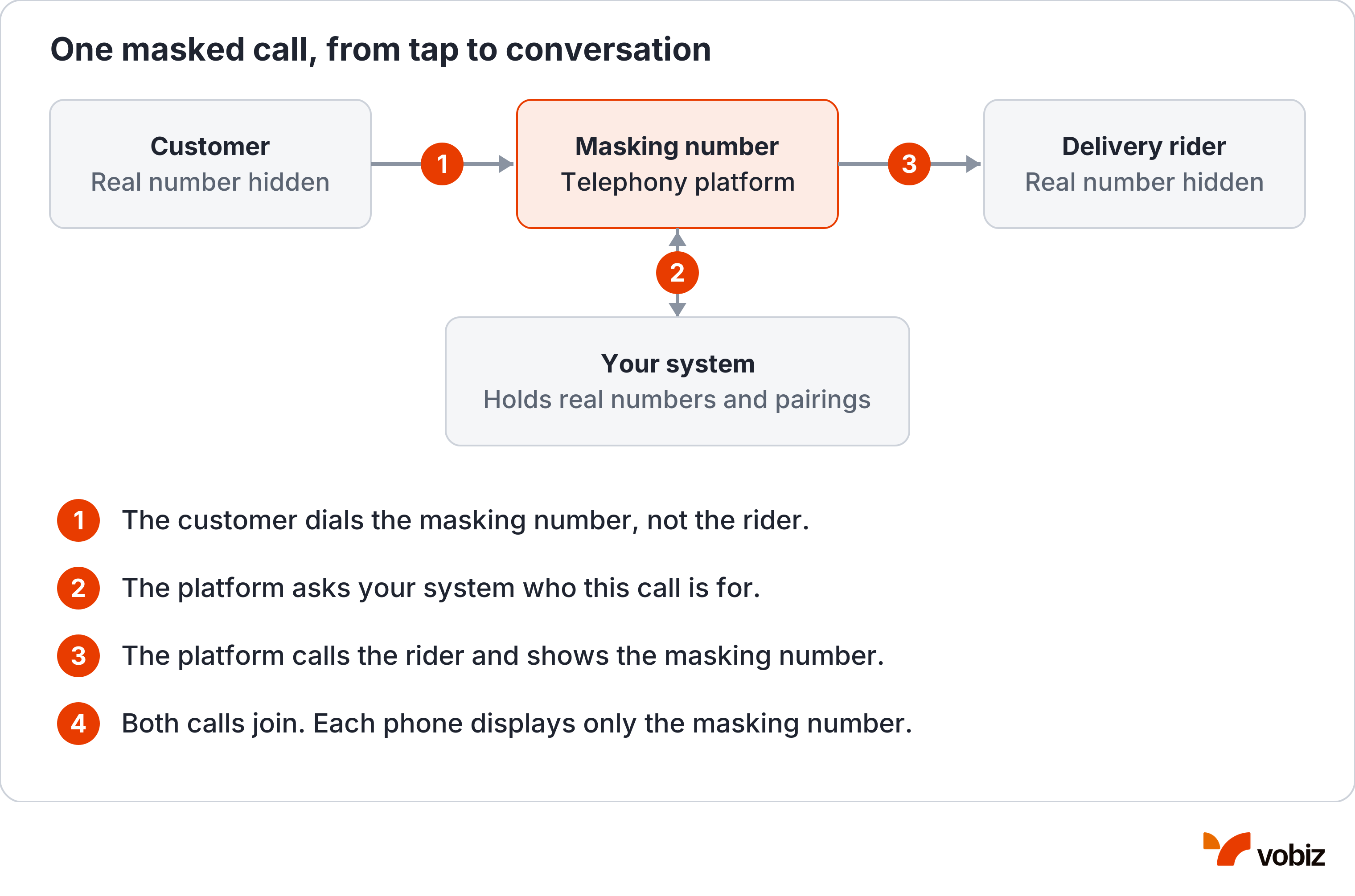
The key step is the second one. Your system looks up who is calling and which number they dialed, then decides who should ring. That decision happens on every call, which is why you can switch a connection off the moment an order closes.
There are two common ways to start the call:
- Dial-in. Each person dials the masking number, often through a Call button in your app.
- Click-to-call. The person taps a button, and the platform connects them to the other side, so nobody handles a number. This flow needs a closer look where app-started calls count as automated.
One-way vs two-way number masking
The difference is who stays hidden and who can start the call.
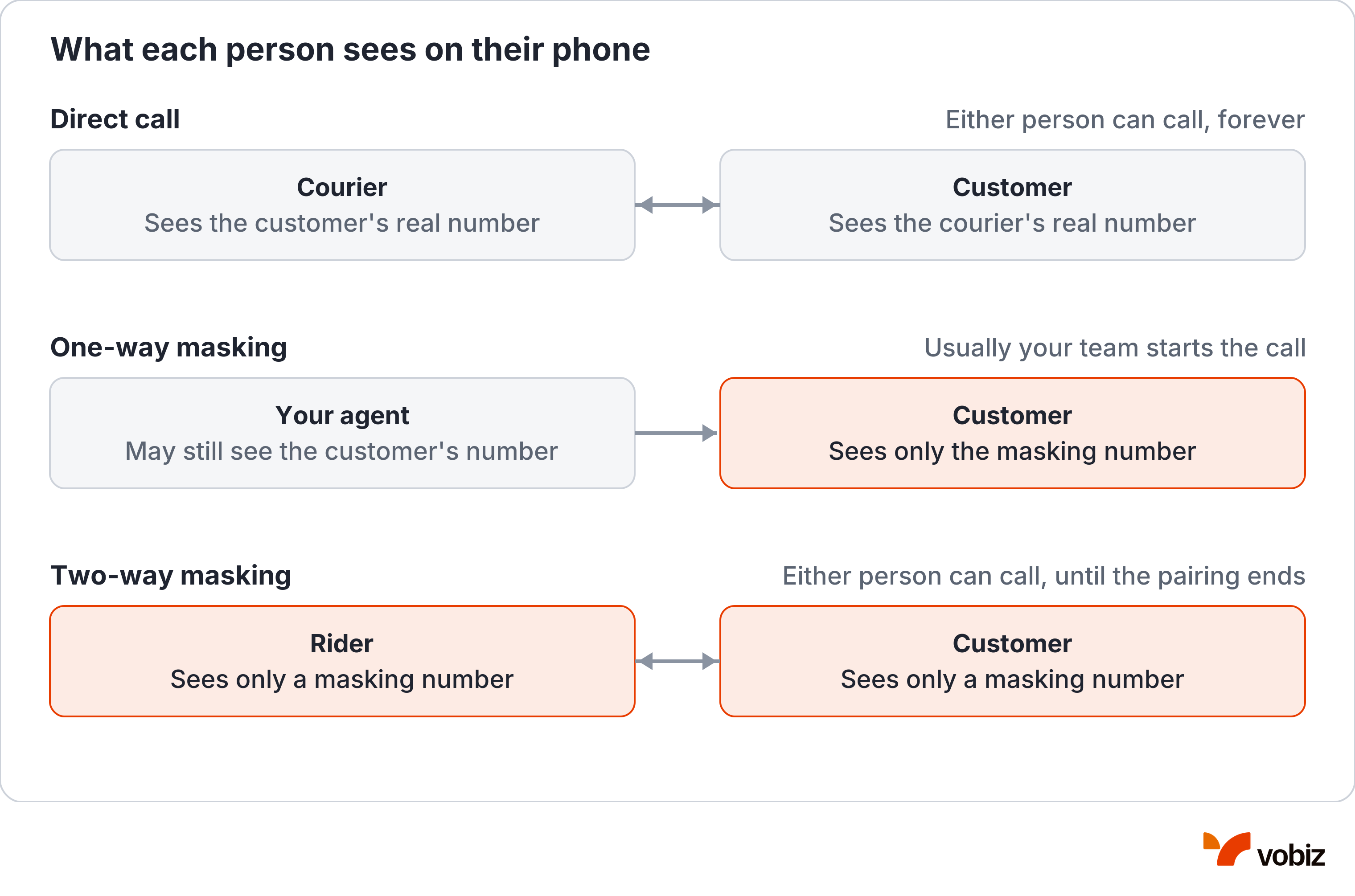
One-way masking suits teams making outbound calls. A field salesperson can call from a business number and keep their own mobile private.
Two-way masking suits two strangers who need each other for a short time, such as a rider and a customer. Either one can call back, and neither learns the other's number.
Which setup fits your business?
Masking isn't the answer to every calling problem. Use this table to decide.
| Your situation | Good fit | Why |
|---|---|---|
| Two strangers meet once, such as delivery or a ride | Two-way masking | Both need to reach each other, and neither needs a lasting contact |
| Buyers and sellers on a marketplace | Two-way masking, one pairing per enquiry | Numbers stay off public listings and can't be collected in bulk |
| Tenants and brokers discussing a property | Two-way masking | Enquiries don't turn into a broker's cold-call list |
| Field staff calling customers from personal phones | One-way masking | Staff mobiles stay private, and customers see a business number |
| A long-term account manager and client | A fixed business number | The relationship is ongoing, so an expiring connection adds friction |
| Automated alerts with no reply needed | A normal outbound call | Nobody needs to reach a second person, so there is nothing to mask |
Does two-way masking need two numbers?
Not always. One shared number works for a pair, provided your system checks who is calling. If the rider dials it, ring the customer. If the customer dials it, ring the rider.
A two-number design adds clarity. One number always means "rider to customer", and the other always means "customer to rider". The dialed number alone then tells your system the direction, which makes problems easier to trace. Vobiz's two-way masking tutorial uses this approach.
Either design is valid. Pick the two-number version if your team wants the simplest logic to audit, and the shared version if you want a smaller pool.
How many masking numbers do you need?
Fewer than most people assume. A common first guess is one number per order, but numbers can be shared across conversations. What matters is that your system can always tell conversations apart.
A number can be reused for a new conversation as long as each person remains uniquely identifiable. A driver with an open conversation on one number gets a different one for the next.
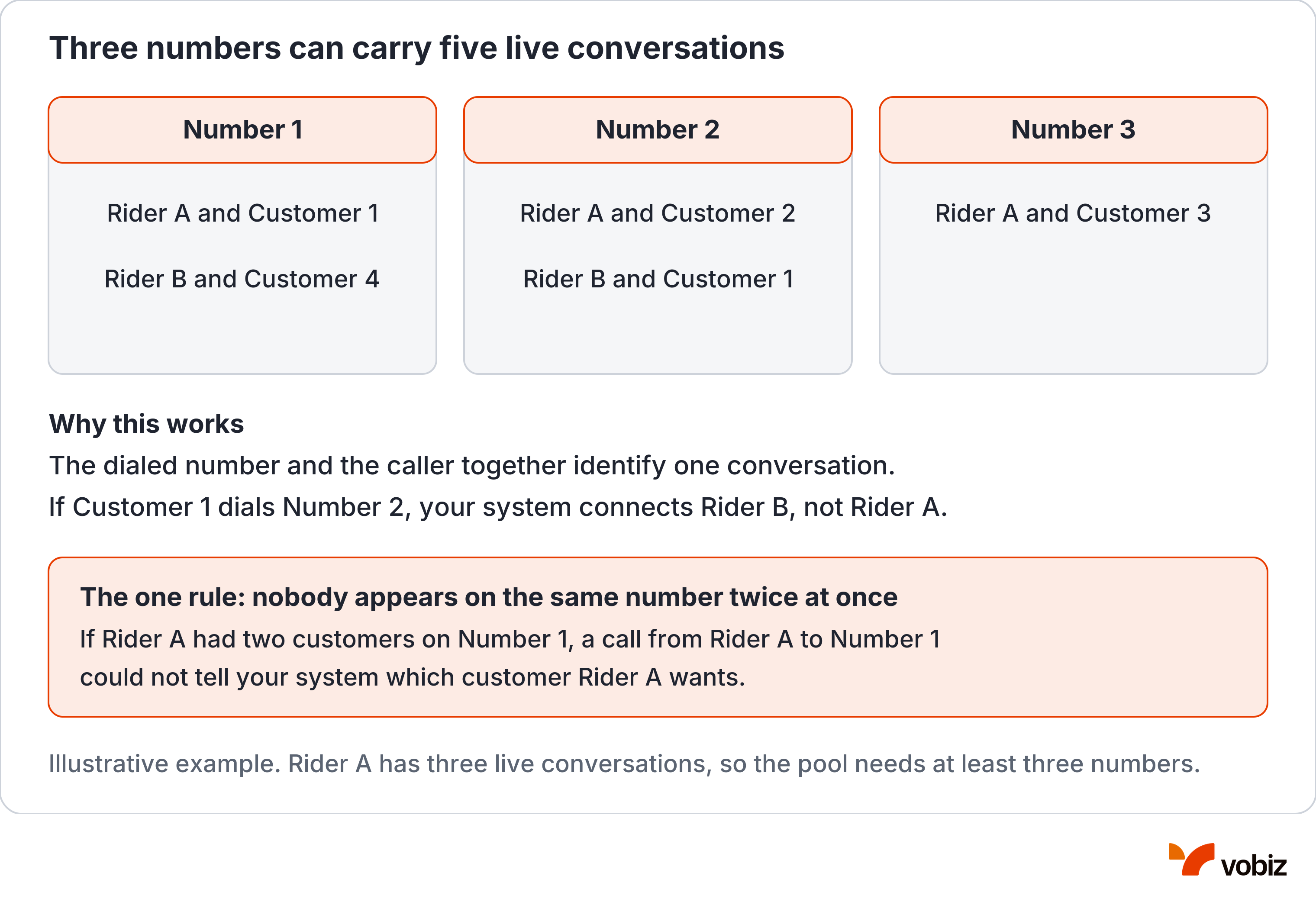
So the minimum pool equals the most live conversations any one person holds at the same time. Order volume doesn't set it. Here is that rule applied to three made-up businesses, with about 25% headroom added.
| Illustrative business | Live conversations at peak | Busiest person holds | Minimum pool | With 25% headroom |
|---|---|---|---|---|
| Local courier | 500 | A rider with 12 parcels | 12 | 15 |
| Goods marketplace | 5,000 | A seller with 40 open buyers | 40 | 50 |
| Property portal | 200 | A broker with 60 open leads | 60 | 75 |
Treat that as a floor, because three things push it up:
- Two-number designs. Each pairing takes two numbers from the pool.
- Busy people on both sides. A new pairing needs a number neither person is already using. If a busy seller meets a busy buyer, a pool at the bare minimum may have no such number free.
- High volume. Every call lands on a few numbers, so one blocked or reported number hurts many conversations. Ask your provider how much load one number can safely carry in each country you use.
Vendors also model this differently. A design that treats a number as one active pair at a time needs a pool that follows peak concurrent conversations. Ask which model applies before you compare quotes.
What happens when the order ends?
People often say the masked number expires after the call. More precisely, the pairing expires. The number itself goes back into the pool for other conversations.
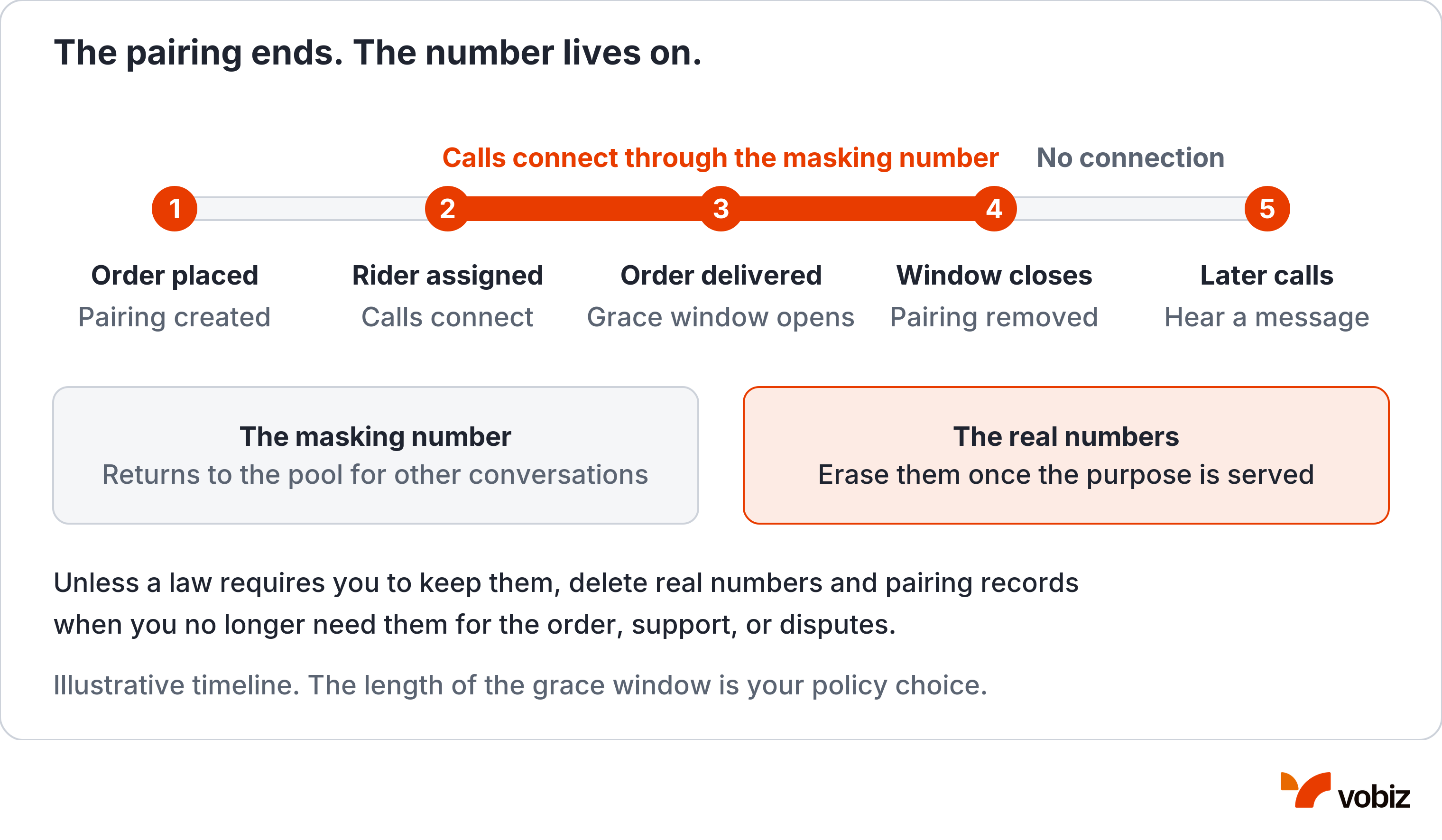
Plan for three moments that catch teams out:
- The grace window. Customers often need to call just after delivery about a missing item. A 2015 Uber post described a similar window, ending minutes after a trip.
- The late caller. Someone will redial an old masking number. Play a short message telling them how to reach support, so they aren't left with silence.
- The reused number. If that person is in a new pairing on the same number, they'll reach their new contact. Keep the pairing check strict, and keep caller-facing wording clear. A short cooldown before a number is reused can also help.
What number masking doesn't do
Masking removes one specific risk, so it's worth being clear on the rest.
- It can't stop people sharing numbers aloud. Anyone can read their number out during a call.
- It can't protect numbers that leak elsewhere. A number shown in a partner app or left in a shared export is still exposed.
- It doesn't remove your responsibility. Your system now holds both numbers in one place, so that store needs protection.
- It doesn't make recordings private. If you record masked calls, those recordings are still personal data. Tell people, limit access, and delete them on schedule.
- It doesn't make marketing calls legal. Commercial calling rules apply whichever number shows on screen.
Number masking vs call forwarding and private numbers
These three are often confused, but they solve different problems.
| Call forwarding | Withheld caller ID | Number masking | |
|---|---|---|---|
| What happens | Calls to one number ring another | The screen shows private or unknown | A virtual number sits between both people |
| Can the other person call back? | Yes | No | Yes, while the pairing is live |
| Who controls it | Phone settings or the carrier | Phone settings or the carrier | Your application, on every call |
| Can it end automatically after an order? | No | No | Yes |
What rules apply to number masking?
We found no major rule that names number masking. General telecom and privacy rules still apply to masked calls, so treat this section as orientation rather than legal advice.
Could masked calls count as automated calls?
Some regulators treat calls that an app starts as automated, even when a person answers. If you're in India, TRAI's Third Amendment of 18 September 2026 requires you to declare application-to-person calls and their caller ID ranges in advance, and TRAI declined to exempt app-connected driver and delivery calls. This matters most for click-to-call, so ask your provider whether your flow needs declaring.
Which numbers and routes can masked calls use?
Some countries reserve number series for service calls, and providers set conditions on their routes:
- Number series. In India, for example, TRAI directed providers in August 2026 to allot 1601-series numbers to utility, courier, and logistics firms for service calls, issued directly to the eligible company.
- Caller ID. On Vobiz's Indian routes, the calling regulations require the masking number to be one you rent from Vobiz, or the call is rejected as an unknown caller ID. Indian numbers also need KYC, and both legs must stay in the country.
- Consent. Commercial calls need valid consent, and on Indian routes unsolicited calls can lead to suspension or blacklisting. Keep masked numbers for the transaction they belong to.
How do privacy laws affect masking?
A phone number is personal data under most privacy laws. GDPR Article 5 limits personal data to what is necessary, and Article 25 asks for data protection by design. In California, the CCPA gives consumers rights over the personal information you hold, and India's DPDP Act covers any data about an identifiable person.
Masking helps because fewer people ever receive that data. It doesn't take you out of scope, because you still store both numbers. Protect them with reasonable safeguards, and erase them once their purpose is served, unless a law requires you to keep them.
How to choose a number masking platform for a marketplace
Most options fall into three groups. The right one depends on how much of the logic you want to own.
| Option | What you get | Best for |
|---|---|---|
| Ready-made masking service | The vendor manages pairings, expiry, and the number pool | Standard flows and small technical teams |
| Programmable voice platform | Numbers and call connection, with your own pairing logic and data | Marketplaces with custom rules or strict data ownership needs |
| SIP trunk with your own telephony system | The deepest control, and the most work | Businesses that already run a telephony team |
Vobiz is a programmable voice platform.
Whichever you shortlist, ask these questions:
- Who stores real numbers and pairings? Your answer decides where your privacy risk sits.
- Can a pairing end on your own event? You want expiry tied to delivery or a closed listing, not just a timer.
- Which number series will you get in each country, and who is the allottee? In India, this matters most for courier and logistics firms.
- How is a number pool managed? Ask how reuse avoids two conversations colliding.
- What do late callers hear? A silent failure creates support tickets.
- What records exist, and for how long? Check logs and recordings, and whether you control deletion.
- What makes up the total cost? Compare number rental and per-minute charges at your real call volumes.
How Vobiz handles number masking
Vobiz gives you the numbers and connects the calls, while the pairing logic and data stay in your own system.
- Numbers. You rent phone numbers from Vobiz. In India, numbers follow KYC verification.
- Routing. You attach your numbers to a Vobiz application. On each call, Vobiz sends the caller and dialed number to your webhooks (callbacks).
- The mask itself. Your system replies in VobizXML with a dial instruction whose caller ID shows a masking number you own or are authorized to use.
- Security. You can validate that callbacks really came from Vobiz before acting on them.
- Records. Call logs and optional call recording sit alongside masked calls.
For a business overview, see Vobiz number masking. Your developers can start from the two-way masking tutorial. Test calls are real, billed calls, so use your own credentials and only ring numbers you have permission to call.
Frequently asked questions
What is call masking in simple terms?
Call masking connects two people by phone while each sees a virtual number instead of the other's real one. A telephony platform joins the call in the middle. It's common in delivery, ride-hailing, and marketplace apps.
Is number masking the same as call masking?
Yes. Both names describe the same technique, along with phone number masking and proxy calling. Number masking stresses the hidden number, while call masking stresses the connected call. Vendors use the terms interchangeably.
Is call masking legal?
We found no major rule that bans it or names it. Masking uses a number your business rents, unlike spoofing. Telecom and privacy rules still apply, including number series, automated-call declarations where they exist, consent, and laws such as the GDPR or India's DPDP Act. Take legal advice for your specific use.
Does two-way number masking need two numbers?
Not always. One shared number works for a pair if your system checks who is calling. Two numbers make the direction clear from the dialed number alone, which keeps routing easier to audit. Both designs are valid.
How many masking numbers does a marketplace need?
At minimum, as many as the most live conversations any one person holds at once. A seller with 40 open buyers needs at least 40, even across thousands of enquiries. Add headroom, and more if you use two numbers per pairing or run at high volume.
Can someone call a masked number after the order ends?
They can dial it, but your system decides what happens. Once the pairing has ended, the call won't connect to the old contact. You can play a short message that points the caller to support instead.
Further reading on Vobiz
- Number masking solution overview · Two-way number masking tutorial
- Logistics and delivery on Vobiz · Call recording
- India calling regulations · India number KYC · UCC and NDNC compliance
- What is a DID number? · Caller ID and CNAM explained
Sources
Indian regulators and government
- TRAI, Press release 113/2026 on the 1601 series, 10 August 2026.
- TRAI, Direction on allocating the 1601 numbering series, 10 August 2026.
- TRAI, Telecom Commercial Communications Customer Preference (Third Amendment) Regulations, 2026, 18 September 2026.
- TRAI, Press release on the Third Amendment, 18 September 2026.
- Ministry of Law and Justice, Digital Personal Data Protection Act, 2023, 11 August 2023.
- PIB, DPDP Rules, 2025 Notified, November 2025.
Legal commentary
- Legal500, MeitY plans to cut short DPDP compliance timeline, 15 April 2026.
Other privacy law
- GDPR, Article 5: Principles relating to processing of personal data and Article 25: Data protection by design and by default.
- California Attorney General, California Consumer Privacy Act (CCPA).
Companies
- Uber Newsroom India, Privacy and security, 24 September 2015 (historical).
- Uber Newsroom Hong Kong, Safety features, 11 December 2015 (historical).
If a voice AI agent sits on either end of a masked call, Vobiz provides the phone numbers and SIP trunks to connect it.
About the author
- I'm a Founding Member at Vobiz, telephony for AI voice agents. I write about where voice agents meet the phone network: SIP, phone numbers, latency, echo, barge-in and everything that breaks on real calls but not in browser demos. More at piyushsahoo.me
Comments
Join the discussionNo comments yet. Be the first to comment.