Do-Not-Call Registries Explained: US National DNC, UK TPS and DND Lists
Do-not-call registries let people opt out of sales calls. Learn how the US, UK and other registries work, what they miss, and what businesses must check before dialing.
Many countries let people opt out of sales calls through a national register. The US has the National Do Not Call Registry, run by the FTC. The UK has the Telephone Preference Service (TPS), Canada has its National Do Not Call List, and Australia has the Do Not Call Register. They share one design: sales calls are allowed until you register, and a business must check the list before it dials.
India's version is a useful worked example, because people can choose which kinds of promotional calls and SMS to block, category by category. Its registry records what each phone user wants from commercial calls and SMS. NDNC was its original name, DND is the everyday name, and NCPR is the name in the regulator's FAQ. You register free through 1909, and promotional traffic you've blocked must stop within 24 hours.
This guide compares the main registries, then uses India's to show the codes, what a registry can and can't stop, how to complain, and what a business must do before it dials. The India sections reflect documents from the telecom regulator (TRAI) read on November 3, 2026. It's general information rather than legal advice.
Note: Key takeaways
- Registries are opt-out. In the US, the UK and India, sales calls are lawful until you register, so your number is open by default.
- A registry only sees callers who follow the rules. Spammers ignore it, so reporting stays your main tool.
- Timing differs by country. US telemarketers must refresh their copy of the registry at least every 31 days, UK marketers have up to 28 days, and India gives operators 24 hours.
- Some calls are outside every registry. Calls you consented to, and in the US calls from charities, political groups and surveyors, can still reach you.
- Businesses carry the risk. In India, repeat violations can disconnect every telecom resource a sender holds for a year.
How do do-not-call registries compare?
The idea is the same everywhere, but the details that affect you differ.
| United States | United Kingdom | India | |
|---|---|---|---|
| Registry | National Do Not Call Registry, run by the FTC | Telephone Preference Service (TPS) | DND, also called NDNC or NCPR |
| What you can block | Telemarketing calls | Live marketing calls | Promotional calls and SMS, all at once or by category, mode, time band or day |
| How fast it works | Telemarketers must sync their lists at least every 31 days | Marketers have up to 28 days after you register | Within 24 hours |
| Main exceptions | Calls with your written permission, an established business relationship, and calls from charities, political organizations and surveyors | Calls you gave specific consent for | Explicit digital consent, and service, transaction and government calls |
Two of these rules apply beyond the list itself. The FTC's Telemarketing Sales Rule also limits US calls to homes to 8 a.m. to 9 p.m. local time, and the ICO says UK marketing callers must display a number and say who is calling.
India's registry is the most detailed of the three, so the rest of this guide uses it as the worked example.
Are DND, NDNC and NCPR different?
In India, they're three names for one opt-out system, and each comes from a different stage of its history.
| Name | Stands for | Where you'll see it |
|---|---|---|
| NDNC | National Do Not Call | The registry created alongside TRAI's 2007 regulations, and still a common search term |
| NCPR | National Customer Preference Register | The name in TRAI's consumer FAQ |
| DND | Do Not Disturb | The name TRAI uses with consumers, as in the TRAI DND app |
The older registry was a national database of numbers that had opted out. The system changed shape under the Telecom Commercial Communications Customer Preference Regulations, 2018 (TCCCPR). Those rules define the preference register as a distributed ledger, and each operator must run its own facility for recording your choices. So you deal with your operator, while TRAI writes the rules.
How does India's registry work?
Think of the registry as a set of instructions that runs before a commercial call reaches you. A business can't simply check a list once and forget it. Under TCCCPR, scrubbing means comparing its target numbers with both the preference and consent ledgers.
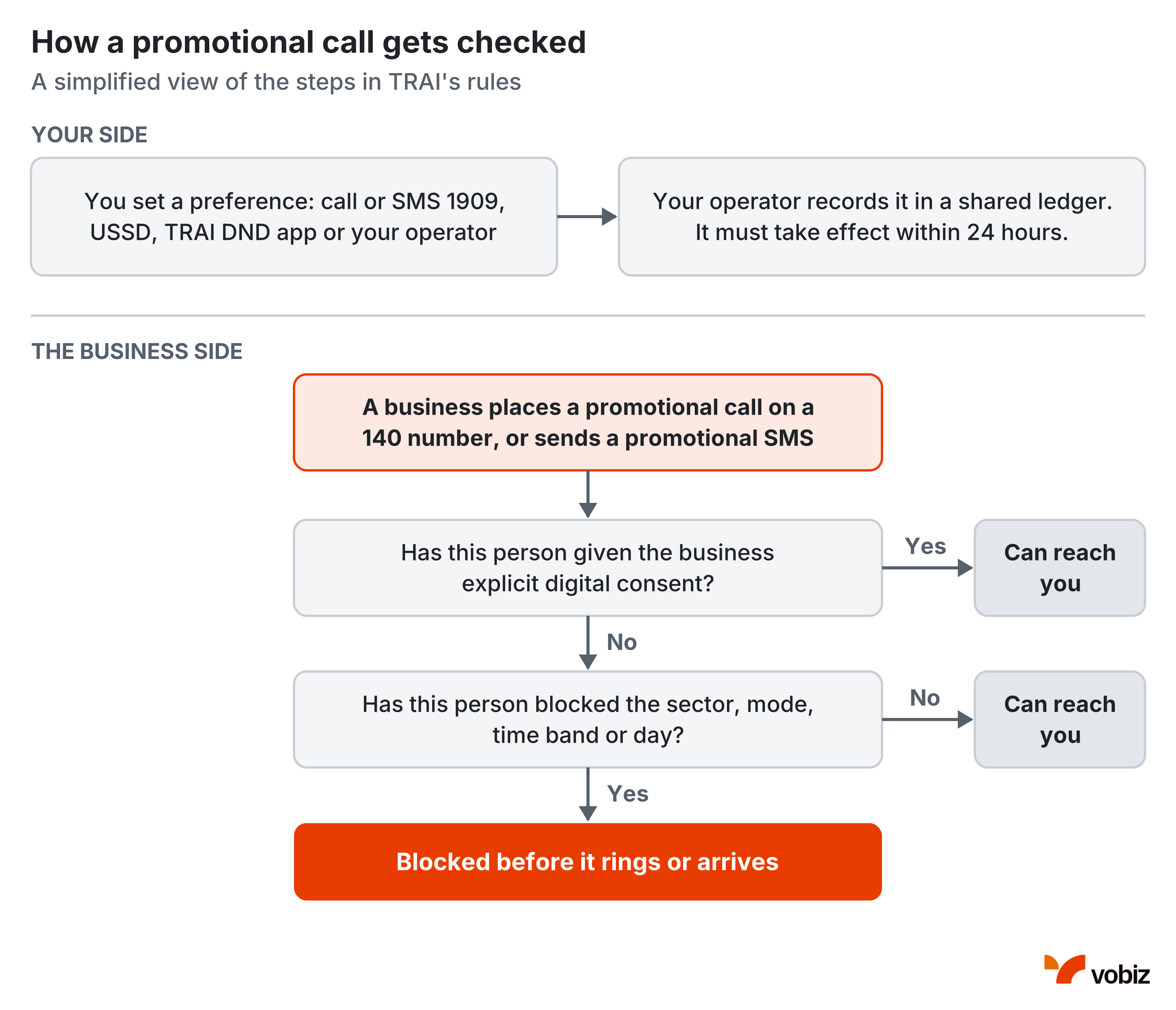
Three details surprise most people:
- Consent beats your block. TRAI's text says promotional traffic with explicit digital consent is delivered regardless of your registered preference. A consent you confirmed digitally can therefore outrank DND.
- You have some protection without registering. The same schedule keeps four time bands off by default for everyone. Commercial communication is therefore limited to 10:00 to 21:00 unless you change it.
- Designated numbers are protected from labels. The 2026 amendment bars call management apps from blanket blocking or tagging 140xx, 1600xx, and 1601xx calls as spam. You can still block calls on your own device.
What does DND stop, and what does it miss?
DND separates selling from everything else. It doesn't try to stop every call you'd rather not take.
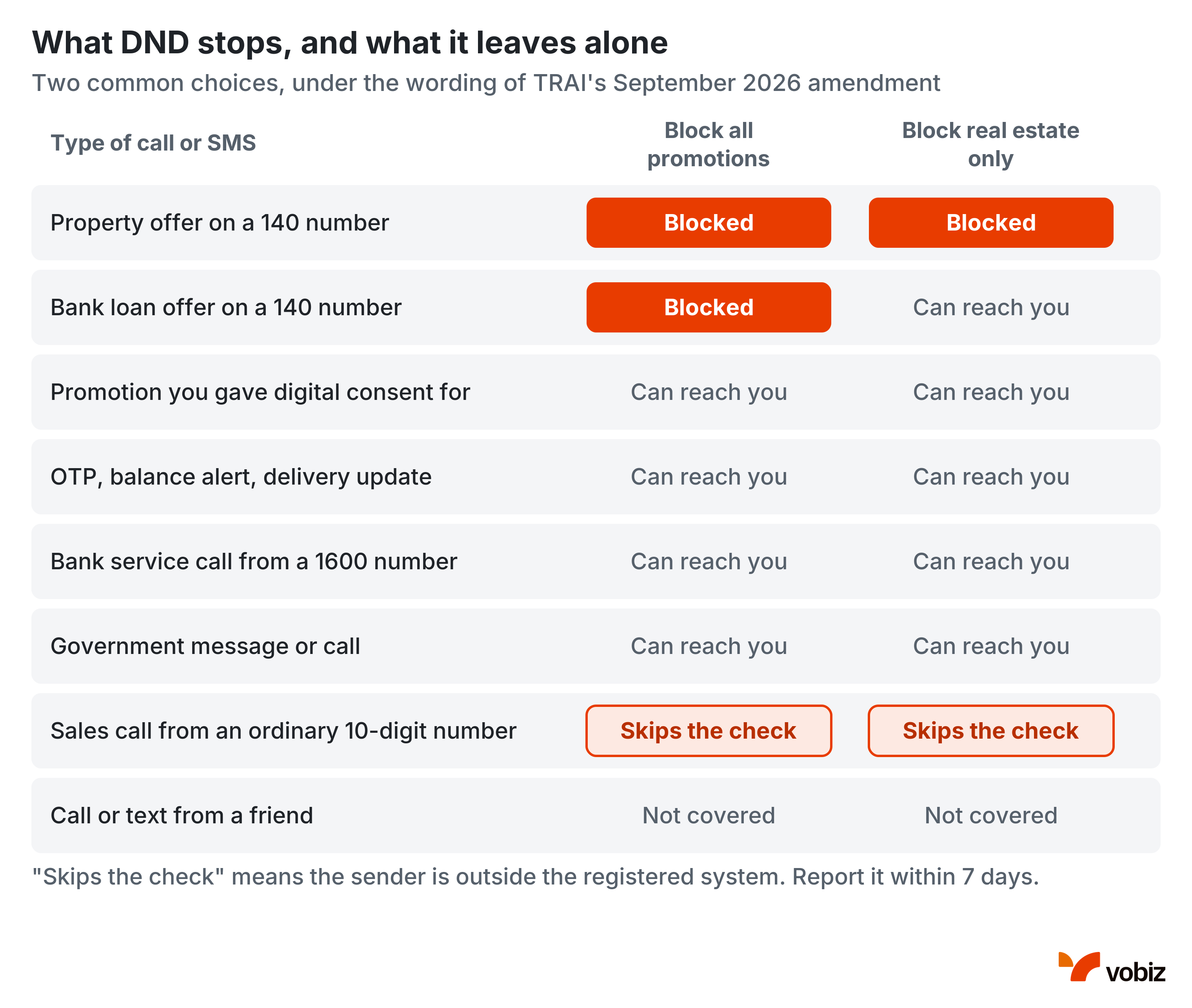
Your OTPs are safe under a promotional block. The 2026 amendment names OTPs for app login, password reset, and two-factor authentication as service messages. It also says BLOCK PROMO doesn't block service, transactional, or government communications.
Sales calls from ordinary mobile numbers are the real gap. TRAI's rules restrict telemarketing from normal 10-digit numbers, but those callers bypass the regulated system, so a registry check never runs. Reporting is your main tool here.
How to register, change or remove DND in India
You can register, change, or remove a preference free of cost by SMS, call, USSD, app, or web portal. Do this from the number you want to protect, because each number is registered separately. The codes below come from the schedules in TRAI's regulations.
| What you want | Press after calling 1909 | SMS to 1909 | USSD |
|---|---|---|---|
| Block all promotions | 50 | BLOCK PROMO | *1909*50# |
| Block banking, insurance, cards | 1 | BLOCK 1 | *1909*1# |
| Block real estate | 2 | BLOCK 2 | *1909*2# |
| Block education | 3 | BLOCK 3 | *1909*3# |
| Block health | 4 | BLOCK 4 | *1909*4# |
| Block consumer goods and cars | 5 | BLOCK 5 | *1909*5# |
| Block communication, entertainment, IT | 6 | BLOCK 6 | *1909*6# |
| Block tourism and leisure | 7 | BLOCK 7 | *1909*7# |
| Block food and beverages | 8 | BLOCK 8 | *1909*8# |
| Remove the block on all promotions | 90 | UNBLOCK ALL | *#1909*90# |
If you'd rather not remember codes, use the TRAI DND app or your operator's app or website. Your operator must acknowledge within 15 minutes with a reference number. Keep that reference until the block has worked.
Which setting should you choose?
| If you... | Choose | Why |
|---|---|---|
| Want no sales calls or SMS at all | BLOCK PROMO | It covers all promotions and keeps OTPs and alerts |
| Like bank offers but not property pitches | One or more sector blocks | You keep the offers you value |
| Only mind recorded sales calls | BLOCK 13 and BLOCK 15 | They cover pre-recorded auto-dialled calls and robo-calls |
| Want quiet evenings | BLOCK 28 | It covers the 18:00 to 21:00 band |
| Want quiet Sundays | BLOCK 37 | It covers that day of the week |
The mode, time, and day codes come from the May 2026 consolidated text. Its disclaimer says the gazetted text prevails, so follow your operator's prompts if they differ.
Old advice you can ignore
Search results for DND still repeat rules that have since changed. Guides dated 2018, 2021, and 2024 were written for those earlier rules. TRAI's FAQ page also showed older wording when we read it.
| You may read | What TRAI's current text says |
|---|---|
| Text START 0 or START DND | The schedule lists BLOCK PROMO. An operator may still accept other wording. |
| There are seven sectors | There are eight, with food and beverages added |
| Registration takes up to seven days | Within 24 hours |
| You have three days to complain | Seven days |
| You must be on DND to complain | Not for unregistered senders |
| Quiet hours are 9 p.m. to 9 a.m. | Bands from 21:00 to 10:00 are off by default |
| You can't leave for 90 days, or change more than once in 30 | We found no such limit in the consolidated text. The 90-day rule we found stops senders asking again for consent after you opt out. |
What changes under India's 2026 amendment?
TRAI notified the Third Amendment on September 18, 2026. Most of it starts 30 days after Gazette publication, and other parts start after 60 or 90 days. We couldn't confirm the publication date, so check with your operator or TRAI whether a given change is live.
For phone users, three changes matter most:
- The full block goes away. Existing FULLY BLOCK preferences move to BLOCK PROMO within 15 days of the amendment starting. You don't need to do anything.
- You gain an appeal. You can appeal a complaint outcome within 15 days, using the same routes as a complaint.
- Spam reports must count. A call management app can offer a spam button only if it sends those reports to the operators' DLT platform.
How to complain about spam calls and SMS
Every registry depends on complaints, because they show which callers ignore it. In the US, report unwanted sales calls to the FTC through the Do Not Call site. In the UK, the ICO handles complaints about marketing calls.
In India, complain as soon as you can, and always within seven days. A complaint filed later is closed and kept only as a report.
A valid complaint needs only four things: your number, the sender's number, the date, and a short description. TRAI's FAQ gives this SMS format for 1909: The UCC, XXXXXXXXXX, dd/mm/yy, with the sender's number or header in place of the Xs. Operator apps must also accept screenshots and can read call logs with your permission.
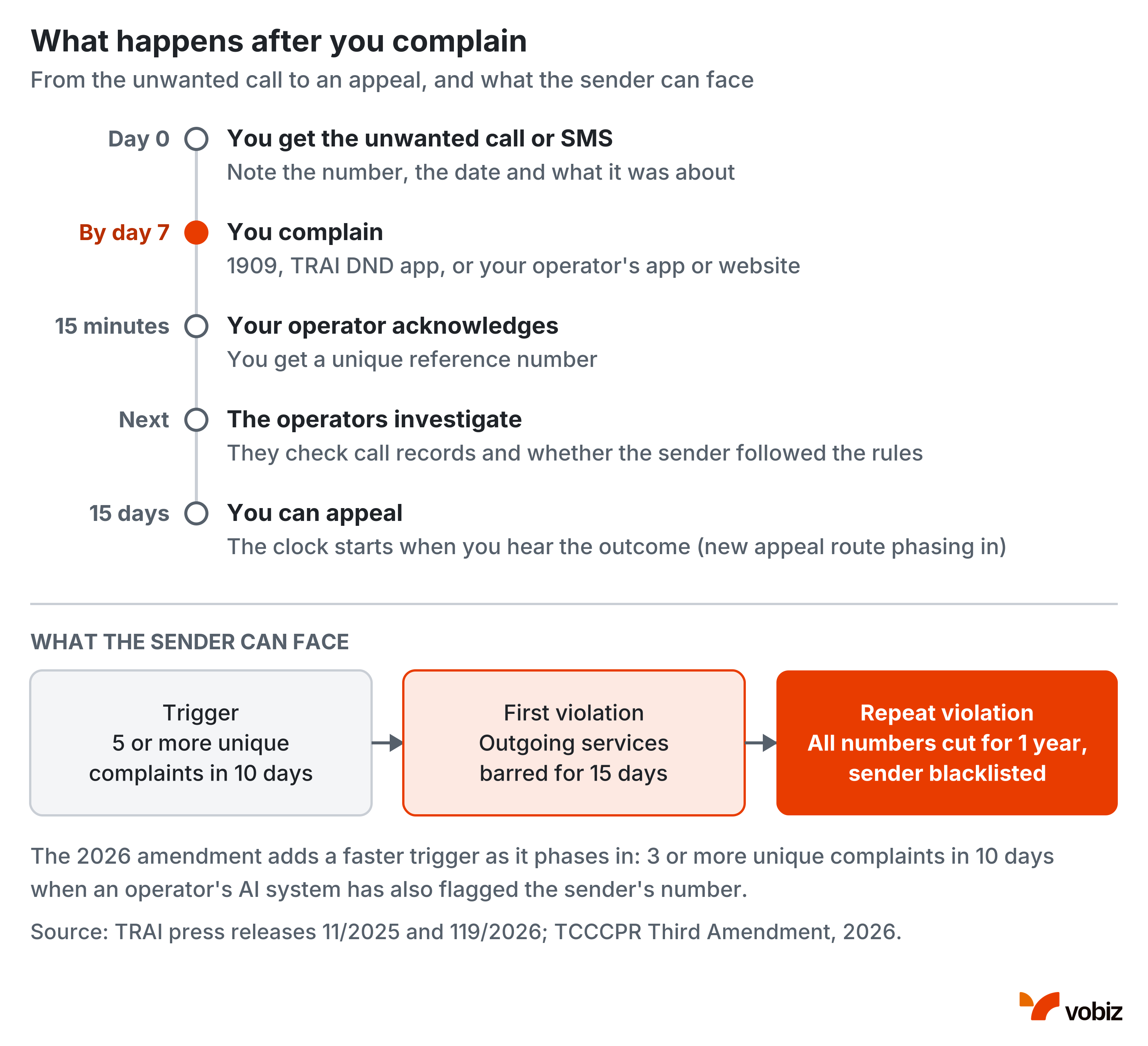
If you hear nothing, the amendment still leaves you a route. When 15 days pass with no word, you get the next 15 days to appeal.
Fraud needs a different route. Report suspected scams, such as fake KYC calls or impersonation, on Chakshu at Sanchar Saathi, within 30 days. If you've already lost money, Chakshu points you to the 1930 cybercrime helpline. Chakshu also takes spam reports and says it investigates those made within 30 days, but TRAI's seven-day limit still applies to complaints through your operator.
What must a business do?
In any country, a registry is an operating rule for your campaigns. Check every list against the registry for the country you're calling, keep proof of consent, and call only within the permitted hours. In the US, that means refreshing your copy of the registry at least every 31 days. In the UK, it means screening live marketing calls against the TPS.
If you run sales or service calls in India, DND works the same way, with more detail. Start with the purpose of the call, because that decides everything else.
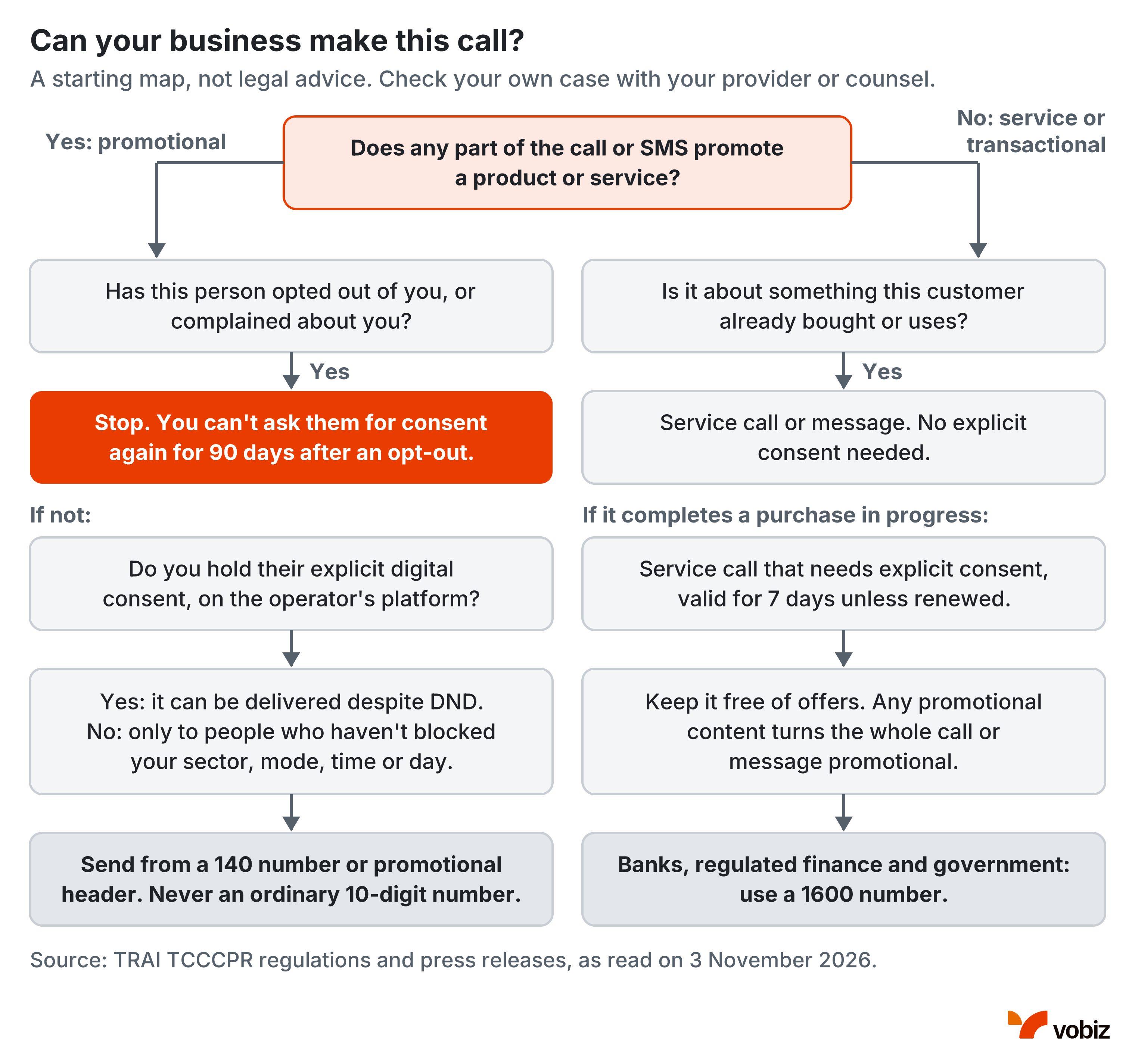
These points catch teams out most often:
- Check lists close to the send. Preferences can change within a day, so re-check before each campaign run.
- Don't treat an enquiry as lasting consent. A written or digital enquiry supports contact for seven days, and an application for three months. Keep verifiable proof of it.
- Bring old consents onto the platform. A legacy consent counts only if you obtained it by verifiable means and register it on your operator's digital platform.
- Declare your dialers and voice bots. Calls started by software, including robo-calls and AI voices, must be declared to your operator with their caller IDs as this rule phases in. Undeclared ones count as unsolicited.
- Respect the 1600 deadlines. TRAI's phased 1600 dates for many banks and finance firms passed in early 2026. Government and BFSI service calls belong on 1600.
- Handle privacy law separately. TRAI's amendment says its consent rules don't exempt you from the Digital Personal Data Protection Act, 2023.
Vobiz docs for this topic
The setup details for this are in the Vobiz docs:
- UCC and NDNC compliance
- 140 and 160 acquisition guide
- Number series FAQ
- DLT registration
- NDNC webhook (callback)
- India DLT for SMS
- Opt-outs
- India calling regulations
Anything that places calls or sends messages is billed and reaches real people, so run it only with your own credentials after confirming the details.
Frequently asked questions
What is a do-not-call registry?
It is a national list of phone numbers whose owners don't want sales calls. Businesses must check their call lists against it before dialing. Examples include the US National Do Not Call Registry, the UK's Telephone Preference Service and India's DND registry. Calls you consented to can still reach you.
Is DND the same as NDNC?
In everyday use, yes. Both are names for India's registry. NDNC stands for National Do Not Call, its original name, and DND stands for Do Not Disturb. TRAI's consumer FAQ calls it the National Customer Preference Register, or NCPR. All three names point to the same opt-out system.
How long does a do-not-call registration take to work?
It depends on the country. US telemarketers must refresh their copy of the National Do Not Call Registry at least every 31 days. UK marketers have up to 28 days after a number joins the TPS. India's rules say a DND preference must take effect within 24 hours.
Does a do-not-call registration block OTPs and bank alerts?
No. Registries target sales calls and messages. In India, the BLOCK PROMO option does not block service, transactional or government communications, and TRAI's 2026 amendment classes OTPs and balance alerts as service messages. If an OTP doesn't arrive, check with the sender or your operator.
Why do I still get spam calls after registering?
A registry only works on callers who check it. Scammers and spammers ignore it, and some callers may hold your consent or be exempt. Report the calls: to the FTC in the US, to the ICO in the UK, or within seven days through 1909 or the TRAI DND app in India.
Can a business call a number on a do-not-call list?
Sometimes. In the US, written permission or an established business relationship can allow a sales call. In the UK, specific consent can. In India, a business can make service calls to its own customers, and a promotional call to a blocked number only with explicit digital consent.
Further reading on Vobiz
- UCC and NDNC compliance · India calling regulations · India number KYC
- 140 and 160 series acquisition · DLT registration · Number series FAQ
- NDNC webhook · Messaging opt-outs · India DLT for SMS
- How an outbound campaign manager works · Automated calling and answering machine detection · What is SIP trunking?
Sources
Other registries and regulators
- FTC, National Do Not Call Registry: register your number.
- FTC, Do Not Call Registry FAQ for businesses.
- FTC, Telemarketing Sales Rule, 16 CFR 310.4, via Cornell LII.
- ICO, Telephone marketing guidance under PECR.
- UK legislation, Privacy and Electronic Communications Regulations 2003, regulation 21.
- CRTC, National Do Not Call List, Canada.
- ACMA, Do Not Call Register, Australia.
Indian regulators and government
- TRAI, Telecom Commercial Communications Customer Preference (Third Amendment) Regulations, 2026, 18 September 2026.
- TRAI, Press release on the Third Amendment, 18 September 2026.
- TRAI, Quarterly highlights of action against UCC, press release 111/2026, 4 August 2026.
- TRAI, Clarifications on the 1600 and 140 series, press release 91/2026, 10 July 2026.
- TRAI, Consolidated TCCCPR, 2018 text, May 2026. The gazetted text prevails.
- TRAI, Direction on phase-wise adoption of 1600-series numbers, 19 November 2025.
- TRAI, Press release 11/2025 on the TCCCPR amendments, 12 February 2025.
- TRAI, FAQ on unsolicited commercial communications, read 3 November 2026.
- TRAI, Consultation paper on unsolicited commercial communications, 11 May 2010.
- Department of Telecommunications, Sanchar Saathi: Chakshu reporting, read 3 November 2026.
Other guides
- Beebom, How to activate DND on Jio, Airtel, Vi and BSNL, May 2021.
Read the Vobiz compliance docs — DND, complaints and consent proof in India.
If a voice AI agent will be making your outbound calls, Vobiz provides the SIP trunks and numbers for it.
About the author
- I'm a Founding Member at Vobiz, telephony for AI voice agents. I write about where voice agents meet the phone network: SIP, phone numbers, latency, echo, barge-in and everything that breaks on real calls but not in browser demos. More at piyushsahoo.me
Comments
Join the discussionNo comments yet. Be the first to comment.