SMS Sender Registration Explained: US 10DLC, Sender ID Registries and DLT
Many countries make businesses register before sending SMS at scale. Compare US 10DLC, toll-free verification, sender ID registries and DLT, and see what each one checks.
SMS sender registration is the step where a business proves who it is, and what it will send, before carriers deliver its messages at scale. The US does this through A2P 10DLC and toll-free verification, Singapore through its SMS Sender ID Registry, and India through DLT, which stands for Distributed Ledger Technology. Each one decides whether your traffic is delivered, filtered or blocked.
The schemes differ in how much they check. 10DLC registers your brand and each use case. A sender ID registry protects the name your customers see. DLT goes furthest, because operators check the wording of each message against a registered template as well as the sender. That makes it the most useful worked example, and most of this guide walks through it.
The DLT sections treat it as a system you have to build against. It maps the records you register, follows one message through the checks, and shows which failure points to which fix. Regulatory points link to TRAI's own documents wherever we could read them.
Note: Key takeaways
- The rules follow the recipient's phone. A registration in one country doesn't carry over to another, so plan sender registration market by market.
- US local numbers need 10DLC. You register a brand and a campaign, and unregistered traffic gets blocked. US toll-free numbers need toll-free verification.
- Sender ID registries protect your name. Singapore marks unregistered sender IDs as "Likely-SCAM", and the US doesn't support alphanumeric sender IDs at all.
- DLT checks the wording too. One Principal Entity owns many headers, each header owns many templates, and operators reject any message that doesn't match.
- Registration can lapse. Under DLT, unused headers and templates can be deactivated after 90 days, and a missed annual self-certification brings automatic suspension.
Which countries require SMS sender registration?
Requirements depend on the destination country and the type of sender. These are the main models.
| Where | What you register | What happens if you don't |
|---|---|---|
| US local numbers | A brand and a campaign under A2P 10DLC, through The Campaign Registry. See 10DLC brands and 10DLC campaigns | Unregistered traffic gets blocked |
| US toll-free numbers | Toll-free verification before production traffic | Messages can be filtered |
| US short codes | A lease from the US Short Code Registry, then carrier approval of the program | You can't send until carriers approve |
| Singapore | Every sender ID, in the SMS Sender ID Registry, mandatory since 31 January 2023 | Messages show the sender as "Likely-SCAM" |
| United Kingdom | Optional. Brands can protect their sender IDs in the MEF SenderID Protection Registry, and participating networks block lookalikes | Your name has no protection from spoofing |
| India | Your business, sender headers and the exact wording of every template, on a DLT platform | Operators reject the message |
Alphanumeric sender IDs, up to 11 characters, work in many countries. AWS notes that several major markets, including the US, Canada and China, don't support them, and that some countries require pre-approval by a regulator.
The rest of this guide covers DLT in detail, because it checks the most. If you build for DLT, the other schemes will feel familiar.
What is the full form of DLT?
DLT stands for Distributed Ledger Technology. TRAI's regulations define it as a shared, sequenced, cryptographically secured record that many participants hold and act on together.
In telecom, and specifically in India, the term has a narrower meaning. It refers to the ledger networks that access providers run under the Telecom Commercial Communications Customer Preference Regulations, 2018 (TCCCPR). Developers usually say "DLT" for the whole compliance regime and "the DLT portal" for the website where they file records.
The regulation names separate ledgers for headers, consent, consent templates, content templates, preferences, and complaints. TRAI's December 2024 note put the number of active Principal Entities at about 113,000. A shared record means that every operator can verify the same sender without trusting a claim in the message.
What do you register on DLT?
You register six kinds of record. Three of them produce the IDs that travel with every message, and the other three decide whether a given send is allowed.
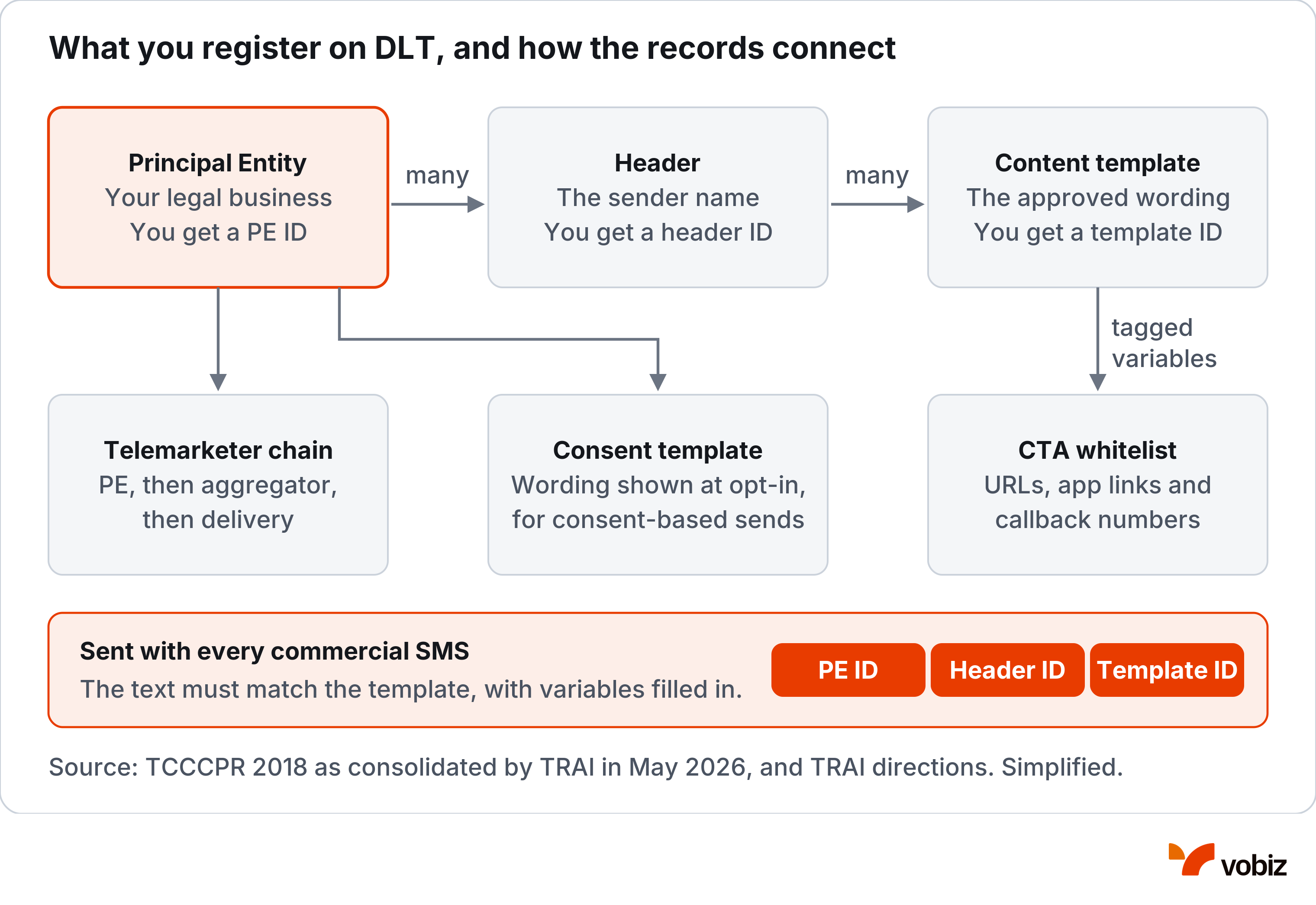
| Record | What it establishes | Rule that catches people out |
|---|---|---|
| Principal Entity (PE) | The legal business behind the traffic | Your details must stay current, and you confirm them each year |
| Header | The sender name on the handset | The regulation caps it at 11 characters, and Vobiz's guide describes the 6-character form you file. Look-alikes of government bodies and brands get extra checks |
| Content template | The approved wording | One template can link to only one header |
| Consent template | The wording a customer sees when opting in | The customer is authenticated by OTP, and a sender can re-acquire a revoked consent only after 90 days |
| PE-TM chain | The path from you through your telemarketers | The regulation allows at most one aggregator and one delivery telemarketer, unless TRAI directs otherwise |
| CTA whitelist | The links and callback numbers you may use | You undertake that listed URLs, APKs, and OTT links aren't malicious |
"CTA" here means a call to action, the term TRAI's tag annexure uses for these registered links and numbers.
Who needs DLT registration?
Anyone sending commercial communication to Indian numbers over telecom routes needs to be in the chain somewhere. Your role decides what you file.
| Your situation | What you need |
|---|---|
| Indian business sending its own SMS | A PE registration, plus headers, templates, and a declared chain through your provider |
| SaaS platform sending for its customers | Usually each customer holds its own PE record, because the regulation ties a header to the business behind it. Your platform appears in the chain if it aggregates or delivers traffic |
| SMS aggregator or reseller | A telemarketer registration with the aggregator function, as the regulation calls it |
| Business placing promotional calls | A 140xx number and registration with a telecom provider, in any sector |
| Bank, NBFC, insurer, or government body placing service calls | A 1600xx number. TRAI's July 2026 note lists entities regulated by RBI, SEBI, IRDAI, and PFRDA, along with government entities |
| Company outside India with no Indian entity | Ask your provider. Regulation 37 stops international SMS that carries an alphanumeric header or a +91 origin |
| Sending WhatsApp Business templates | Meta's template approval, which is a separate process |
How do you complete DLT registration?
The work runs in a fixed order, because each record depends on the one before it. We found no regulator-published service level for approvals, so ask your portal for current times.
Choose a portal
Operators run their own portals, including Jio, Airtel, Vi, BSNL, and MTNL. Check your voice plans before you pick, as the table below explains.
Register the Principal Entity
File your legal name as it appears on your PAN, with PAN, certificate of incorporation, GST, address proof, and business proof. The DLT registration guide lists the documents.
Register headers
Apply for each sender name in the right category, with evidence of your brand. Expect more scrutiny for names close to a bank, a government body, or a known brand.
Whitelist your links and numbers
Add each URL, app link, and callback number that your templates will use. Do this before template work, because a tagged variable has nothing to validate against without it.
Register templates with tagged variables
Link each template to one header, pick the category, and tag every variable.
Register consent templates where needed
You need them for promotional sends that rely on explicit consent. Vobiz's guide requires a consent template for 140 series calling.
Declare the chain and give your provider the IDs
Bind your PE to each telemarketer on the path, then pass the IDs to your provider. Allow extra time if an approved entity hasn't synced across operators.
Which portal should you use?
You normally need only one registration, because the ledger is shared across operators. That makes the choice mostly about what you plan to do next.
| If you plan to | Then |
|---|---|
| Send SMS only | Any operator portal can work. Compare fees and support, and confirm your provider accepts it |
| Provision 140 or 160 numbers on Vobiz | Start with the DID provisioning guide, which names the operators whose PE Certificate it accepts |
| Use a Vobiz-assigned 140 number | Read the acquisition guide first, because some of its paths need one specific DLT portal |
How much does DLT registration cost?
Budget for the entity fee, and expect it to vary by portal. The regulation lets TRAI set such fees or direct providers to, and we didn't find a single published schedule, so confirm the amount on your portal before paying.
How do you choose the right message category?
Category drives consent, preference checks, and the header suffix. Work through the questions in order, because the first match wins.
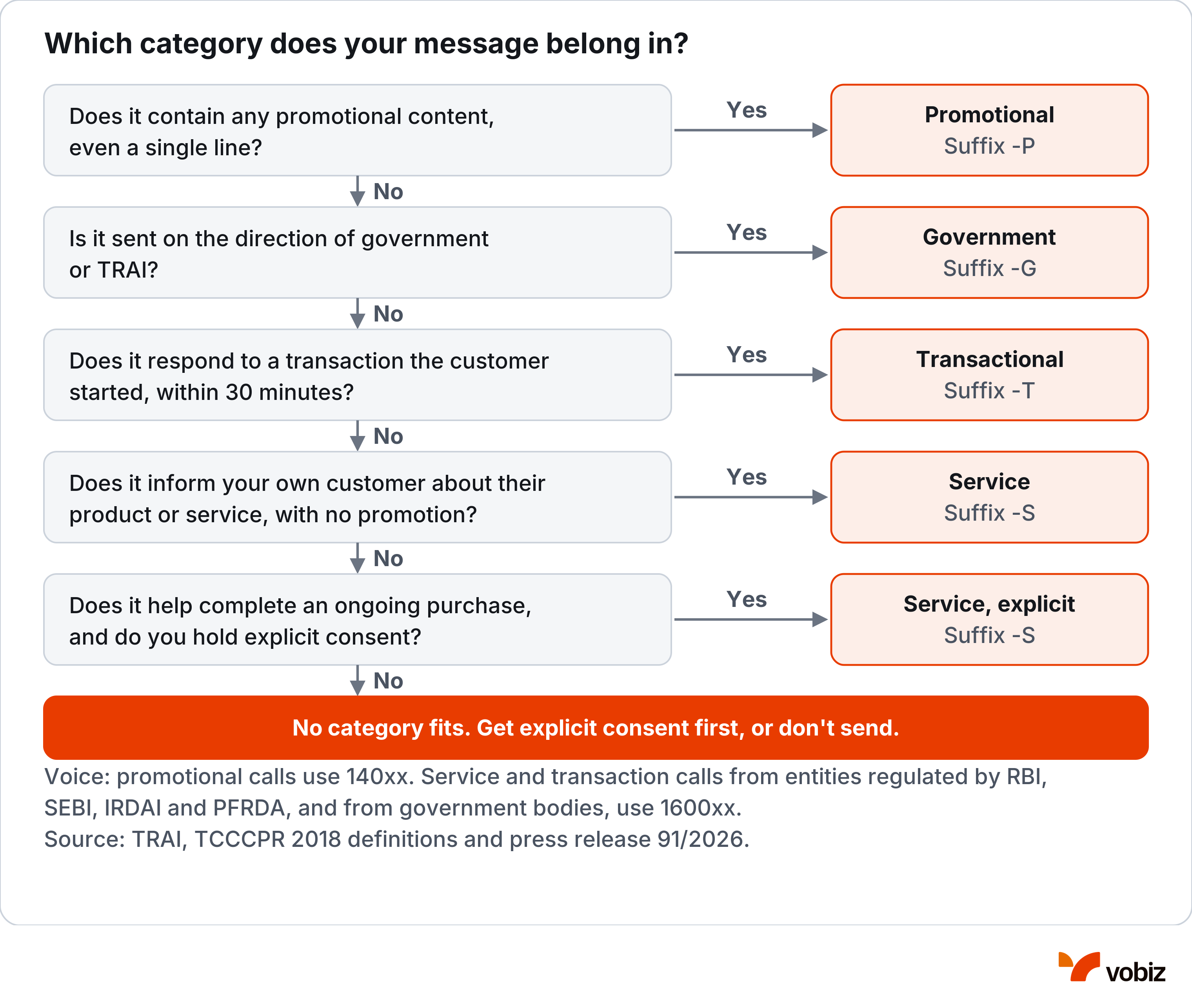
The definitions in the regulation create three traps:
- Mixed content turns promotional. A delivery update with a discount line is a promotional message, whatever category you filed.
- Thirty minutes is part of the test. A reminder sent the next day doesn't fit the transactional definition, so it needs another category.
- Explicit service consent is short. Consent for messages that complete an ongoing purchase lasts seven days, unless TRAI directs otherwise.
Filing in the wrong category costs more than a rejected message. TRAI says a template in the wrong category will be blacklisted. Under the Third Amendment, a complaint triggers that blacklisting, and five such blacklists in 90 days will suspend the sender. The suspension lasts one month, or until every template is re-verified if that takes longer.
Timing also differs from what you may have read. The regulation treats time as a recipient preference that is checked during scrubbing, and many guides quote a fixed promotional window. Confirm the window with your provider before you schedule a campaign.
How does a DLT template get checked?
A template is a pattern with fixed and variable parts. The regulation defines transactional and service templates this way, and describes a promotional template as fixed content. The regulation tells registrars to create a one-way hash of the fixed part, and to define how the fixed and variable parts are pulled out of a real message. That design explains why small wording changes fail: your text no longer yields the same fixed part.
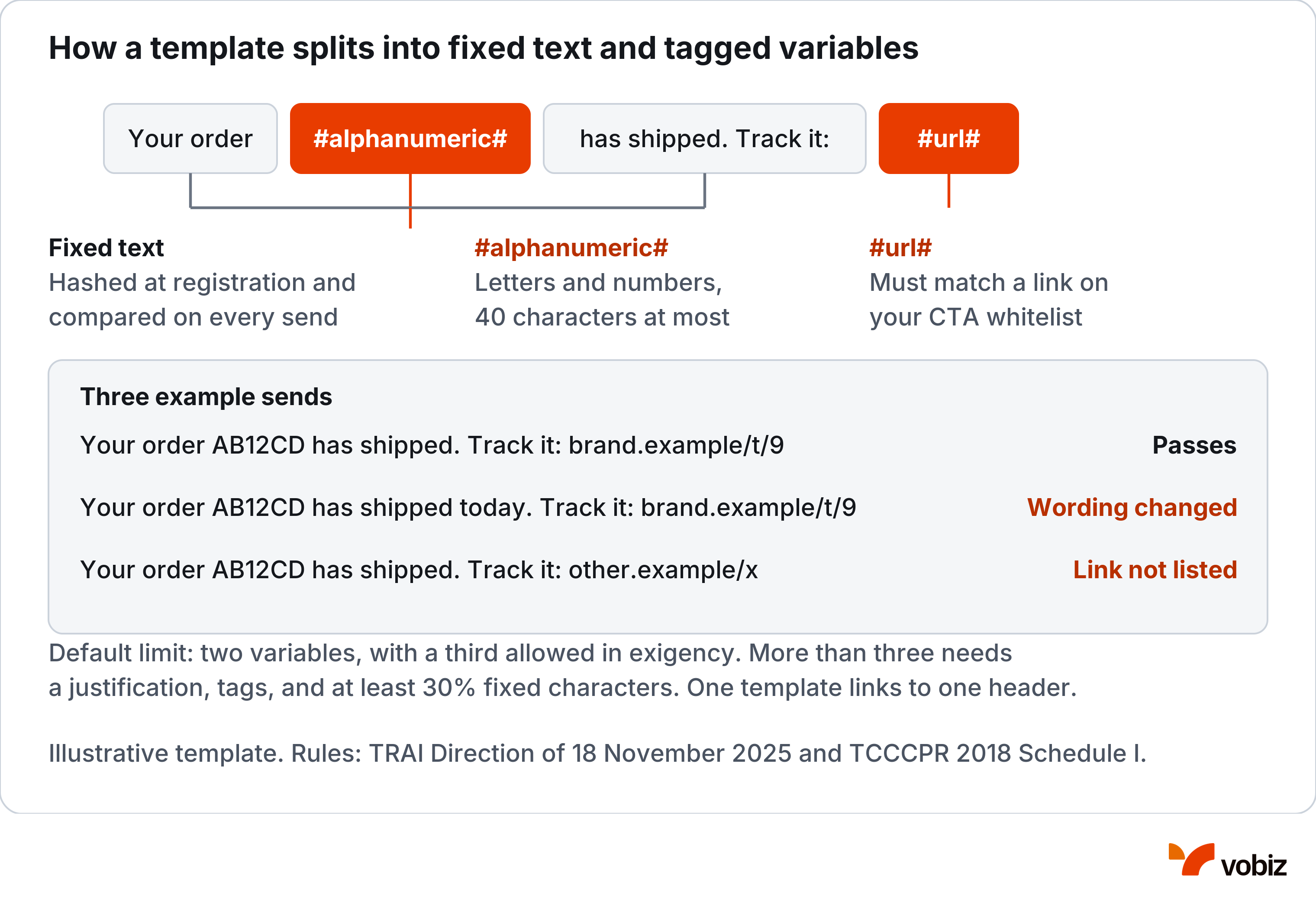
The November 2025 direction sets six tag types:
| Tag | Holds | Validation |
|---|---|---|
| #number# or #numeric# | Digits such as an OTP | Digits only |
| #url# | A web link | Must match a registered static, dynamic, or short URL |
| #urlott# | An app or OTT link | Must match a registered OTT or APK entry |
| #cbn# | A callback number | Must match a registered mobile, landline, or toll-free number |
| #email# | An email address | Must fit a valid email pattern |
| #alphanumeric# | IDs such as a booking reference | Letters and numbers, up to 40 characters |
Build your application around these types. Generate each message from the same stored string you registered, and validate variables before you submit them. A value that passes your code but breaks its tag is still a failed message.
What happens when you send a message?
Your message passes through a declared path, and each stage has a defined way to stop it. The diagram simplifies the order, because operators can split these checks across their own systems.
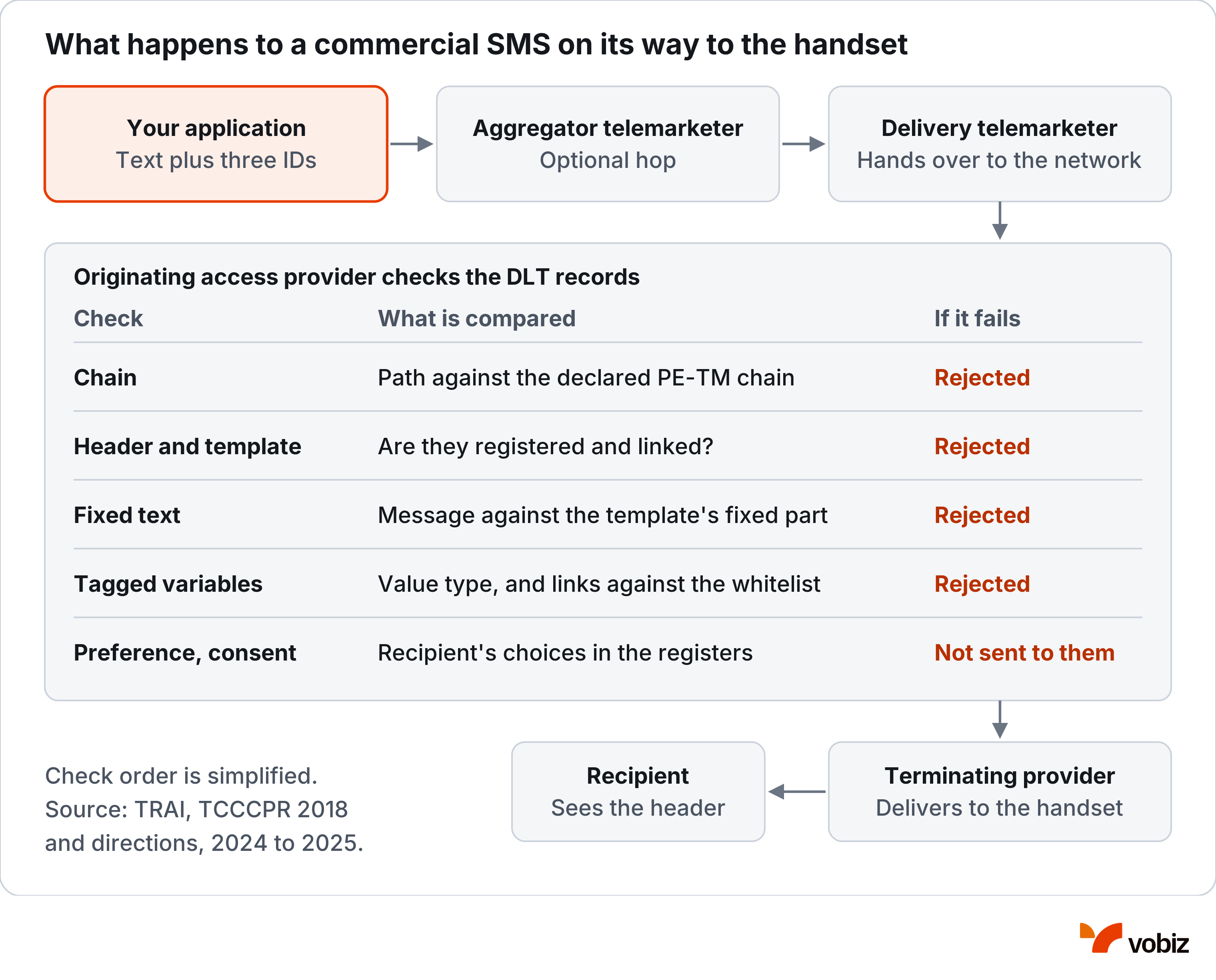
Use the pattern of the failure to find its layer. Error codes differ by operator and provider, so this table starts from symptoms.
| What you see | Likely layer | Why | What to do |
|---|---|---|---|
| All traffic through one vendor fails | Chain | Undeclared paths have been rejected since 11 December 2024 | Declare or fix the PE-TM binding |
| One message type fails after a copy edit | Fixed text | The text no longer matches the template | Restore the wording, or register a new template |
| Only messages with links fail | Tags and whitelist | The domain or link isn't in your CTA list | Whitelist it, and check the variable's tag |
| A header that sat idle stops working | Deactivation | Headers and templates unused for 90 days can be deactivated | Request reactivation |
| All your headers stop at once | Certification or misuse | Annual self-certification lapsed, or a misuse suspension applies | Check your portal and your provider's notices |
| Some recipients don't receive promotions | Scrubbing | Those people blocked the category in their preferences | Nothing is broken. Acquire explicit digital consent if appropriate |
What has changed in the DLT rules?
Most of today's enforcement arrived from 2024 onward. If you registered before then, compare your setup with each step.
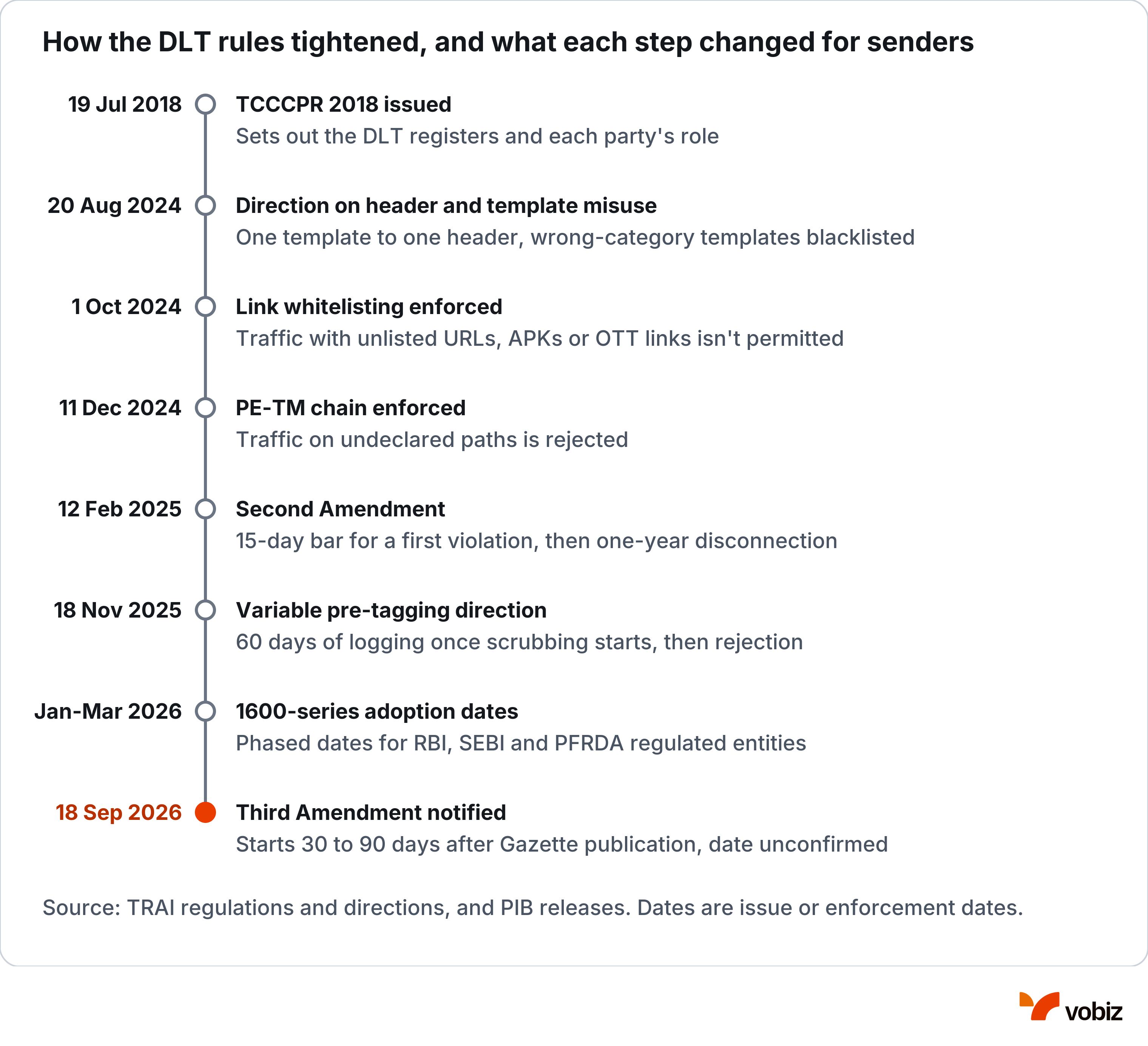
Three of these deserve a closer read.
Link whitelisting came in stages. TRAI moved the date to 1 October 2024 for URLs, APKs, and OTT links, and left callback numbers for later. The November 2025 direction then added callback numbers to the tag checks.
Variable tagging had a logging period. The direction allowed 60 days of logging from the start of tag scrubbing, during which failing messages were still delivered. After that, they are rejected outright. We couldn't confirm a single operator-wide end date, so treat tagging as already required and check your templates now.
The Third Amendment changes incident response. TRAI announced it on 18 September 2026. The notification starts most provisions 30 days after Gazette publication. The misuse sequence below starts after 60 days, and the wrong-category suspension after 90. We couldn't confirm the publication date, so check whether each one applies today. Once in force, a misuse case follows this sequence:
- The originating provider suspends the misused header or template within six hours of noticing it, and sends you a notice within 48 hours.
- You reset passwords, API keys, and system permissions within three business days of the notice, and file a complaint with a law enforcement agency in that same period.
- If credentials leaked, your registrar de-registers all your headers and templates within five business days, or in phases if it allows. You then re-register them, and they receive new IDs.
- You review every registered header and template within ten business days, and report the cause to the provider.
Point three has a direct engineering consequence. Keep your IDs in configuration rather than in code, so a forced re-registration doesn't need a release.
The penalties for unregistered senders are heavier still. The Second Amendment applies when an investigation upholds complaints against one. It bars outgoing services on all of the sender's telecom resources for 15 days on a first violation. Later violations disconnect those resources for one year, across all providers, along with blacklisting. The Third Amendment keeps these steps.
How do you keep a DLT registration healthy?
Treat DLT records like production configuration with an owner and a review date.
- Self-certify every year. Providers must suspend senders automatically when details, headers, or templates go uncertified. Put the date on a shared calendar.
- Audit idle records every quarter. List headers and templates that won't send within 90 days, and either retire them or plan for reactivation.
- Limit portal access. Each credential can now trigger a sender-wide event, so use named users and remove leavers quickly.
- Keep consent evidence. Under the Third Amendment, an inquiry supports messages for seven days only when it was written or digital and you hold it in verifiable form. Legacy consent counts only if you obtained it through verifiable means and register it on the providers' digital platform.
- Review your templates against your product copy. A copy edit can break a match with a valid template, so add template checks to your copy review.
Does DLT apply to voice calls?
Yes. The regulation's template definitions cover voice calls as well as messages, and TRAI required the 140xxx series to move onto DLT in 2024. On voice, Vobiz's guide notes that the header is the DID itself.
The number series depends on the call type. Promotional calls use 140xx, and regulated financial entities and government bodies use 1600xx for service and transaction calls. TRAI's November 2025 direction set dates for RBI, SEBI, and PFRDA entities in phases. The dates for RBI-regulated entities ran from 1 January to 1 March 2026. Check the annexure for your entity type, because some intermediaries remain voluntary.
Automated calling gets its own rule. The Third Amendment defines application-to-person (A2P) calls as those an application or automated platform starts without direct human dialing. You must declare them to your provider in advance, with the caller ID ranges you plan to use, or they count as unsolicited. The notification starts this rule 60 days after Gazette publication.
How Vobiz handles sender registration
For US traffic, Vobiz documents the 10DLC brand and campaign steps, and toll-free verification. The messaging compliance overview covers other markets.
Vobiz also supports DLT for both messaging and voice. You keep your own registration on a DLT portal, and Vobiz carries the identifiers.
- SMS fields. Send a message accepts your DLT entity, header, and template IDs. The India DLT guide explains how they map to your records. Vobiz stores them on the message, and operators check each message against your registration.
- Broadcasts. Broadcasts take the same three fields once, up to 64 characters each, and copy them onto every recipient's message. After variables are substituted, each message must still match the template.
- Sender IDs. India uses registered headers rather than long codes. The available numbers endpoint returns an empty list for India, with a hint that explains why. To use a header as your sender, register it and contact Vobiz support.
- Market rules. The coverage endpoint returns market notes for a country, plus allowed sending hours where the country restricts sending hours, so your code can read them.
- Opt-outs and events. Opt-outs record STOP replies, and later sends to those recipients return 422. You can follow delivery through webhooks (callbacks).
- 140 and 160 voice. The DLT entity guide covers your organisation's records, DID provisioning covers each number, and the acquisition guide covers how numbers are sourced. Vobiz's docs use "160 series" for this service and transactional range.
- Complaints. The UCC and NDNC page explains complaint handling, and India calling regulations covers the wider voice rules.
Messages and calls reach real people and are billed to your account. Run them with your own Auth ID and Auth Token, and confirm numbers and wording before you send. Current rates are on the Vobiz pricing page.
Frequently asked questions
What is SMS sender registration?
It is the process of telling carriers or a registry who you are and what you will send before you text customers at scale. Examples include A2P 10DLC and toll-free verification in the US, Singapore's SMS Sender ID Registry, and India's DLT. The destination country decides which one applies.
What is the full form of DLT?
DLT stands for Distributed Ledger Technology. In telecom, it refers to the operator-run ledgers that India's regulator uses to record commercial senders, headers, templates, consent and customer preferences. Developers say DLT registration when they mean getting set up to send commercial SMS there.
Can I send business SMS without registering?
Usually not at scale. In the US, unregistered 10DLC traffic gets blocked. In Singapore, unregistered sender IDs appear as "Likely-SCAM". In India, operators reject commercial SMS with no DLT data. Personal messages between individuals aren't covered by these schemes.
Is registration required for OTP messages?
Generally, yes. In India, an OTP needs a registered header and template, with the code in a tagged numeric variable. In the US, The Campaign Registry's overview covers one-off business messages that aren't marketing, so codes sent from local numbers fall under 10DLC too.
How long does sender registration take?
It varies by scheme and provider. US short codes typically take two to four weeks, according to the registry. Under DLT, entities, headers and templates are each reviewed, and synchronisation across operators can add more time, so ask your portal for current times.
Is sender registration free?
Usually not. The Campaign Registry publishes fees for 10DLC, and US short codes carry a monthly lease. DLT portals typically charge for entity registration, and we found no single published schedule. Check your provider or portal before you pay.
Further reading on Vobiz
- India DLT for SMS · DLT entity registration guide · Messaging compliance overview
- DID provisioning for 140 and 160 · 140 and 160 acquisition guide · Number series FAQ
- UCC and NDNC compliance · India calling regulations · What is SIP trunking?
Sources
Other registries and references
- The Campaign Registry, The Campaign Registry and 10-Digit Long Code, 2026.
- The Campaign Registry, TCR Fees and Pricing, updated 13 August 2026.
- CTIA US Short Code Registry, Frequently asked questions.
- SGNIC, SMS Sender ID Registry overview, Singapore.
- Mobile Ecosystem Forum, SMS SenderID Protection Registry.
- AWS, Sender IDs in AWS End User Messaging SMS.
Indian regulators
- TRAI, Telecom Commercial Communications Customer Preference Regulations, 2018, consolidated document, May 2026. TRAI notes that the gazetted text prevails over this consolidation.
- TRAI, TCCCPR (Second Amendment) Regulations, 2025, 12 February 2025.
- TRAI, TCCCPR (Third Amendment) Regulations, 2026, 18 September 2026.
- TRAI, Press release 119/2026 on the Third Amendment, 18 September 2026.
- TRAI, Press release 91/2026 on the 1600 and 140 series, 10 July 2026.
- TRAI, Direction on pre-tagging variables in content templates, 18 November 2025.
- TRAI, Direction on phase-wise adoption of 1600-series numbers, 19 November 2025.
- TRAI, Direction on message traceability timelines, 28 October 2024.
- TRAI, Direction revising the link whitelisting date, 30 August 2024.
- PIB, TRAI achieves key milestone in ensuring SMS traceability, 19 December 2024.
- PIB, TRAI issues directions to curb misuse of messaging services, 20 August 2024.
Send your first message to India — Add your DLT IDs to the Vobiz Messaging API.
If your next step is a voice AI agent calling the same customers, Vobiz provides SIP trunks and numbers built for that.
About the author
- I'm a Founding Member at Vobiz, telephony for AI voice agents. I write about where voice agents meet the phone network: SIP, phone numbers, latency, echo, barge-in and everything that breaks on real calls but not in browser demos. More at piyushsahoo.me
Comments
Join the discussionNo comments yet. Be the first to comment.