Caller Name Display Explained: CNAP, US CNAM and Network-Verified Names
Phone networks can show a caller's name, not just the number. See how CNAM, CNAP and branded calling differ, where the name comes from, and what businesses should check.
Caller name display is a phone-network service that shows a caller's name beside their number when that number isn't in your contacts. The standard name for it is CNAP, or Calling Name Presentation. North American networks have long offered it as CNAM, looked up from a database during the call, and newer branded-calling systems carry a signed name with the call itself. India is the newest large example: its Department of Telecommunications ordered operators to introduce CNAP from November 1, 2026, on 4G and newer networks, with no app or sign-up.
Note: Key takeaways
- The name comes from a record, not from the person. In the US it comes from a CNAM database, and in India from the operator's SIM verification record. It identifies the registered holder of the number, who may not be the person speaking.
- The receiving side usually looks it up. In a CNAM lookup, the recipient's carrier queries a database when the call arrives, and may skip it.
- Names are short. A CNAM name holds about 15 characters, so plan your business name to fit.
- Your saved contact name still comes first. In India, calls from abroad show the words "International Call".
- Check what your customers see now. A vendor's or employee's name on your number may cost you answered calls.
How does caller name display work in different countries?
Three models are in use. They differ in where the name comes from and who checks it.
| Model | Where it's used | Where the name comes from | What to know |
|---|---|---|---|
| CNAM | The US and Canada | A name database. In the US, the business registers a short name, and the recipient's carrier dips the database during the call | About 15 characters. Canada lets the originating side supply the name |
| Network CNAP from operator records | India, from November 2026 | The caller's operator, from the subscriber record created at SIM verification | No app needed. Coverage starts with 4G and 5G networks |
| Branded calling (Rich Call Data) | Growing, on IP networks | A signed display name carried with the call, which can add details such as a logo | The FCC has asked about using it to show verified caller names |
Whatever the model, the name describes who holds the number. It doesn't prove that a particular request is genuine. Our guide to caller ID and CNAM covers the US system in depth. The rest of this guide uses India's rollout as the worked example.
What will you see when CNAP is working in India?
An incoming call now has two fields: the number, and a name. Your phone picks the name in a fixed order set by the DoT circular of October 13, 2026.
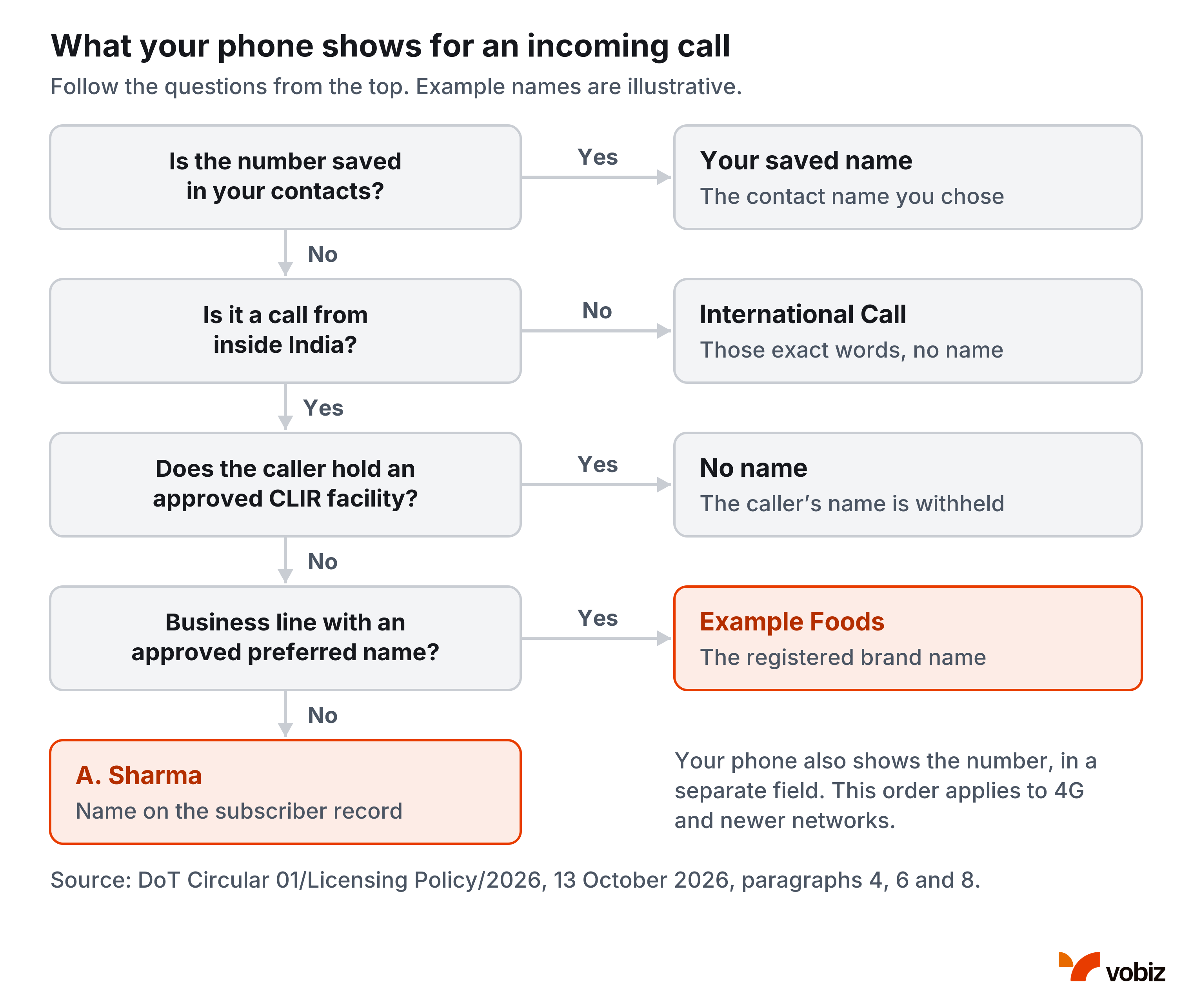
So CNAP changes nothing for people already in your contacts. It matters for the numbers you don't recognize, which is where DoT aimed it. Its 2022 background note to TRAI said the goal was to help people decide whether to answer and to reduce harassment from unknown callers.
Where does the CNAP name come from?
The name comes from the caller's subscriber record at their operator. For most people, that record starts with the customer application form and the KYC check done when the SIM was issued.
No central government directory sits behind this. Each operator keeps a database of its own subscribers, and the receiving operator asks for the name when a call arrives.
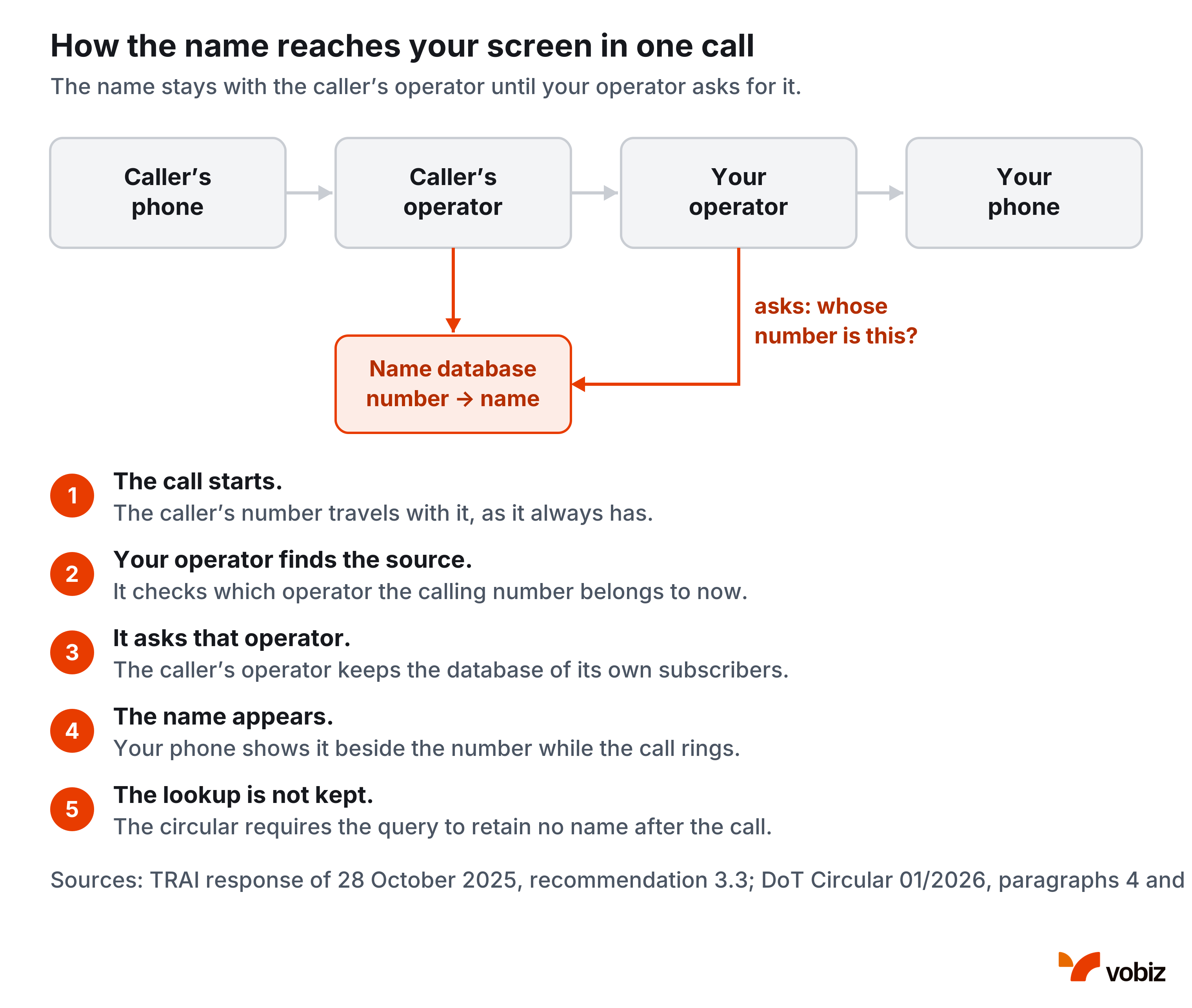
This differs from the system many Americans know. In the US, CNAM relies on carrier-run lookup databases that a business registers a short name in. India ties the name to the operator's verified customer record.
The TRAI model accepted in principle by DoT describes this lookup for today's networks. TRAI expects the name to travel with the call itself once older voice networks are phased out.
Who is covered in India right now?
Coverage depends on the network and the phone. Here's the position as of November 3, 2026.
| Situation | Status | Source |
|---|---|---|
| 4G and 5G mobile networks | Operators instructed to introduce it from November 1, 2026 | DoT circular |
| 2G and 3G networks | To be considered separately | DoT circular |
| Landlines on the public switched network | To be considered separately | DoT circular |
| Your handset | No handset rule in the circular. DoT said this would be taken up with the IT ministry | TRAI response |
Handsets are the practical gap. TRAI wanted CNAP built into every device sold after a cut-off date, and it noted that some phones need software updates and that older ones may be hard to enable. MediaNama points out that the circular is silent on phones, so an individual model may or may not show the name.
Some operators moved earlier. ThePrint reported that private operators were live by the missed March 2026 deadline, while BSNL then expected to need three to four more months.
The start date passed two days before this article was published. We didn't find a DoT or TRAI report on operator-by-operator coverage since then, so expect some unevenness and check again later.
Why did India's rules keep changing?
If you've read conflicting articles, the timeline is why. The question of who has to ask for CNAP changed more than once between 2024 and 2026.
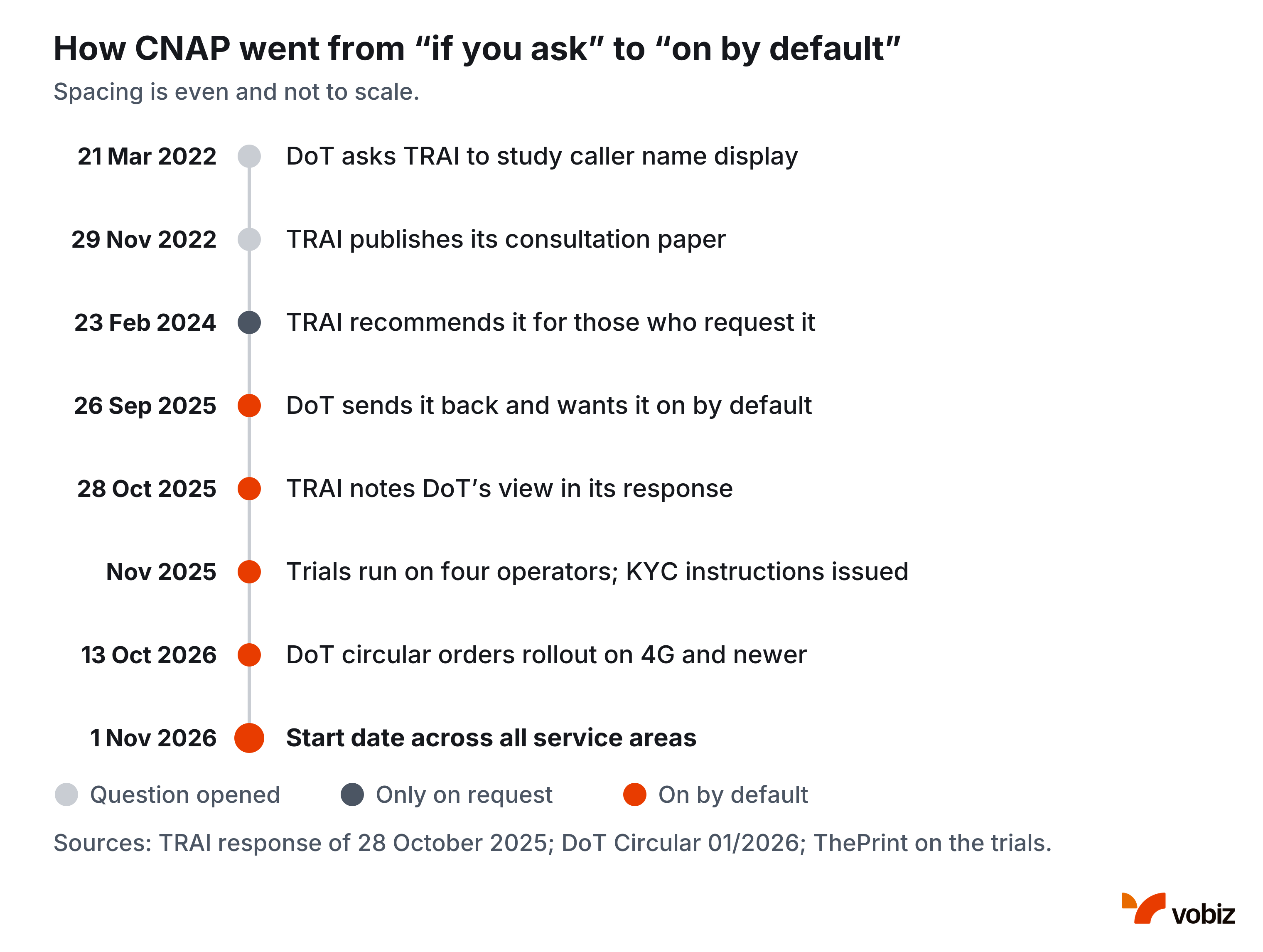
Articles written before October 2026 often quote an older position, including a March 2026 deadline that has now passed. The October circular is the current instruction, and it supersedes DoT's November 2025 KYC instructions.
Can you turn CNAP off?
This is really two questions, and the honest answer to both is "not simply".
Can you stop seeing names on calls you receive? In September 2025, DoT said a user who didn't want the service could ask to disable it, and TRAI noted that view. The final circular doesn't include that option. Both ThePrint and MediaNama read it the same way. Ask your operator, since DoT can still issue further instructions.
Can you stop your name from showing when you call? The circular withholds a name only for users who have availed CLIR "in accordance with extant guidelines". CLIR stands for Calling Line Identification Restriction, and it hides your caller identity.
That facility is harder to get than it sounds. A 2015 TelecomTalk report on the DoT guidelines described this process for ordinary users:
- A written reason, plus identity and address proof.
- A recommendation from a senior state police intelligence officer.
- Physical verification and government approval, valid for 12 months.
The same report said bulk connections, call centers, and telemarketers can't get it. MediaNama described similar limits in October 2026. We read those reports rather than the original guideline, so confirm the current rules with your operator.
Some guides list dial codes and phone settings as a way to hide your name. Don't assume they count as approved CLIR for this purpose. If it matters to you, ask your operator and test it with a friend's phone.
How does network caller name compare with caller ID apps?
They answer different questions, in India and elsewhere. CNAP says who a number is registered to. Apps try to say who the caller is and whether others found the call unwanted.
| CNAP | Caller ID apps such as Truecaller | |
|---|---|---|
| Where the name comes from | The caller's operator record | Mainly crowd-sourced data, which TRAI says may not be reliable |
| What you install | Nothing | An app |
| Spam labels | Not part of the circular | Offered by these apps |
| Who runs it | Telecom operators, under DoT rules | Private companies |
CNAP only presents a name, and the circular doesn't ask operators to block anything. You don't have to choose. If you rely on spam warnings, keep your app and treat CNAP as a second opinion on identity.
Can you trust the name on your screen?
Trust it as a record, not as proof. Four things can separate the name from the person on the line:
- Shared connections. A parent's SIM used by a child shows the parent's name. Operators raised this attribution problem for families and companies.
- Old or wrong records. The KYC details may be out of date. The annexure to DoT's 2025 instructions listed data-entry errors, legal name changes, and ownership transfers as complaint types.
- Scam targeting. MediaNama warns that showing names could also help scammers tailor their approach.
- Business labels. A company name tells you who holds the line, not whether this particular request is genuine.
So keep your usual habits. A familiar name is no reason to share an OTP, a PIN, or banking details. If your own name is wrong, contact your operator, because the circular requires a grievance process for CNAP complaints. MediaNama notes that it sets no specific timeline for resolving them.
What should your business do about caller name display?
Your customers now judge your calls by a name you may never have looked at. In the US, that means registering a CNAM name for each number with the carrier that issued it, keeping it within about 15 characters, and testing on the carriers your customers use. Our CNAM guide covers those steps, and branded calling adds a verified name where it's supported.
In India, the same problem looks different. Fourids makes this point well: the registered holder of a company's number could be an unfamiliar legal entity, a vendor, or an employee. A customer who sees an unfamiliar name may simply not pick up.
The circular offers a route to fix this. An operator may offer a "preferred name" to holders of business or bulk connections.
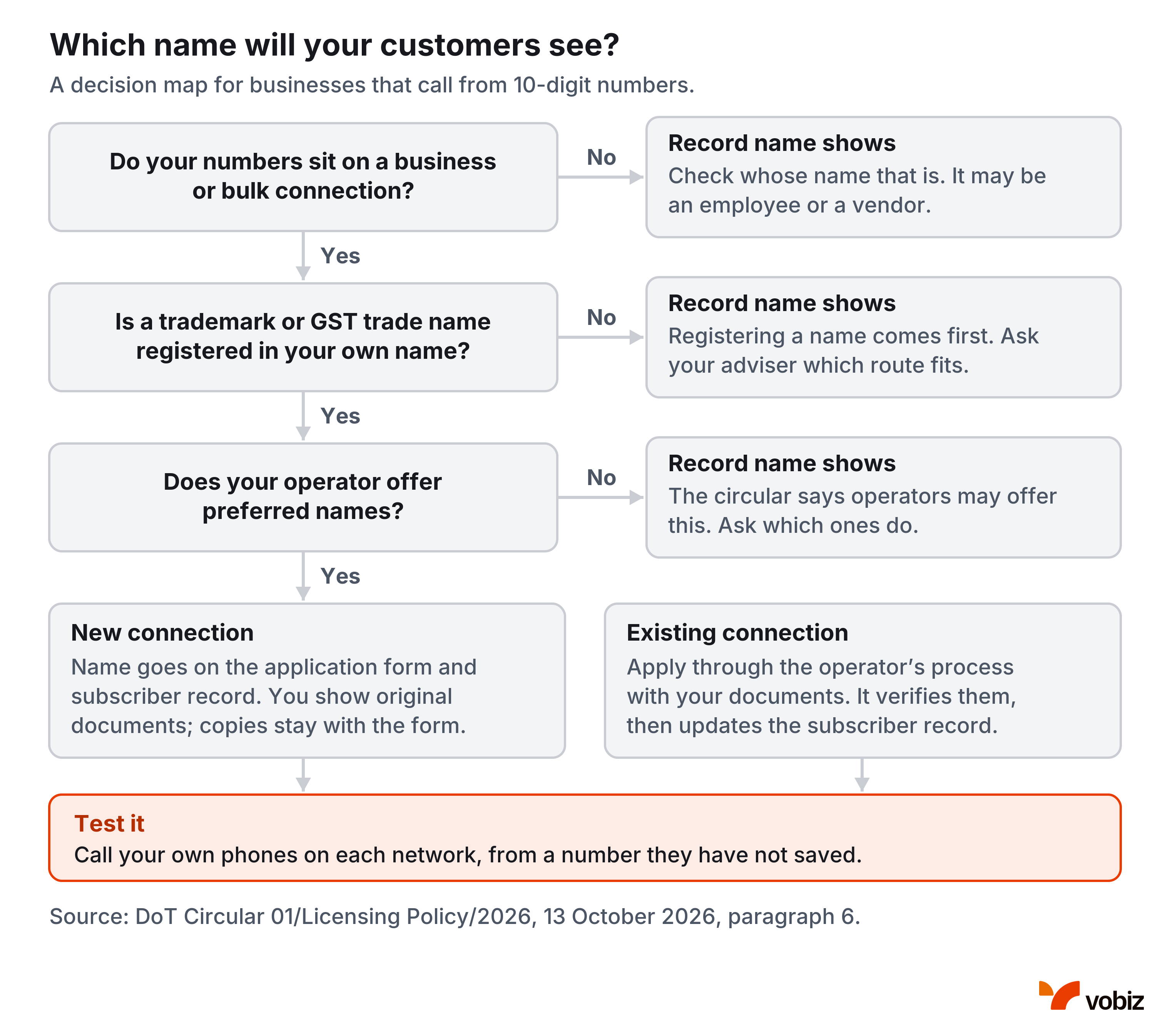
Three decisions follow from that:
| Your situation | What to do first |
|---|---|
| Your team calls from SIMs in employees' names | Move customer calls to connections held by the company, so the record reflects the business |
| Your brand differs from your legal name | Check whether the brand is a trademark registered in your name or a trade name on the GST portal. Those are the two routes the circular allows |
| A vendor or call center dials for you | Ask who holds each number, because the preferred name must be registered in the connection holder's own name. Get legal advice if the holder isn't you |
Don't assume a wired or 160-series number shows a name. The order covers 4G and newer wireless networks, and it leaves the public switched network for later. It doesn't spell out what happens for every business number type. TRAI did recommend that 140-series and service-call numbers always present the entity's name, but the circular doesn't repeat that. Test each number type you use, and ask the provider that issued it.
A name doesn't change the calling rules. You still need the right number series for each call type, and valid consent to avoid unsolicited commercial communication complaints. A clear name may make people more willing to answer, but it doesn't replace either requirement.
To test safely, call only phones you own or have permission to call, from a number they haven't saved. Note what appears on each network, then repeat after any name change.
Vobiz docs for this topic
The setup details for this are in the Vobiz docs:
- India KYC
- India calling regulations page
- Number series FAQ
- Number Health dashboard
- Number Health guide
- Connecting calls in VobizXML
Anything that places calls or sends messages is billed and reaches real people, so run it only with your own credentials after confirming the details.
Frequently asked questions
What is the full form of CNAP?
CNAP stands for Calling Name Presentation. It is a phone-network service that shows the caller's name when the number isn't saved in your contacts. In the US and Canada, the same idea runs as CNAM. In India, the name comes from the caller's operator, so you don't need an app.
Is caller name display mandatory?
It depends on the country. In the US, CNAM is a lookup the recipient's carrier may run or skip. India's Department of Telecommunications told operators to introduce CNAP from November 1, 2026, on 4G and newer networks, without waiting for a user request.
What is the difference between CNAP and CNAM?
Both show a caller's name. CNAM is the North American system, where the recipient's carrier looks the name up in a database during the call, and the name holds about 15 characters. CNAP is the general service name. India's version takes the name from the caller's operator record.
Why is no caller name showing on my phone?
Your contacts may already include the number, or the call may be international. The caller may have restricted their identity, or the carrier may have skipped the lookup. Your phone may also not support the feature, so test on another handset if it matters.
How do I correct the name shown for my number?
Contact the carrier or operator that issued the number, because it holds the record. In the US, that means updating the CNAM entry. In India, every operator must run a grievance process for CNAP complaints, and a qualifying business can apply for a preferred name.
Will network caller names replace Truecaller?
Not necessarily. Network caller name tells you whose name a number is registered under. Caller ID apps add their own data and spam reports, which India's CNAP circular doesn't ask operators to provide. Many people may use both.
Further reading on Vobiz
- What is caller ID and CNAM? · What is a DID number? · Toll-free vs local vs mobile numbers
- India calling regulations · India KYC · UCC management
- 140 and 160 series number guide · Number Health guide
Sources
Other standards and references
- Wikipedia, Calling Name Presentation.
- FCC, Further Notice of Proposed Rulemaking, FCC 25-76, in the Federal Register, 5 December 2025.
- IETF, RFC 9795: PASSporT Extension for Rich Call Data, July 2025.
Indian government and regulators
- DoT, Circular 01/Licensing Policy/2026: Introduction of calling name presentation service in telecommunication networks, 13 October 2026.
- DoT, Instructions for handling anticipated KYC issues during implementation of CNAP, 21 November 2025 (superseded by the circular above; cited for history).
- TRAI, Response to DoT's back-reference on CNAP, 28 October 2025.
- TRAI, Recommendations on Introduction of CNAP Service in Indian Telecommunication Network, 23 February 2024.
News and analysis
- MediaNama, DoT mandates caller name display on 4G, 5G networks from Nov 1, offers no opt-out, 16 October 2026.
- ThePrint, No more unknown callers, govt makes caller name display mandatory from 1 November, 15 October 2026.
- TelecomTalk, DoT issues guidelines for Calling Line Identification Restriction service, 12 April 2015.
- Fourids, CNAP explained: India's built-in caller name, and its blind spot for businesses, 14 October 2026.
- Techmitra, CNAP caller ID explained, 2 November 2026.
Get your Indian calling setup ready — Review the number series, KYC, and consent rules that apply to your calls.
If a voice AI agent is the one calling your customers, Vobiz provides the numbers and SIP trunks it calls from.
About the author
- I'm a Founding Member at Vobiz, telephony for AI voice agents. I write about where voice agents meet the phone network: SIP, phone numbers, latency, echo, barge-in and everything that breaks on real calls but not in browser demos. More at piyushsahoo.me
Comments
Join the discussionNo comments yet. Be the first to comment.