What Is a Call Leg? A-Leg, B-Leg, SIP and Billing
A call leg is one connection between a voice platform and one party. Learn how A-legs and B-legs map to SIP dialogs, billing, webhooks, and compliance rules.
A call leg is one connection between a voice platform and one party, such as a phone, SIP device, or carrier. A two-person call usually has two legs, called the A-leg and B-leg, joined by a bridge. Each leg has its own identifier, events, record, and charge, so you can control it separately.
This guide takes the idea from the SIP layer up to the bill. It counts the legs in common flows, shows where webhooks (callbacks) fire, and lists the compliance rules that depend on how you join legs.
Note: Key takeaways
- A call is what people experience. A leg is what a platform controls, meters, and records.
- "A" means first, not caller. On a call your app places, the A-leg is the person you dialed.
- Count legs by flow. An IVR needs one, a forward needs two, and a conference needs one per member.
- Each answered leg is usually billed separately, so a bridged minute can count on both legs.
- The join can matter for compliance. Some countries restrict where legs run, and automated-call rules can cover legs your API places.
What is a call leg?
A leg is one side of a call as seen by one system in its path. The word is relative, and that explains most of the confusion around it.
Cisco's gateway guide says inbound and outbound call legs are defined from the device's point of view. So the outbound leg from your platform can be an inbound leg for the next carrier. PortaOne's billing docs show how this adds up: a call crossing two gateways, from PSTN to internet and back to PSTN, produces four accounting records, which a shared ID ties together.
When you build on a voice API, you only count the legs on your own platform. That platform stands between the parties and treats each side as its own connection.
Where the term comes from
"Call leg" began as a SIP term. RFC 2543 used it, and RFC 3261 replaced it with "dialog" in 2002, noting that the old name was no longer used in that specification. It also calls a "call" an informal term.
The old wording still shows in RFC 3261's message grammar, which comments status 481 as "Call Leg/Transaction Does Not Exist". SIP still sends that response when a request names a dialog that no longer exists.
The industry kept the word and widened it. Today, "leg" usually means the whole connection and everything attached to it, including its events, record, and cost.
A-leg vs B-leg: what is the difference?
The A-leg exists first. The platform creates the B-leg from it to reach someone else. RFC 3261 doesn't define either label, so these are industry conventions rather than a standard.
| Flow | A-leg | B-leg |
|---|---|---|
| Inbound to your number | The person who called you | The agent or number you dial next |
| API-placed call | The person you dialed first | A third party you bridge in, if any |
| Agent-first click to call | Your agent | The customer |
| Simultaneous ring | The original caller | Each number tried, with one winner |
The second row is the easy one to get wrong. Vobiz's Transfer API glosses aleg as the caller and bleg as the callee, which fits inbound calls. On an API-placed call, the A-leg is the party who received your call, because it's the original call.
The same words differ between platforms
Check the labels whenever you read another system's docs or logs. Which party counts as Leg A can change with the flow, and the fields that link legs vary too.
This table translates the terms, as each source documented them on November 3, 2026:
| System | What it calls a leg | How it links legs |
|---|---|---|
| SIP (RFC 3261) | Dialog | Not reliably across a back-to-back agent, so RFC 7989 adds a Session-ID |
| Vobiz | A-leg and B-leg | bridge_uuid, parent_call_uuid, DialALegUUID |
How many legs does a call have?
The flow sets the count, not the number of people talking. A caller listening to a menu is one leg. Two people talking through a platform are two.
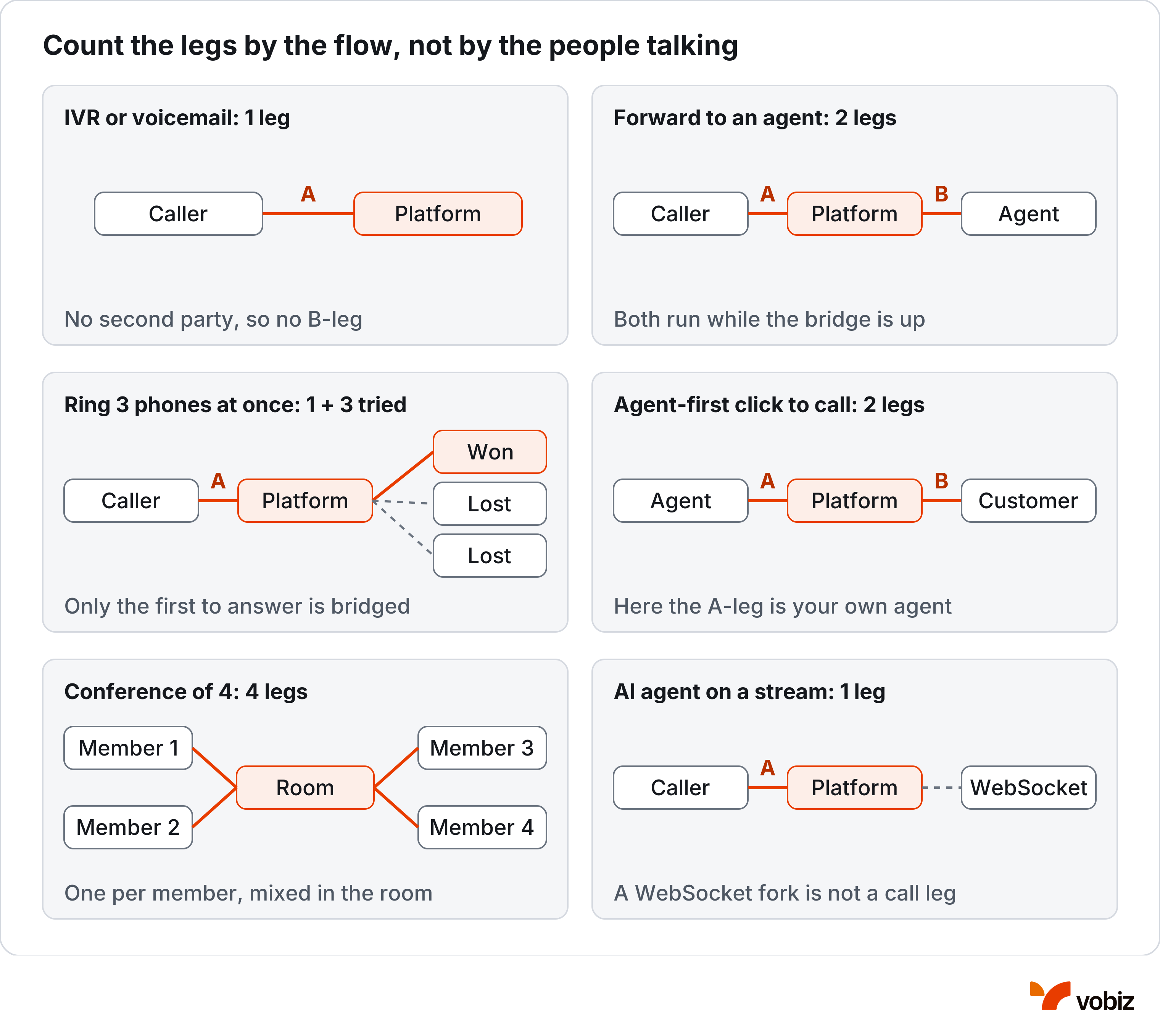
Three of these flows behave in ways worth noting:
- Simultaneous ring creates legs that lose. Vobiz bridges the first answer and cancels the rest. Those report LOSE_RACE with code 9000, which is a normal outcome, so don't alert on it.
- A conference has no A-to-B bridge. Each member's leg joins a shared room, and you can control members one at a time.
- A stream isn't a leg. Stream forks audio to a WebSocket without using Dial, so it creates no B-leg. A CDR reports any streaming_cost separately.
Choosing a flow by its legs
If you're designing a flow, decide what each leg must do for you.
| You need | Flow | Legs | What the extra leg gives you |
|---|---|---|---|
| Automated menu or message | Gather, Speak, or Play | 1 | No extra leg |
| AI agent over a socket | Stream | 1 | No extra leg |
| A SIP destination, such as a PBX or AI agent | Dial with User | 2 | A separate leg with its own events and record |
| Live human on any phone | Dial with Number | 2 | You can reach any number and swap either side |
| Reach whoever answers first | Simultaneous dial | 1 + N attempts | Unanswered attempts carry no charge |
| Three or more people | Conference | 1 per member | Per-member mute, removal, and playback |
Capacity planning starts here too. Plan one channel per agent or simultaneous outbound leg, plus headroom for peaks (concurrency docs).
What does a leg look like in SIP?
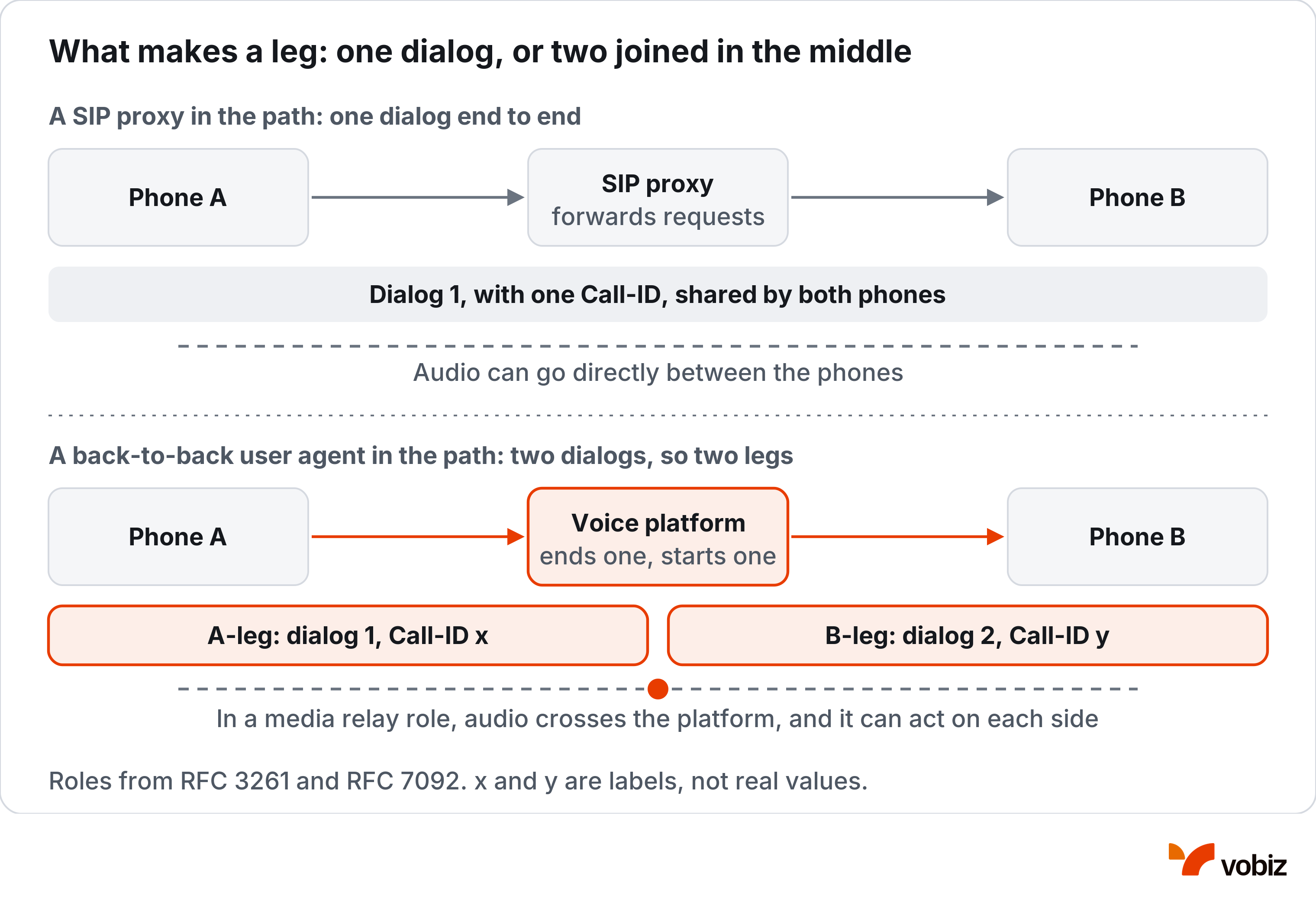
On the SIP side, each leg of a two-party call through a back-to-back user agent (B2BUA) is normally its own dialog. RFC 3261 identifies a dialog by three values: a Call-ID, a local tag, and a remote tag.
Vobiz's hangup cause reference describes the SIP and B2BUA layer beneath its call logs. This position is what makes a leg programmable, because the platform takes part in each dialog separately. It can end one dialog and start another.
Not every B2BUA touches the audio. RFC 7092 sorts them by how much of the call they handle:
| B2BUA role | What it handles | Example from RFC 7092 |
|---|---|---|
| Signalling only | SIP, and the audio path stays elsewhere | An application server handling REFER |
| Media relay | Terminates IP and transport, and copies the payload across | Often the default on a session border controller |
| Media aware | Inspects packets without decoding the codec | An SRTP terminator |
| Media termination | Works at the payload, such as codecs | A transcoder or conference server |
Three debugging habits follow from this:
- Don't join legs on the SIP Call-ID. RFC 7092 says a signalling-only B2BUA doesn't guarantee that any header carries over between sides. RFC 7989 exists partly because border devices deliberately change call identifiers. Use your platform's IDs instead.
- Look at each leg's quality separately. A relay terminates media on both sides, so one bad path may affect only one leg. Vobiz CDRs report mos, jitter, packet_loss, and codec, which you can compare across the two records.
- Expect several early dialogs when a call forks. RFC 3261 lets provisional responses from different destinations create separate early dialogs. Only those that answer can continue, which mirrors the winner and losers in a simultaneous ring.
Where does a leg's time and money go?
Each leg runs its own clock. Here is an illustrative example with two legs, adapted from the transferred-call guide. Pulse lengths and rates vary by provider and route.
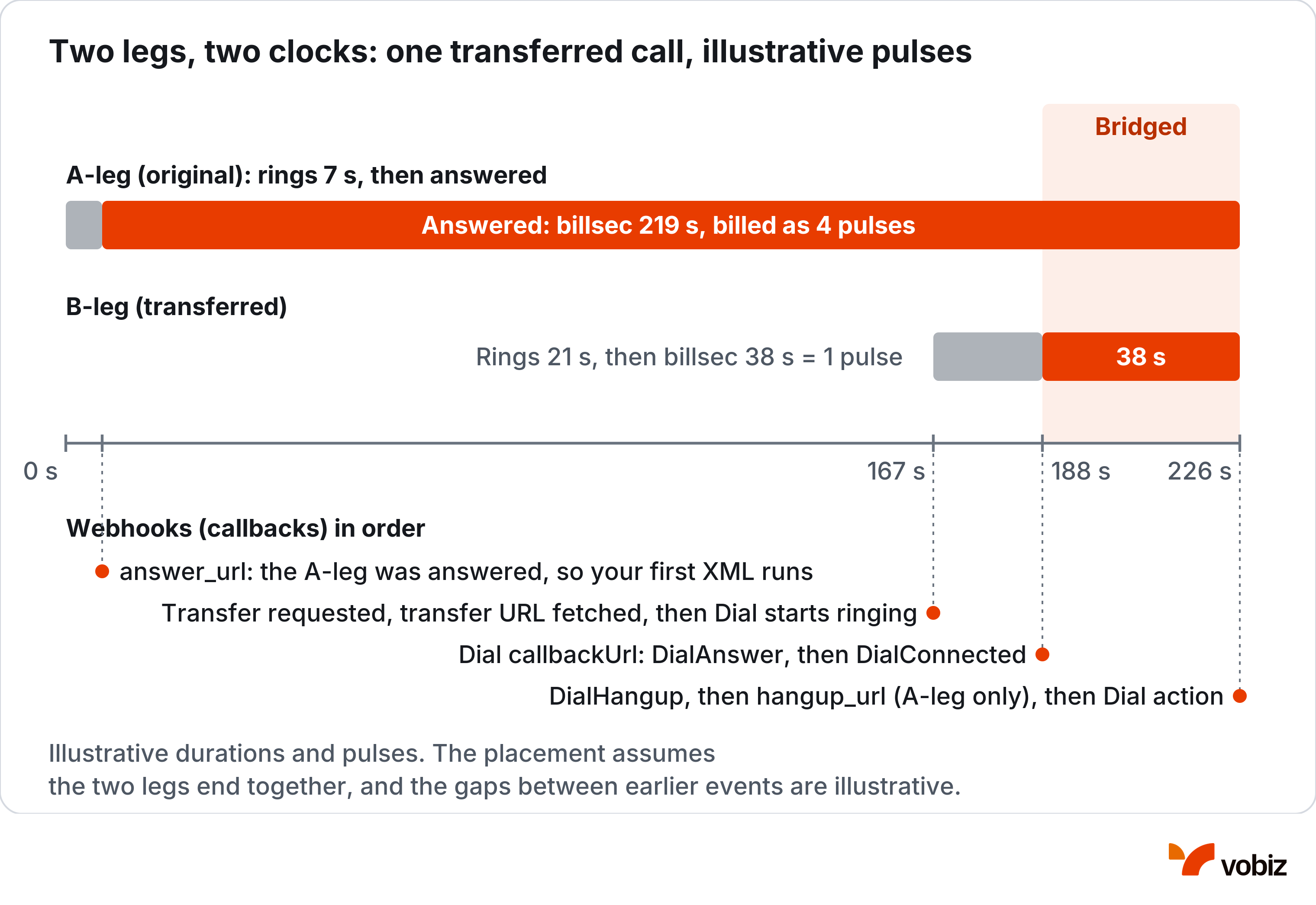
| Leg | Ring time | Billable time | Total duration | Pulses at 60 seconds |
|---|---|---|---|---|
| A-leg (original) | 7 s | 219 s | 226 s | 4 |
| B-leg (transferred) | 21 s | 38 s | 59 s | 1 |
That's five pulses across two legs, on a call that lasted under four minutes end to end. Three rules explain the total:
- The bridge counts twice. The A-leg is billed for its whole life, including the bridged period, and the B-leg for its own.
- Rounding works per leg. A 38-second leg is billed as a full pulse, even though it only spans the final part of the call.
- Ringing is free. Billable time starts at answer, and an unanswered leg gets a record with billsec and cost at zero.
Don't assume another system works this way. Firebrick's documentation, for example, attaches the CDR to the outbound leg and describes moving it when a call is diverted. Ask each provider how it meters legs. For Vobiz rates, see the pricing page.
Which leg should you target?
Start from what should change, then choose the control. Name the leg in every request rather than relying on a default.
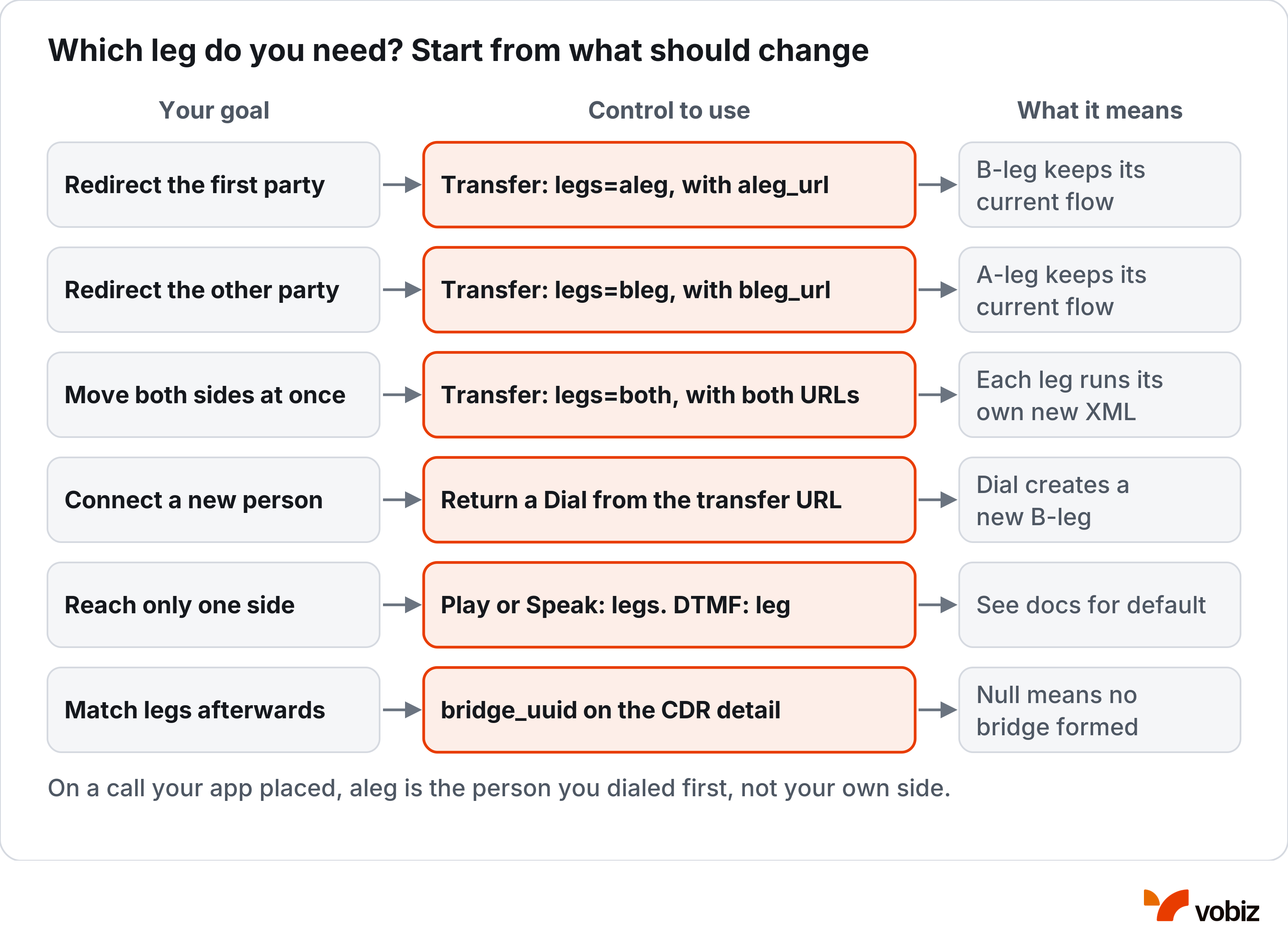
When a multi-leg flow misbehaves, the symptom usually points at one leg:
| What you see | Likely cause | What to do |
|---|---|---|
| A transfer moved the wrong person | The request relied on a default leg (Transfer Call docs) | Set legs on every request |
| A leg drops during a transfer | The transfer URL failed or returned bad XML | Host it reliably and return XML quickly |
| Only one party hears a prompt | Play or Speak targeted only one leg | Pass legs, or leg for DTMF |
| Dial is skipped, with no Dial webhooks | callerId was left out on an inbound flow, so it came from the caller's number | Set callerId to a Vobiz number your account owns or is authorized to use |
| The B-leg's end never reaches your app | hangup_url reports the A-leg only | Add a Dial callbackUrl |
| A recording seems to be missing | Recordings attach to the A-leg CallUUID | Search by the original call's UUID |
| bridge_uuid is null | No bridge formed, as the destination didn't answer | Join on DialALegUUID and DialBLegUUID |
| A call ends with code 2060 | The B-leg would redial the A-leg's number | Fix the routing loop |
Why do call legs matter for compliance?
Some rules turn on where each leg runs and what starts it, so leg design is a compliance question as well as an engineering one. Two patterns come up in many countries:
- Where legs run. Some countries restrict bridging a domestic leg to an international one, or joining public-network legs in two places over your own network, which regulators call toll bypass.
- What starts the leg. Rules on automated calls, such as the US TCPA on prerecorded and artificial-voice calls, can apply to a leg your application places.
If you're in India, both legs of a domestic call, and conference participants, must stay within India (calling regulations, domestic calling FAQ). The hangup cause reference says your server must be in India for India calls, under code 2070, and warns against mixing PSTN and WebRTC members in a conference. TRAI's Third Amendment also treats API-placed legs as A2P calls that need advance declaration, even when an agent joins.
On Vobiz, you set the number shown on a B-leg with callerId on Dial. The calling regulations cover which series fits each call type in India, and 140 and 160 series acquisition covers commercial numbers.
Vobiz docs for this topic
The setup details for this are in the Vobiz docs:
- Vobiz docs introduction
- Call API
- VobizXML
- Make Call
- Webhooks (callbacks)
- Dial webhooks
- Call object
- CDR detail
- Dial
- Transfer API
- Session recording
- Record Calls API
- Machine detection
- Dial transfer visualizer
Anything that places calls or sends messages is billed and reaches real people, so run it only with your own credentials after confirming the details.
Frequently asked questions
What is a call leg in simple terms?
A call leg is one connection between a voice platform and one party. The platform sits in the middle, so a normal two-person call runs as two connections joined together. Each one can ring, answer, fail, and end by itself.
How do the A-leg and B-leg differ?
The A-leg exists first, and the platform creates the B-leg from it to reach another party. On an inbound call, the A-leg is the caller. On a call your app places, the A-leg is the person you dialed first.
Is a call leg the same as a SIP dialog?
Nearly. RFC 2543 used the term call leg, and RFC 3261 replaced it with dialog. Platforms now use leg more loosely, for the whole connection and its records. A platform leg usually maps to one dialog on its SIP side.
How many legs does a conference call have?
A conference has one leg per participant, so a five-person conference has five legs. Each leg connects to a shared room instead of being bridged to one other party. That lets you mute or remove one member without touching the rest.
Are both legs of a forwarded call billed?
Usually, when both are answered: each leg is rated on its own billable time, so the bridged period counts on both. Check your provider's billing docs.
Why would you transfer only one leg?
You transfer one leg to change one party's next step and leave the other on its current flow. Target the A-leg or B-leg and supply that leg's instructions (Transfer Call docs). Use both only when each side needs new instructions.
Further reading on Vobiz
- Transferred calls end to end · Dial status reporting · Hangup causes
- What is SIP? · What is a voice API? · Context-aware call transfers
Sources
Standards
- IETF, RFC 3261: SIP: Session Initiation Protocol, June 2002.
- IETF, RFC 7092: A Taxonomy of Session Initiation Protocol (SIP) Back-to-Back User Agents, December 2013.
- IETF, RFC 7989: End-to-End Session Identification in IP-Based Multimedia Communication Systems, October 2016.
Indian regulators and legal updates
- DoT, Revised Guidelines for Other Service Providers, 23 June 2021.
- TRAI, Third Amendment Regulations, 2026, 18 September 2026.
- Khaitan & Co, Update on the principal telecommunication services authorisation rules, June 2026.
Vendor documentation, all read on November 3, 2026
- Cisco, Understanding inbound and outbound dial peers on Cisco IOS platforms.
- PortaOne, xDR calculation.
- Firebrick, Call Data Records.
If one of your call legs is a voice AI agent, Vobiz provides the SIP trunks and numbers that connect it.
About the author
- I'm a Founding Member at Vobiz, telephony for AI voice agents. I write about where voice agents meet the phone network: SIP, phone numbers, latency, echo, barge-in and everything that breaks on real calls but not in browser demos. More at piyushsahoo.me
Comments
Join the discussionNo comments yet. Be the first to comment.