What Is Call Tracking? How It Measures Marketing by Calls and Sales
Call tracking shows which ad, listing, or page made your phone ring. Learn how it works, which setup to choose, what to measure, and the local rules that apply.
Call tracking is a way to find out which advertisement, listing, or web page made a customer phone your business. You give each marketing source its own phone number, forward those numbers to your normal line, and record which one was dialled. You can then compare marketing by calls and sales, not clicks.
This guide explains the idea in plain language, helps you pick the simplest setup that answers your question, and shows how local rules change the setup.
Note: Key takeaways
- The number dialled is the evidence. Each source gets its own number, so the number reveals where the call came from.
- Start with fixed numbers. One number per source works for print, hoardings, listings, and most small ad budgets.
- Cost per call can pick the wrong winner. Our illustrative example gives three different winners for cost per call, per good call, and per sale.
- Google's forwarding numbers cover Google Ads only. In some countries, including India and Japan, Google's reports also leave out the caller's number.
- Tracking numbers receive calls. Sales calls back to a lead are regulated separately in many markets, so plan them before you launch.
What does call tracking tell you?
Web analytics can tell you that someone clicked an ad. It usually can't tell you that the same person rang you ten minutes later and placed an order. Call tracking fills that gap.
A basic setup answers five business questions:
- Which ads, listings, and offline campaigns make the phone ring?
- Which of those calls turn into real enquiries and sales?
- Which sources send calls that your team misses?
- When do calls arrive, so that you can staff those hours?
- Which channel can lose budget without losing sales?
It doesn't tell you everything. Suppose someone sees your newspaper ad, searches your name on Google, and rings the number in your Google ad. Call tracking will credit Google, even though the newspaper started it. Ruler Analytics shows a similar multi-visit journey and argues that basic tracking alone can't see every step. Treat each result as strong evidence, not a complete story.
How does call tracking work?
Think of it as a separate front door for each campaign, with every door leading to the same reception desk.
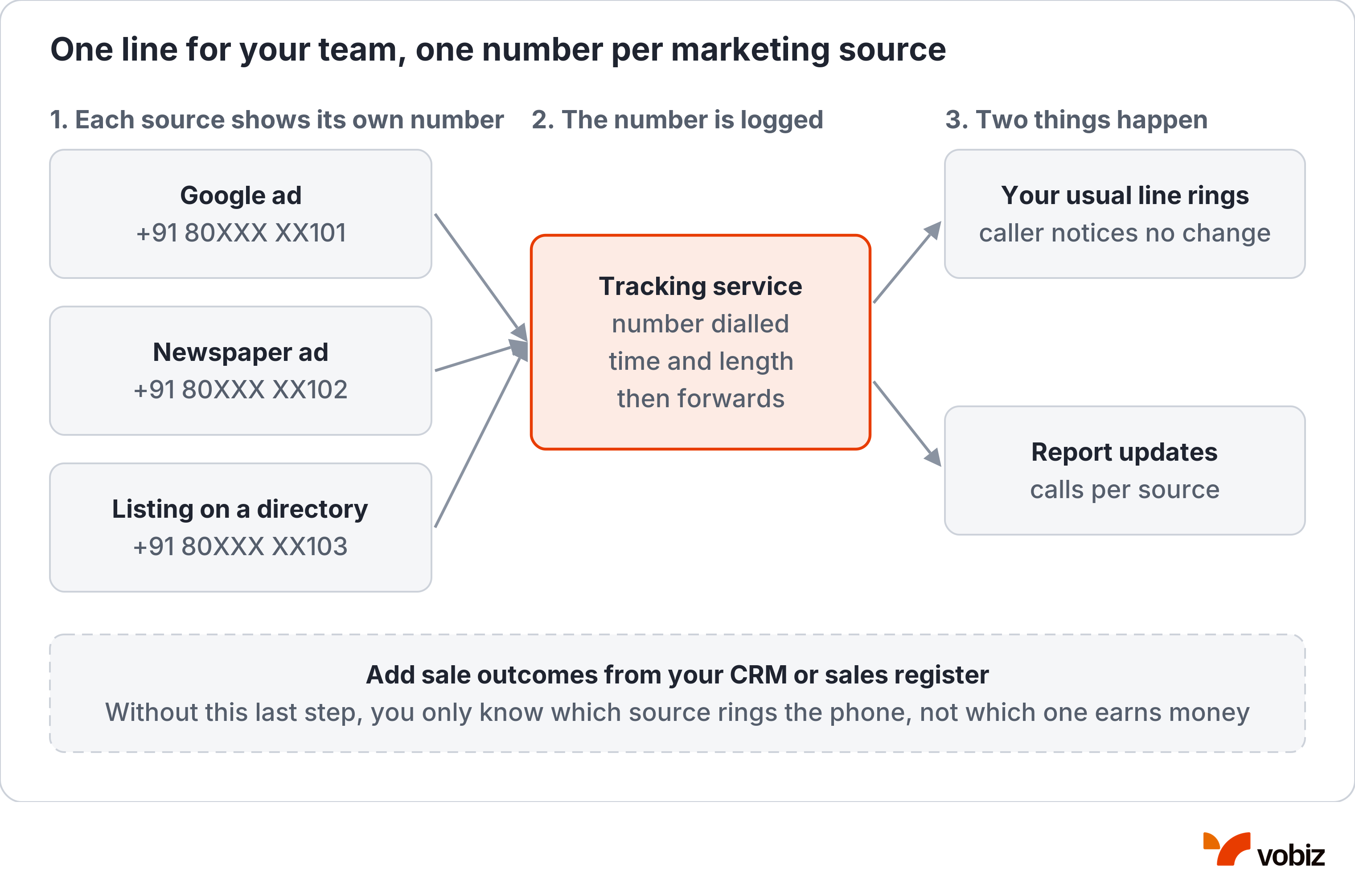
- You assign numbers. You rent a separate virtual number for each source you want to measure.
- A customer dials one. The caller sees an ordinary phone number and notices nothing unusual.
- The system records the call. It stores the number dialled, the time, and how long the call lasted.
- Your team answers. The call routes to your usual line, so nobody needs a new handset.
- You add the outcome. Your team marks the call as a sale, a lead, or neither, and that record lets you compare channels on money.
The fifth step takes the most discipline, and it's the one that changes budget decisions.
Which setup do you need?
Vendors usually offer two choices. PowerChord splits tracking into static and dynamic, and others split it into campaign level and keyword level. In practice, you have four levels, and most businesses should start at the second.
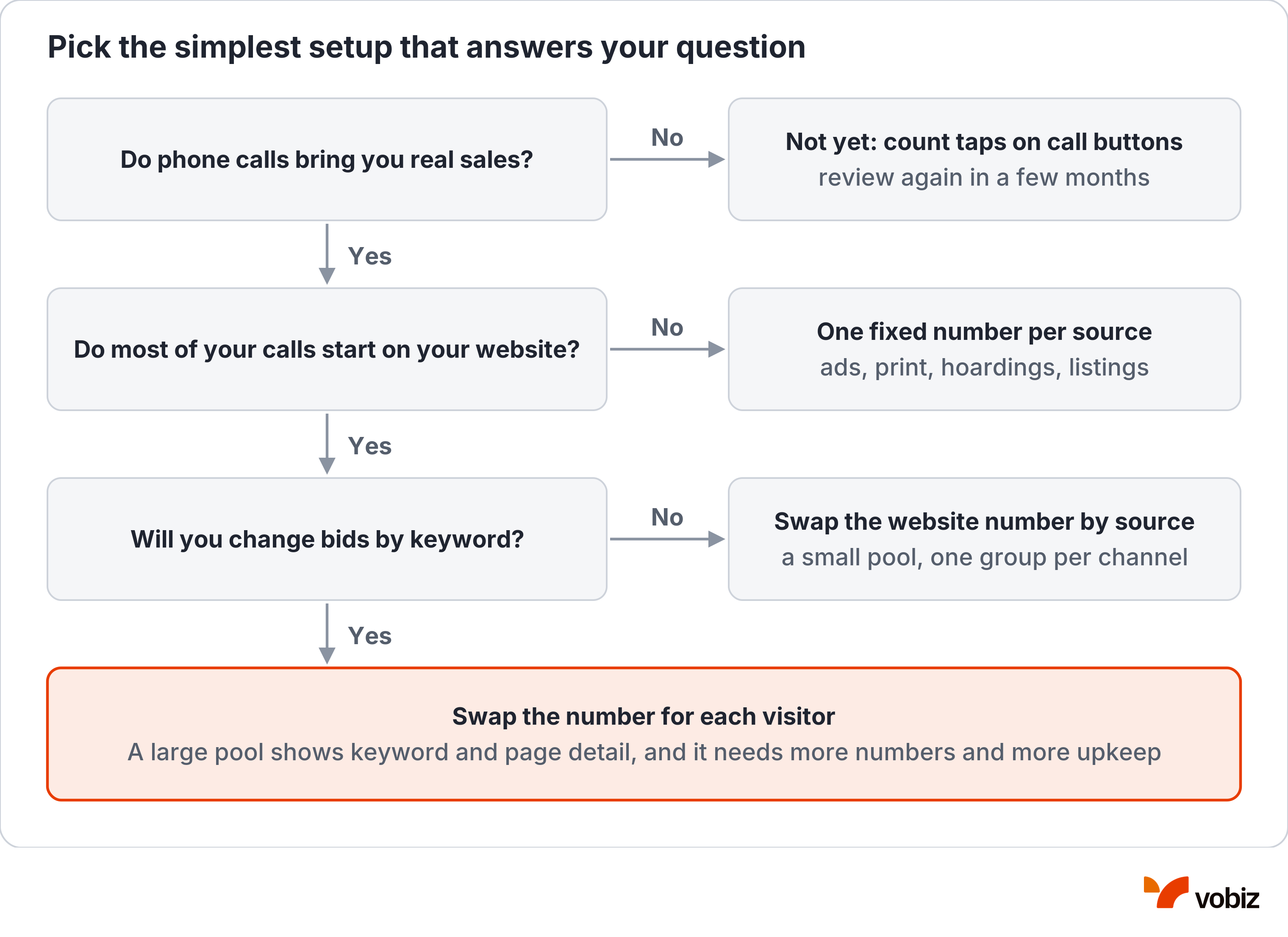
| Level | How it works | Answers | Watch out for |
|---|---|---|---|
| Count taps | Your website records taps on its call button | How many people tried to call | Google notes that this method tracks clicks, not the calls themselves |
| One fixed number per source | A different number appears on each ad, poster, or listing | Which channel rings the phone | A reused flyer keeps ringing that number long after the campaign ends |
| Swap by source | A script changes your website's number based on where the visitor came from | Which online channel drives calls from your site | Someone may save the number and call again later, which credits the first source |
| Swap per visitor | A pool of numbers lets each visitor see their own for a while | Which keyword or page led to the call | You need many more numbers, and pool upkeep becomes real work |
Number swapping is known as dynamic number insertion, or DNI. It works only on websites, because a hoarding can't change its number for each person walking past.
Skip call tracking for now if calls are rare, or if you have one marketing channel and no plan to add another. You'd collect data without a decision to make.
How many tracking numbers do you need?
For fixed numbers, count your sources. If you run Google Ads, Facebook ads, two newspapers, and one directory listing, you need five numbers. A separate number for each creative or size of ad only helps if you'll act on the difference.
Per-visitor tracking needs arithmetic, because each visitor holds a number for a set time after they arrive. We call this the hold time:
Numbers needed = peak visitors per hour × hold minutes ÷ 60
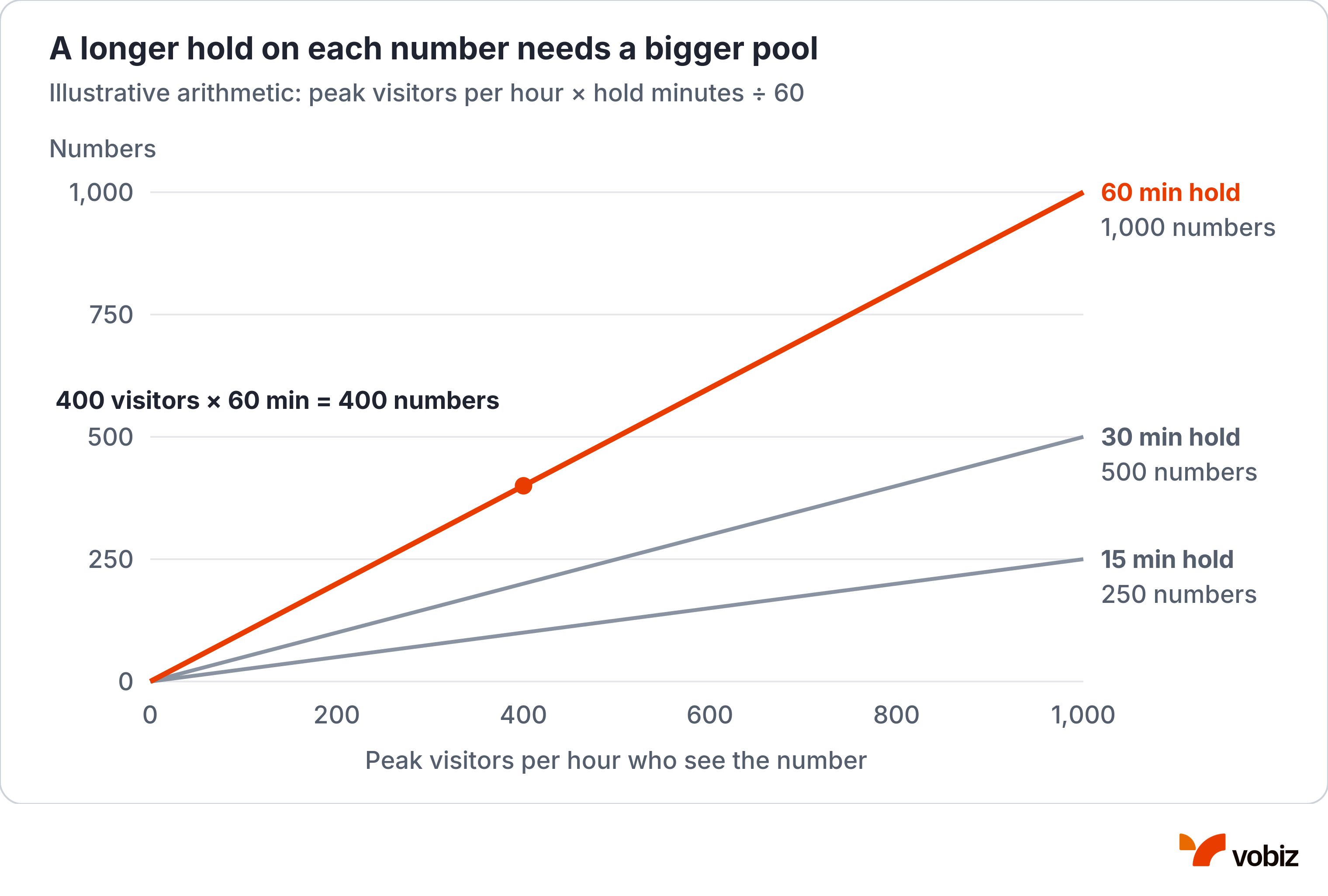
So 400 visitors in your busiest hour with a 60-minute hold means 400 numbers. A 15-minute hold cuts that to 100, but it creates a different risk. Someone who rings after the hold ends may reach a number that another visitor has since seen, which can credit the wrong source.
This is our own simplified calculation, and it assumes that every visitor gets a number. Your provider may reuse numbers differently, so ask how they handle calls that arrive after a hold ends. Every number in a pool adds monthly rent, which is a good reason to start with source-level tracking.
What should you measure?
Count the outcome you can spend money against. The further down this list you can measure, the safer your budget decisions become.
| What you count | What it proves | How it can mislead you |
|---|---|---|
| All calls | The source rings your phone | It includes wrong numbers, spam, and job seekers |
| Missed calls | You lost a chance to talk | A poor result may reflect staffing rather than the ad |
| Calls past a set length | A conversation took place | A long complaint can look like a strong lead |
| New callers | The source reaches new customers | Existing customers may be calling too, so split first-time and repeat callers, as PowerChord suggests |
| Qualified calls | Your team judged it a real enquiry | It depends on staff marking calls consistently |
| Sales and revenue | The channel earns money | Long sales cycles delay the answer |
Now look at why this matters. The chart below uses invented figures for one month of equal spending on three channels.
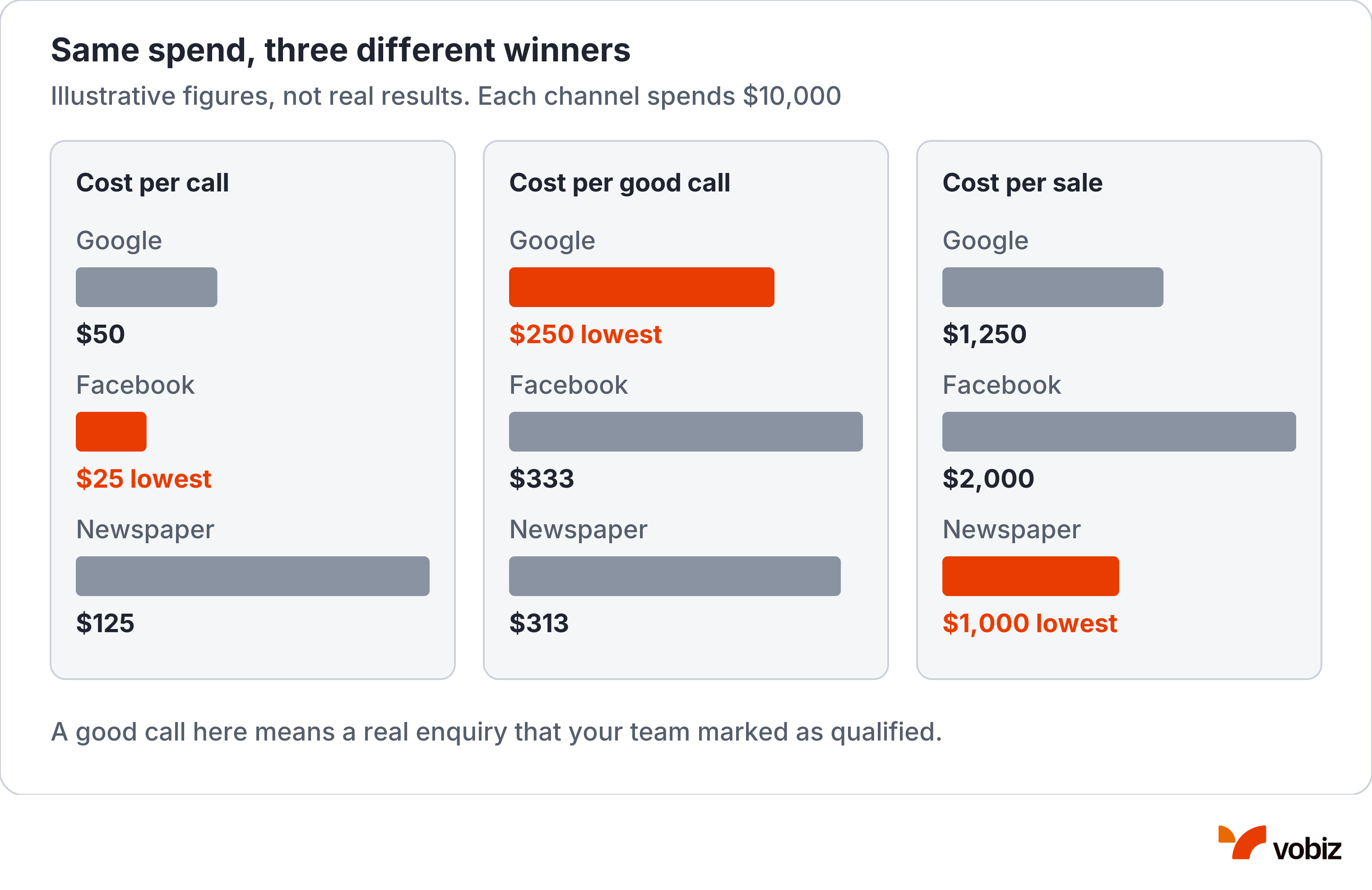
| Illustrative channel | Calls | Good calls | Sales |
|---|---|---|---|
| Google search | 200 | 40 | 8 |
| 400 | 30 | 5 | |
| Newspaper | 80 | 32 | 10 |
A manager who judges by cost per call moves money to Facebook, and one who judges by sales moves it to the newspaper. Neither should move everything yet, because 10 sales against 8 could easily be chance in a single month. Collect several months before you make a large change.
How to decide what counts as a good call
Google lets advertisers count a call as a conversion when it reaches a minimum length that they choose. That's a useful start, but it's still a stand-in for real interest. Pick your threshold by listening to a sample of your own calls. A clinic booking may take less time than a property enquiry, so don't copy someone else's number.
Automatic transcription and scoring can reduce the listening. If your callers mix languages in a single sentence, test any scoring tool on your own calls before you trust its grades.
How do you keep local search accurate?
Your real number should stay the public face of your business, while tracking numbers do the measuring.
- Google Business Profile. Google's guidelines ask for a number that connects to your location and is under your direct control. They also say not to provide numbers that redirect users to numbers other than the actual business's, and they don't address tracking numbers by name. Some guides assign a tracking number to a profile. The safer default is to keep your real local number as the main one.
- Your website. With number swapping, keep the real number in the page and change only what visitors see. PowerChord recommends this to keep your business details consistent for search engines.
- Directories. Keep your name, address, and main number consistent wherever customers look you up. If a paid directory listing needs measuring, ask whether a separate number is allowed under its terms.
- Print and outdoor. Use a number you plan to keep. A poster can outlast its campaign by months, so don't release that number soon after the campaign ends.
Should you use Google's call reporting or separate numbers?
If Google Ads is your only channel, Google's built-in option may be enough. When you turn on call reporting, Google assigns a forwarding number to your ad and reports call length, start time, and whether the call connected.
| Google forwarding numbers | Numbers your business rents | |
|---|---|---|
| What it measures | Calls from your Google ads and from your website after an ad click | Any source, online or offline |
| Who controls the number | Google, which can change or reassign it | Your business, as long as you keep renting it |
| Print and outdoor | Not permitted | Yes |
| Caller's number in reports in some countries | Not available | Available in your own call records, subject to your privacy duties |
| Linking calls to sales | Import conversions from another system, which Google says requires its forwarding numbers | Your own CRM or sheet |
You can also mix them, with Google's numbers on your Google ads and your own numbers everywhere else. To show your own number on the ads too, Google says you can turn off call reporting, though Google Ads then stops tracking those calls. Either way, avoid counting one call twice when you compare reports.
What changes by country?
Most of the ranking guides we read were written for US or UK advertisers. These points vary by country, so check each one for the markets you advertise in. India appears often because several of its rules differ.
| Issue | What the source says | What to do |
|---|---|---|
| Caller numbers in Google reports | Google reports the caller's number on most calls longer than 15 seconds, with India and Japan excluded | Don't plan to match Google's reports to customers by phone number |
| What your staff see | Some countries, India among them, carry a note in Google's country table: a Google number can appear as Caller ID in place of the customer's own on certain calls | Have staff ask for the caller's number during the call |
| Late calls to Google's numbers | A first call can fail to connect if it comes more than about 30 minutes after the ad view, or about 2 hours in some markets. Google calls this rare | Show your own number wherever someone may save it for later |
| Special number series | Some regulators reserve series for business calls. In India, TRAI mandates 140xx for promotional calls by any sector, and 1600xx for service and transaction calls by regulated financial firms and government bodies. On Vobiz, both series are outbound only | Use regular inbound numbers for tracking, and treat these series as your outbound setup |
| Sales callbacks | Telemarketing rules, such as the US TCPA, often cover calls back to leads. In India, TRAI's 2025 amendment restricts normal 10-digit numbers for telemarketing and points promotional calls to the 140 series | Decide which number and consent record you'll use before your team calls leads back |
| Do-not-call registries | The US National Do Not Call Registry and the UK's TPS let people refuse sales calls. In India, customers can block promotional calls by sector on the DND registry | Don't assume that a past enquiry allows every future sales call. Check this with your legal adviser |
| Caller data | Privacy laws such as the EU's GDPR and India's DPDP Act cover data about an identifiable individual, and that can include phone numbers and recordings | Collect only what you'll use, limit access, and set a deletion period |
If you record calls, tell callers before the recording starts, and read our guide to compliant call recording. If you're in India, most duties under the DPDP Rules, 2025 start in May 2027. These rules change often, and this section isn't legal advice.
How do you start without overbuilding?
You can run a useful first test with a small number of phone lines and a spreadsheet.
- List your spending. Write down each channel and its monthly cost.
- Choose your top sources. Pick three to five that together take most of the budget.
- Assign one number each. Keep one channel untouched if you want a simple comparison.
- Test each number. Ring each one yourself and confirm that it reaches the right team.
- Define a good call. Agree with sales on the threshold and the marks they'll use.
- Review on a schedule. Compare cost per sale monthly, and act only on consistent patterns.
Vobiz docs for this topic
The setup details for this are in the Vobiz docs:
- Buying numbers
- My Numbers
- Application
- Inbound SIP trunk
- Call request parameters
- Connecting calls in VobizXML
- Call detail records
- CSV export
- Webhooks (callbacks)
- CRM integration
- Post-call analytics
- Recording APIs
- Sub-accounts
- KYC
Anything that places calls or sends messages is billed and reaches real people, so run it only with your own credentials after confirming the details.
Frequently asked questions
What is call tracking in simple terms?
It tells you which piece of marketing made someone phone you. Each ad or listing shows its own number, and every number rings your usual line. When a call arrives, the number dialled reveals its source, so you can compare channels by calls and sales.
How do static and dynamic call tracking differ?
Static tracking prints one fixed number on each source, such as a newspaper ad or a hoarding. Dynamic tracking uses a website script to change the number a visitor sees, based on how they arrived. Use static for offline sources and dynamic for detail on website traffic.
Does call tracking hurt local SEO?
It can if your real number disappears from public listings. Keep your real local number as the main one on your Google Business Profile and directories. On your website, swap only the number a visitor sees and leave the real number in the page's source.
Can I print a Google forwarding number on a hoarding or newspaper ad?
No. Google says its forwarding numbers belong to Google, can change or be reassigned, and shouldn't be promoted outside Google Ads. For print, outdoor, and other offline sources, use a number that your own business rents and controls.
Is call tracking legal?
Separate numbers for measuring marketing are a normal business use, but the data and follow-up calls carry duties. Treat caller numbers and recordings as personal data under your privacy law, such as the GDPR or India's DPDP framework, and follow local telemarketing rules for sales callbacks. Take legal advice for your own setup.
How long should a call last to count as a lead?
No single length suits every business. Listen to a sample of your own calls, find the point where real enquiries begin, and set that as your first threshold. Then check it against sales every few weeks, because a long complaint can look like a good lead.
Further reading on Vobiz
- What is a virtual phone number? · What is a DID number? · Toll-free vs local vs mobile numbers
- What is call routing? · What is an IVR? · What is number masking?
- Post-call analytics · Call detail records · India calling regulations
Sources
Indian regulators and government
- TRAI, Press release 91/2026 on the 1600 and 140 series, 10 July 2026.
- TRAI, Press release 11/2025 on the TCCCPR amendments, 12 February 2025.
- MeitY, Digital Personal Data Protection Rules, 2025, November 2025.
- Government of India, Digital Personal Data Protection Act, 2023, August 2023.
Google help pages (read 3 November 2026)
- Google Ads Help, Google forwarding number.
- Google Ads Help, About call reporting.
- Google Ads Help, About phone call conversion tracking.
- Google Ads Help, View details of each call.
- Google Business Profile Help, Guidelines for representing your business on Google.
Industry and legal commentary
- The Privacy Labs, DPDP 13 November 2026: What Actually Starts (and What Does Not), October 2026.
- MirvoLegal, DPDP Rules, 2025: Compliance Timeline for Data Fiduciaries, September 2026.
- SS Rana & Co, MeitY plans to cut short DPDP compliance timeline, February 2026.
- Ruler Analytics, Complete guide to phone call tracking, October 2022.
- PowerChord, What is call tracking?, August 2025.
Set up your first tracking number on Vobiz — Buy a number, route it to your team, and start comparing marketing sources by real calls.
If some of those tracked calls are answered by a voice AI agent, Vobiz provides the phone numbers and SIP trunks behind it.
About the author
- I'm a Founding Member at Vobiz, telephony for AI voice agents. I write about where voice agents meet the phone network: SIP, phone numbers, latency, echo, barge-in and everything that breaks on real calls but not in browser demos. More at piyushsahoo.me
Comments
Join the discussionNo comments yet. Be the first to comment.