What Is an IVR Number? Meaning, Types and How to Choose
An IVR number is a phone number answered by an automated menu. Learn what it means, which number type suits your business, and how many lines you need.
An IVR number is a phone line your business publishes, answered by an automated voice menu instead of a person. When someone calls, the menu greets them, takes a key press or spoken reply, then sends them to the right team or gives them the answer. IVR stands for interactive voice response.
This guide explains what the term means, what to do if an IVR call just rang your phone, and how to pick the right number for your business. It also shows how many lines you need and which rules change if the number calls customers.
Note: Key takeaways
- An IVR number is two decisions, not one: the number callers dial and the menu that answers it.
- The number type decides who pays. With toll-free you pay for the call, while shared-cost numbers put some or all of the cost on the caller.
- Plan for your busiest hour. In our illustrative example, 300 two-minute calls in an hour need about 18 lines, not 10.
- Calling customers is a separate question. Rules on commercial and automated calls can decide which number you may use.
- An unexpected IVR call about your money deserves suspicion. Hang up and call the official number yourself.
What does IVR number mean?
An IVR number is any phone number with an automated menu behind it. The distinction is useful: the number is the entry point, and the IVR system is the technology behind it.
That distinction matters when you buy. Numbering plans don't usually have a separate IVR category. India's TRAI numbering recommendations of February 2025, for example, describe categories such as free phone and universal access numbers. In practice, you pick an ordinary number type and then connect a menu to it.
People use the phrase in three ways, so check which one you need:
| What you're looking for | What the phrase means | Where to go |
|---|---|---|
| A number for your business | A number that opens a menu when customers call | Choose a number type |
| An explanation of a call you received | An automated call that asked you to press a key | Check the call |
| A company's helpline | The menu line of your bank, telecom provider, or retailer | The company's official website, app, or card |
If you want the wider picture of the technology, read what an IVR is.
What happens when someone dials an IVR number?
The caller passes through the number, then the menu, then one of a few outcomes. Each option should lead somewhere useful, including the path for callers who press nothing.
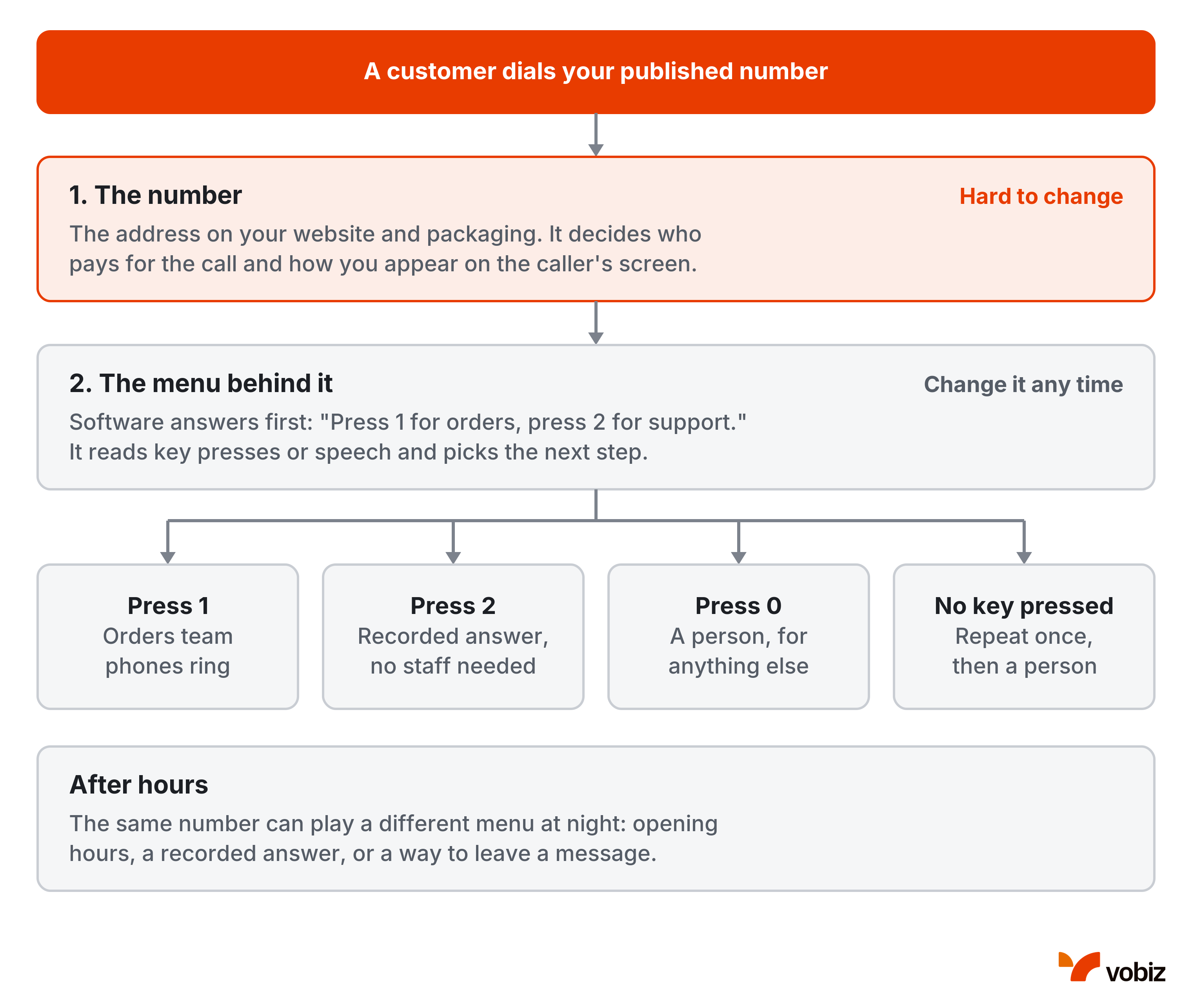
The two layers age differently, and this shapes how you should buy:
- The number is hard to change. It ends up on your website, packaging, and invoices, and in customers' phones. Choose it with care.
- The menu is easy to change. You can reword it, add a language, or remove an option as you learn what callers want. Launch a simple version and improve it.
What does IVR call mean if one just rang you?
An IVR call is a call handled by a recording or synthetic voice that responds to your key presses or speech. Many are routine, such as a delivery update you expected. Some are fraud.
In one case Digit reported in January 2025, a woman got a call from a number that appeared to be her bank. A recording told her that money was leaving her account and asked her to press 1 to report it. She pressed 1 and later found about ₹2 lakh debited. A familiar name on your screen and a professional voice don't prove who is calling.
If you receive a call like this, take these steps:
- Don't act inside the call. Hang up, and don't share an OTP, PIN, or card details.
- Call back on a number you trust. Take it from your bank's app, website, or card, not from the call or a search result you haven't checked.
- Report it. Tell your bank and your country's fraud reporting service. In the US, that's the FTC at reportfraud.ftc.gov. If you're in India, use the Chakshu service on Sanchar Saathi within 30 days.
- If you lost money, act at once. Call your bank straight away. In India, the cyber crime helpline is 1930.
The number can also tell you something. Some countries reserve series for business calls. If you're in India, 140xx numbers are for promotional calls, and 1600xx numbers are for service calls from financial and government bodies.
Which type of number should an IVR use?
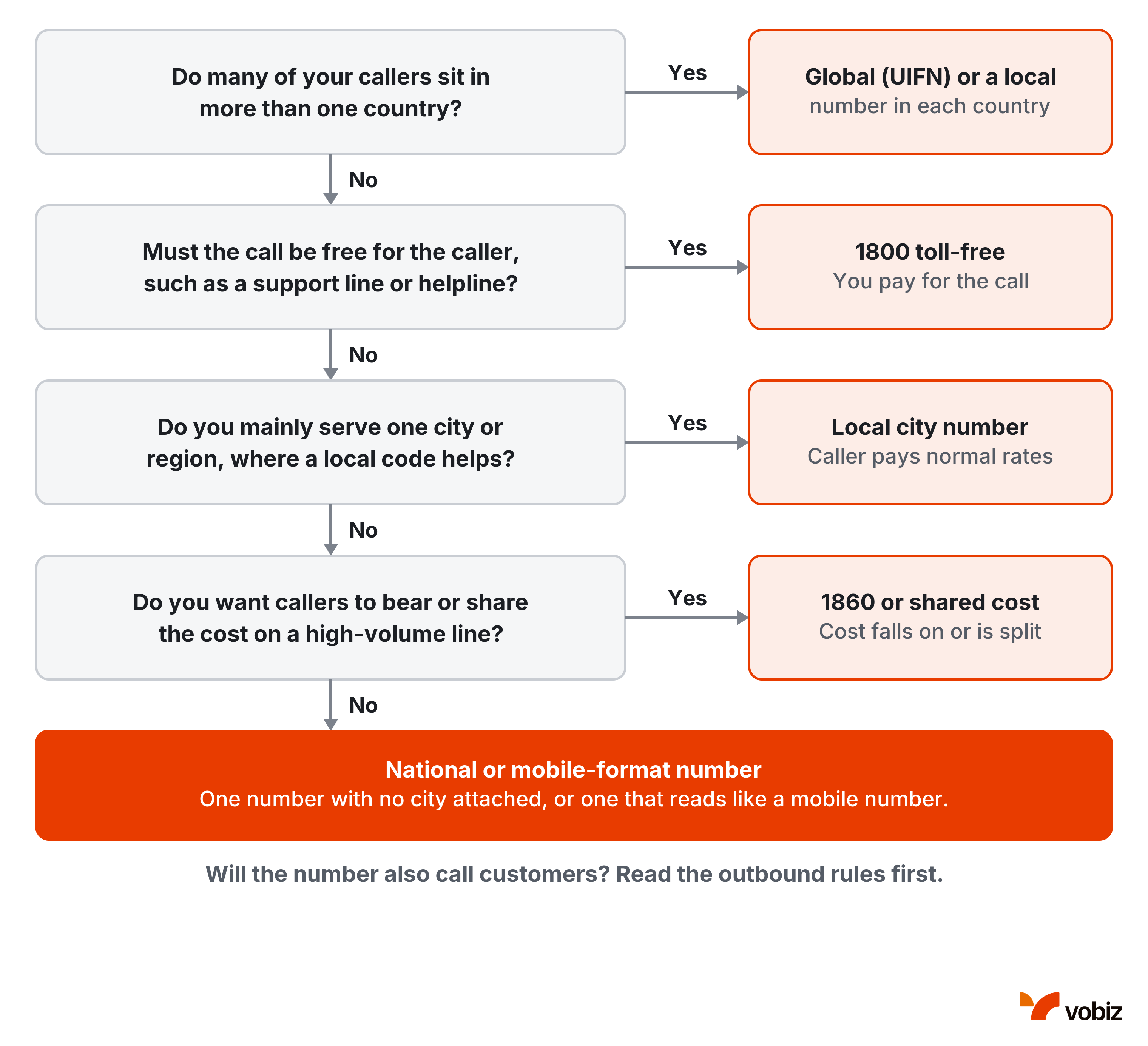
Start with who should pay for the call, then consider how the number looks to callers. These are the common options:
| Number type | Who pays for the call | How it reads | Good fit |
|---|---|---|---|
| Toll-free (800 in the US, 0800 in the UK, 1800 in India) | You. TRAI describes the called party bearing all expenses | A free helpline | Support lines where any charge would put callers off |
| Shared cost or universal access (such as 1860 in India) | The caller, or caller and business together, according to TRAI | A national business line | High-volume service lines |
| Local city number | The caller, at normal rates | A business in that city | Clinics, schools, and shops serving one area |
| National number | The caller, at normal rates | A business with no city attached | Businesses that serve the whole country |
| Mobile-format number | The caller, at normal rates | A personal mobile number | Small teams where a mobile number feels natural |
| Global (UIFN) | You, in the countries it covers | One freephone number across countries | Support desks serving several countries |
Your provider may also bill you for call minutes on any of these. Setup fees, subscriptions, and per-minute charges are the usual costs, so ask for all of them in writing. Use this map to narrow your choice:
Your menu length has a price on toll-free
With toll-free, you pay for the time callers spend listening to the menu, provided your provider bills from the moment the IVR answers. Check that with your provider. Here's an illustrative example:
- Calls: 5,000 a month.
- Menu length: 40 seconds before the caller reaches a person.
- Result: about 3,333 minutes a month spent in the menu alone.
Cutting the menu to 20 seconds would save about 1,667 of those minutes. Callers also get to the point faster, so a shorter menu helps twice.
For a closer look at number types, read about virtual phone numbers and DID numbers.
Can the same number call your customers?
Don't assume it can. Inbound and outbound calls raise different questions. When customers call you, the choice is mostly commercial. When you call them, the rules on commercial and automated calls decide which number you may use and how. In the US, for example, the TCPA restricts prerecorded and artificial-voice calls made without consent. Rules change often, so confirm the current text and take legal advice for your own case.
- A pre-recorded reminder can count as automated. Many regimes treat autodialled, pre-recorded, and artificial voice calls alike, so an IVR that places reminder calls falls under them.
- A key press may not be consent. Before you call back with offers, check whether an IVR key press counts as permission where you operate, and keep a record you can verify.
If you're in India, promotional calls must use the 140xx series and service calls from regulated financial firms and government bodies use 1600xx (TRAI, July 2026), and TRAI's September 2026 regulation makes senders declare automated calls in advance.
How many calls can an IVR number take at once?
The number itself sets no limit that matters. Your lines do. A line is one call in progress, and each caller holds one while listening to the menu. Callers beyond your limit may hear busy, so plan for your busiest hour.
Averages mislead here, because calls don't arrive evenly. Take 300 two-minute calls in an hour. On average, 10 are in progress, yet you need about 18 lines to keep busy signals to 1% or fewer.
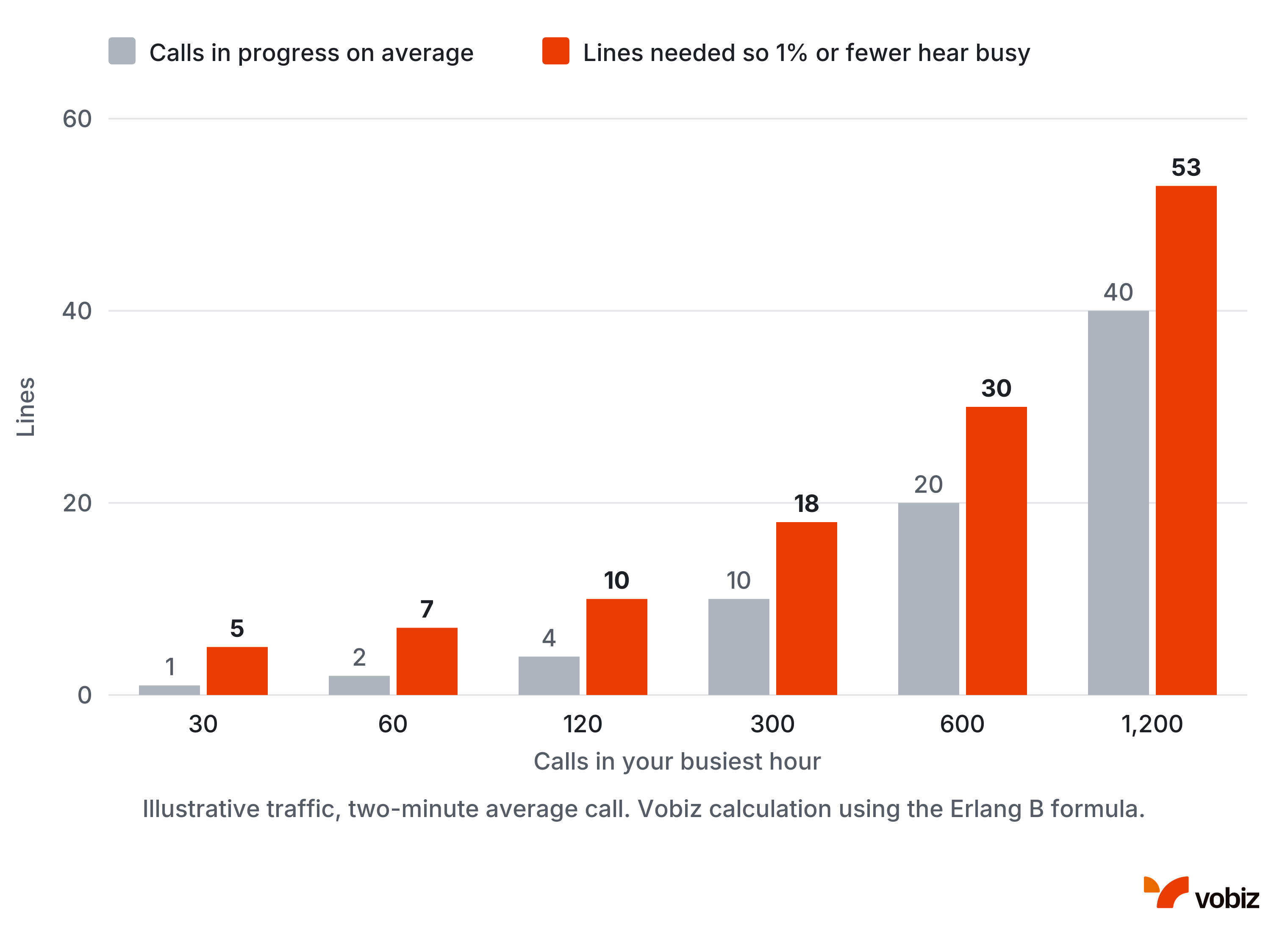
We calculated these figures with the Erlang B formula, which telecom teams use for this estimate. Small call volumes need the most spare room. At 30 calls an hour, you need 5 lines for an average of 1 call. To size your own number, use your call logs from a busy day. Our SIP trunking guide explains the maths if you want the detail, and the CPS and concurrency calculator helps you model it.
What should you settle before you buy?
Answer these questions first, because they'll narrow your choice of number and provider:
- Why do people call? Build the menu around the three or four most common reasons, not your org chart. Ask whoever answers the phone today.
- Which calls can end without a person? Order status and opening hours are good candidates. Complaints usually aren't.
- Which languages do your callers speak? Plan a recording for each one, and let callers choose early.
- What happens when nobody presses a key? Decide this in advance. Repeat the options once, then pass the caller to a person or a message.
- What happens after hours? Tell callers your hours, and give them a recorded answer or a way to leave a message.
- What will you measure? Find where callers drop off and adjust the menu around it. Ask each provider what its reports show.
- What will it cost in total? Add setup, rent, call minutes, and any release fee, using your real call volumes.
If your menu needs more than one layer, keep it shallow. Our guide to multi-level IVRs covers that design, and call routing explains the ways to choose who answers.
Vobiz docs for this topic
The setup details for this are in the Vobiz docs:
- Cloud IVR
- Number inventory
- Buy a phone number
- 92 series guide
- India KYC
- India calling regulations page
- Attach a number to an application
- VobizXML
- Collecting caller input
- Text-to-speech
- Playing audio files
- Connecting calls
- Supported languages page
- Recording calls
Anything that places calls or sends messages is billed and reaches real people, so run it only with your own credentials after confirming the details.
Frequently asked questions
What does IVR call mean?
An IVR call is a phone call handled by a recording or synthetic voice that responds to your key presses or speech. It may be a business's own helpline when you dial in, or an automated call made to you. Treat any unexpected call that mentions your money or asks for details with suspicion.
Is an IVR number the same as a toll-free number?
No. Toll-free describes who pays for the call, and IVR describes what answers it. A toll-free number can ring a person directly, and a local city number can open an automated menu. Many helplines combine the two, which is why the terms get mixed up.
Can an IVR number handle many calls at once?
Yes, up to the number of lines on your plan. Callers beyond that limit may hear busy, because each caller holds a line while listening to the menu. Plan for your busiest hour. In our illustrative example, 300 two-minute calls in an hour need about 18 lines.
How do I get an IVR number?
Choose a telephony provider, complete its KYC checks, and pick a number type that suits your callers. Then write the menu, connect it to the number, and test every option with real calls before you publish the number. Buying a number and taking calls usually costs money, so confirm the charges first.
How much does an IVR number cost?
Cost depends on the provider and number type. Compare the one-time setup fee, monthly rent, per-minute charges, and any release fee. On a toll-free number, you also pay for callers' minutes, usually including time spent in the menu. Estimate your total from real call volumes, not the monthly rent alone.
Does a small business need an IVR number?
Only if calls need sorting. If one person answers everything, a menu adds a step for callers. It starts to help when several people handle different requests, when the same questions repeat, or when calls arrive outside working hours. Start with two or three options and review them after a month.
Further reading on Vobiz
- What is an IVR? · What is a multi-level IVR? · What is call routing?
- What is a virtual phone number? · What is a DID number?
- Vobiz cloud IVR · Buy a phone number on Vobiz · India calling regulations
Sources
Indian regulators and government
- TRAI, Recommendations on Revision of National Numbering Plan, 6 February 2025.
- TRAI, Press release 91/2026 on the 1600 and 140 series, 10 July 2026.
- TRAI, Press release 119/2026 on the Third Amendment, 18 September 2026.
- TRAI, Telecom Commercial Communications Customer Preference (Third Amendment) Regulations, 2026, 18 September 2026.
- Department of Telecommunications, Chakshu on Sanchar Saathi, read November 2026.
News
- Digit, Bengaluru woman loses Rs 2 lakh after pressing 1 on fake IVR call, 31 January 2025.
Set up your first Vobiz number — Get a number and place your first call on Vobiz.
If the voice behind your IVR number is going to be an AI agent, Vobiz provides the number and the SIP trunking to connect it.
About the author
- I'm a Founding Member at Vobiz, telephony for AI voice agents. I write about where voice agents meet the phone network: SIP, phone numbers, latency, echo, barge-in and everything that breaks on real calls but not in browser demos. More at piyushsahoo.me
Comments
Join the discussionNo comments yet. Be the first to comment.